


BluePes Blog: Insights & Trends



Power BI developer vs data engineer: who comes first
A Power BI developer specialises in visualisation, data modelling inside Power BI, and report logic. They do not build data pipelines or transform raw data from complex sources. Without a clean, prepared data layer in place, there is nothing for them to work with — and no amount of experience changes that constraint. The decision that determines project success is not who you hire, but what is already ready when they start.
- Apr 17, 2026
- 16 min


Education data privacy requirements in the US and Europe for software
Education data privacy requirements create binding architectural constraints the moment a vendor touches a student record. FERPA, COPPA, state statutes, and GDPR each impose distinct obligations — on access design, data retention, sub-processor management, and deletion logic — and they frequently apply to the same system at the same time. This article is for IT directors, CTOs, and compliance leads at edtech vendors and school districts who are building or procuring student-facing platforms across U.S. and European markets. If your system stores, processes, or transmits student data in either jurisdiction, what follows maps the legal obligations directly to the technical decisions you need to make. The short answer: U.S. frameworks (primarily FERPA and state laws) focus on institutional control over disclosure and vendor accountability. GDPR centers on individual rights and enforceable technical measures. Both require compliance to be visible in system behavior — not policy documents. The architectural patterns that satisfy one framework partially overlap with the other, but the gaps matter and have caused failed procurement reviews.
- Apr 13, 2026
- 15 min


Education technology pilot strategy for institutional scale
Most EdTech pilots succeed technically and fail institutionally. A platform hits its uptime targets, educators respond positively, integration flows run without errors — and then the renewal review stalls. The reason is almost always the same: the pilot was designed to validate features, not to survive a procurement committee. This article is for IT directors, CTOs, and procurement leads at educational institutions and EdTech vendors who are preparing — or already stuck in — the transition from a controlled pilot to multi-campus or district-wide deployment. Next — you will find a structured framework covering governance ownership, regional compliance requirements, integration durability, and funding transition, with direct comparisons between U.S. and European institutional contexts. An education technology pilot strategy that accounts for renewal criteria from the start reduces friction during expansion reviews. The variables that matter most are not classroom metrics. They are governance continuity, regulatory alignment (FERPA in the U.S., GDPR in the EU), integration capacity at institutional load, and the ability to move from grant-based to operational funding without re-tendering.
- Mar 31, 2026
- 16 min

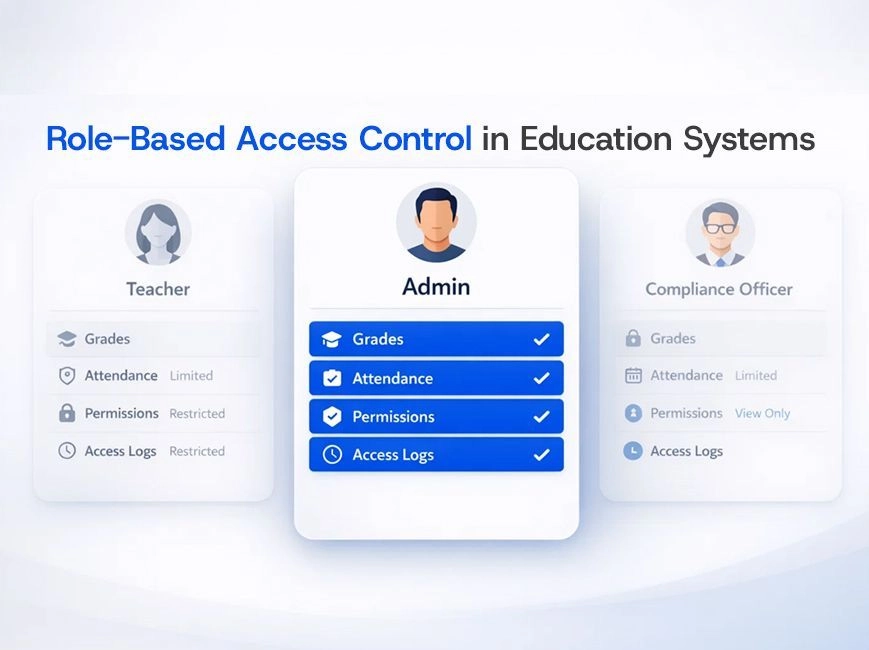
Role-based access control in education systems
Student data visibility is not a configuration choice — it is a governance decision with regulatory consequences. When role-based access control in education systems is designed without clear boundaries, what starts as a flexible pilot setup quickly becomes an audit liability. School districts and institutions reviewing vendor platforms now ask precise questions during procurement: who can see student records, under what permission rules, and what the logs confirm. The access model either answers those questions or it delays the deal. This article is for CTOs, VPs of Engineering, and IT directors building or deploying education platforms who need their permission models to hold up under institutional compliance review. Next — a practical framework for structuring roles, permission matrices, and logging in alignment with FERPA and COPPA requirements. Role-based access control (RBAC) in education systems is a structured permission framework that assigns data visibility and action rights according to instructional, administrative, and governance responsibilities, aligned with regulatory obligations. Getting this architecture right reduces audit exposure, simplifies vendor classification under FERPA, and prevents the informal permission drift that compounds across deployment phases. Teams working through education product development often find that access design is the first question institutional clients raise — before features, pricing, or SLAs.
- Mar 26, 2026
- 15 min


EdTech batch integration architecture
Many education platforms operate without real-time APIs and rely on structured exports such as CSV files for data exchange. Reliable learning logic in these environments requires deterministic batch processing, normalization rules, and clearly defined synchronization windows. System behavior must account for delayed updates, reconciliation logic, and audit traceability. This article explains how to design integrations for K–12 and higher education systems when near-real-time connectivity is unavailable. It is relevant for integration architects, district IT teams, and vendors working with legacy or closed educational platforms.
- Mar 23, 2026
- 15 min


Instructional Orchestration vs. Software Automation in Regulated Education Systems
Instructional orchestration defines how learning sequences, mastery rules, and teacher intervention logic are structured within a digital system. Automation alone does not guarantee pedagogical alignment; orchestration requires mapping educational theory to system behavior. In K–5 and K–12 environments, sequencing logic directly affects learning progression, while in higher education it impacts curriculum pathways and credit logic. This article explains how mastery modeling, teacher override controls, and system constraints intersect in regulated learning environments. It is relevant for instructional designers, academic technology teams, and EdTech product leaders building structured learning systems.
- Mar 16, 2026
- 10 min


Why Most EdTech Pilots Fail: Designing a Contained Learning Path Pilot in Regulated Education
A contained learning path pilot is a structured, limited-scope validation phase designed to test instructional logic, sequencing rules, and mastery criteria without building a full production system. In K–5, K–12, and higher education environments, pilot containment reduces instructional and technical risk while preserving architectural clarity for future scaling. Overextending early pilots often increases adoption friction and governance complexity. This article explains how to define pilot scope, isolate variables, and align validation metrics with long-term system strategy. It is relevant for school leaders, EdTech founders, curriculum architects, and technology directors evaluating instructional pilots.
- Mar 09, 2026
- 10 min

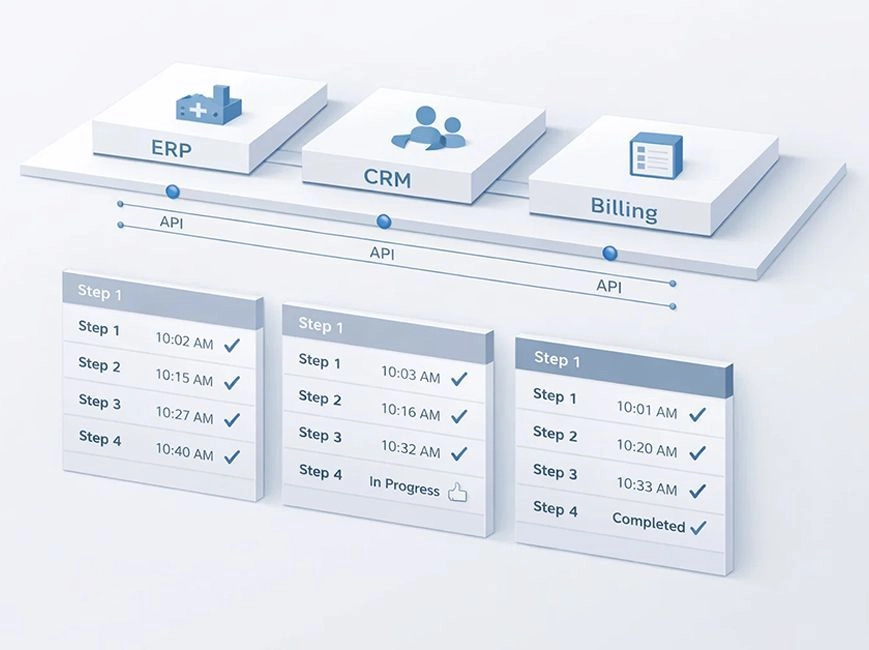
When Systems Look Stable but Operations Keep Fixing Things: The Hidden Cost of Limited Integration Visibility
This article is relevant for CTOs, operations leaders, integration architects, and finance teams responsible for system interoperability and workflow reliability. In many organisations, integrations are considered reliable because they rarely fail in visible ways. Interfaces respond, data is exchanged, and monitoring dashboards do not show critical alerts. Yet operational teams still spend time reviewing exceptions, correcting records, and confirming that business steps completed as intended. The discrepancy becomes apparent when process outcomes are examined rather than technical signals. A workflow may execute without triggering an error while still producing incomplete or delayed results. Over time, this pattern creates operational overhead that is not visible in infrastructure metrics. This article examines why technical monitoring alone does not provide sufficient assurance for business processes and outlines practical approaches to improving integration visibility.
- Mar 02, 2026
- 10 min

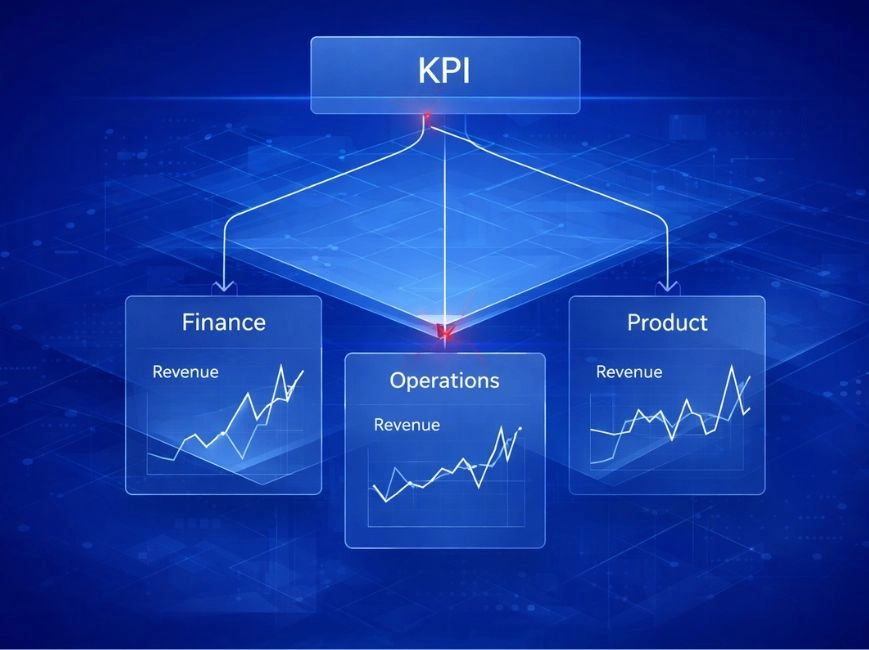
KPI misalignment across teams: the structural causes
KPI misalignment is the condition where the same metric carries different definitions across teams, so each one produces a defensible but different value. The cause usually sits in how metrics were introduced, defined, and copied across systems over time. The conflict only becomes visible — and expensive — when those numbers meet in a shared decision.
- Feb 23, 2026
- 16 min