


HL7v2 to FHIR in Java: a boundary-first ingestion model


A Friday afternoon mapping change to one OBX field makes Monday's ward round noisy. Lab values appear twice on three patient charts, a discharge shows up before the admission it belongs to, and the on-call engineer spends the morning reading raw HL7v2 messages line by line because the mappings live in a wiki nobody owns. None of these are exotic failure modes — they are what happens when an HL7v2 to FHIR integration is designed around the happy path.
HL7v2 to FHIR integration in Java becomes reliable when the ingestion boundary is treated as a contract rather than a glue layer. The contract has three parts: accept HL7v2 fast and idempotently, validate and map every message against a versioned FHIR R4 profile, and emit an audit record that someone can read without a stack trace. With Java 21, Spring Boot 3, and HAPI FHIR, those three guarantees fit into a single team's reach within a month.
This rewrite stays on the ingestion side end-to-end. For the matching egress story — publishing FHIR changes to downstream consumers via Subscriptions — the article on event-driven FHIR delivery on this blog covers that scope in detail and is linked later in the body.
Updated in May, 2026
Where HL7v2 to FHIR interfaces fail under load
HL7v2 to FHIR interfaces fail in four predictable places: duplicate writes from retried messages, partial FHIR resources from mid-mapping errors, ACK timeouts when validation is done synchronously, and silent drift when a sending system changes a code without telling anyone. Those four are not bugs — they are the absence of design choices that should have been made at the boundary.
Duplicates and drift
An ADT^A04 retried after a TCP reset creates a second Encounter when the write path has no idempotency key. A reordered ORU^R01 lands an Observation before the ServiceRequest it references. A discharge arrives a millisecond after a transfer and the patient ends up listed in two units at once. The HL7v2 spec gives operators MSH-10 (the message control ID) as a natural idempotency token, but most platforms ignore it on the persistence path and trust the sending system to deduplicate. Sending systems almost never do.
Partial updates and silent drops
A mapping that catches IOException but not a missing OBX-3 component will happily post an Observation without a code. Downstream apps that filter by LOINC code drop the result silently. The clinician never sees it; the audit log never flags it. Silent drops are the worst category of failure because nothing alerts.
Synchronous choke points
Heavy work in the ACK path is the most common operational mistake in HL7v2 ingestion. If the listener waits for HAPI FHIR validation, terminology lookup, and persistence before returning the MSA segment, a single slow downstream call backs up the entire interface. The sender's queue fills, retransmissions start, duplicates pile up. The fix is structural: ACK on receipt, validate and map asynchronously, surface backlog explicitly.
Untraceable mapping changes
When mapping rules live in spreadsheets or wiki pages, a renamed OBX field ships to production with no test coverage. A senior interface analyst usually catches it; occasionally one doesn't. The cost of a missed rename is one corrupted resource type across every patient touched until someone notices. Mapping logic belongs in version-controlled code with fixture tests for every resource shape the interface produces.
The boundary-first architecture: HL7v2 in, FHIR R4 out
The boundary-first model treats the HL7v2 listener as an event collector and the FHIR server as the contract that downstream systems read from. Between them sits an asynchronous pipeline: parse, validate against a profile, map, persist, audit. Each stage is replayable from its predecessor and produces a record that the next stage either commits to or rejects with a structured error. The shape matters more than the framework choice, but in practice this design fits cleanly onto Java 21 and HAPI FHIR.
Java 21's virtual threads remove the usual reason for splitting the listener into an event loop and a worker pool: a blocking I/O call inside a virtual thread no longer costs an OS thread, so the listener can fan out one virtual thread per incoming MLLP connection without exhausting the platform. Structured concurrency makes the per-message scope explicit, so cancellation and timeouts clean up everything they started. The deeper rationale for picking Java 21 as the LTS for this kind of work is covered in the team's separate analysis: Java 21 LTS features for enterprise systems.
HAPI FHIR supplies three things the team would otherwise build by hand: a parser and serializer for FHIR R4 resources, a validator that can be pointed at a custom StructureDefinition, and a set of server hooks that fire on create and update. The FHIR specification itself (see the official HL7 FHIR R4 reference) defines the resource shapes; HAPI implements them in Java. The library is well-documented on its own site: HAPI FHIR project documentation. Treating these as the canonical references — rather than secondary explainers — shortens onboarding for any new engineer joining the interface team.
On the engagement side, this kind of work usually lands inside a dedicated team engagement model, because the operational load — interface monitoring, replay, incident review — does not fit neatly into a project-based scope. The team's enterprise Java engineering services page describes how that engagement is usually structured for healthcare platforms.
Most ingestion incidents trace back to design choices made in the first month of an interface project — ACK strategy, idempotency keys, validation strictness.
If the team is scoping a new HL7v2 feed or auditing one that drifts, an hour with engineers who have shipped this pattern is usually enough to surface the highest-risk decisions. Discuss your integration scope.
MLLP, ACK semantics, and idempotency at the HL7v2 boundary
Most production HL7v2 traffic still moves over MLLP — the Minimal Lower Layer Protocol — a thin TCP framing standard that wraps each message between a vertical tab (0x0B) and a file separator plus carriage return (0x1C 0x0D). MLLP is simple enough that teams underestimate the failure modes around it. The three that come up most often are framing drift, slow ACKs, and ambiguous acknowledgement modes.
Framing and character set negotiation
A misaligned framing byte is enough to make the listener treat two messages as one or split one across two parses. The fix is a strict frame reader that rejects anything that does not start with 0x0B and ends with 0x1C 0x0D, with a configurable maximum frame size to bound memory. Character set negotiation is the second trap: the HL7v2 default is ASCII, but most modern senders declare UTF-8 in MSH-18. A listener that hard-codes ISO-8859-1 will corrupt names with accented characters — common in European healthcare contexts. Read MSH-18 before decoding the rest of the message.
ACK strategy: AA, AE, AR, and the enhanced mode
HL7v2 defines three acknowledgement codes — AA (Application Accept), AE (Application Error), and AR (Application Reject) — and two acknowledgement modes, original and enhanced, controlled by MSH-15 and MSH-16. The practical rule for ingestion is to use the enhanced mode where the sender supports it, ACK with AA on successful persistence of the raw message and dedupe record, and reserve AE for structural errors the sender can fix. AR is rarely the right answer — it tells the sender to discard the message, which is almost never what the operations team actually wants.
Idempotency keys and dedupe windows
MSH-10 is the natural idempotency key for HL7v2 ingestion. Combined with the sender identifier (MSH-3 and MSH-4) and a tenant scope, it produces a composite key that survives partner-side retries without trusting the partner to be unique across tenants. Persist the composite key with a time-to-live that matches the retry window operators expect from each sender — typically between 7 and 30 days. Within that window, a repeated key returns the original ACK without re-processing the payload. Outside the window, the message is treated as new, which matters for replays older than the retry horizon.
Z-segments and partner-specific quirks
Most real HL7v2 feeds carry custom Z-segments — ZBE for billing extensions, ZPV for patient visit additions, vendor-specific Z-segments for everything the standard missed. A boundary-first design treats Z-segments as configuration, not code: a per-sender ruleset declares which Z-segments to parse, which fields to capture, and where they land in the FHIR resource (usually as an Extension). New Z-segments appear without code changes, and breaking changes from a sender become a config diff in a pull request.
Mapping HL7v2 segments to FHIR R4 resources without losing fidelity
Mapping HL7v2 to FHIR R4 is where most clinical interfaces accumulate technical debt fastest. The standard does not give a one-to-one mapping for every segment, and the segments that look obvious — PID for Patient, OBX for Observation — hide decisions about identifier systems, terminology binding, and partial-data handling that affect every downstream consumer.
Patient identity and the multiple-identifier problem
PID-3 carries a repeating list of patient identifiers — MRN, SSN, insurance, national ID — each with an identifier type code. Mapping to Patient.identifier in FHIR requires assigning a system URI to each identifier type so downstream consumers can disambiguate. A common error is to collapse all identifiers into a single system, which then breaks any consumer that searches by MRN scoped to a specific care network. The mapping rule should be explicit: type code MR with assigning authority X maps to system 'urn:oid:...' or a project-defined URL, and the rule is covered by a fixture test.
Observation: terminology binding and value types
OBX-3 contains the observation identifier — typically a LOINC code for lab results or a vendor-specific code for device readings. FHIR R4 Observation.code is bound to a CodeableConcept and downstream apps usually filter by LOINC. If the sender ships internal codes, the mapping layer needs a translation table maintained alongside the code, not in a spreadsheet. OBX-5 (the value) maps to Observation.value[x], where the [x] is chosen from OBX-2 (the value type): NM becomes valueQuantity, ST becomes valueString, CE becomes valueCodeableConcept, and so on. A mapping that hard-codes valueQuantity will silently truncate text results.
Timestamps, time zones, and partial precision
HL7v2 timestamps in the DTM data type can carry precision down to fractions of a second and an optional time zone offset. FHIR R4 dateTime values require timezone qualification for full-precision timestamps. Senders frequently omit the zone, especially on devices configured with local-time clocks. The safe rule is to reject ingestion of any timestamp without an explicit zone — and fall back to a documented sender-level default only when the partner has confirmed in writing which zone their clock represents. Silent zone assumptions corrupt longitudinal data quietly.
Versioned mapping rules and contract tests
Mapping rules belong in code, in a module separate from the listener and the persistence layer, with a contract test for every resource type the interface produces. The contract test takes a known HL7v2 message — including the awkward edge cases the sender ships — and asserts the exact FHIR resource shape it should produce. When the LIS changes OBX-3 from one code system to another, the test fails in CI before deployment. This is the single highest-leverage practice in HL7v2 to FHIR integration; teams that skip it usually rebuild the same interface every 18 to 24 months.
The healthcare data platform engagement described in our healthcare data platform architecture case study is an example of how the ingestion boundary, mapping layer, and FHIR persistence are organised across multiple clinical data sources — the published page covers the architectural shape; specific code-system mappings remain client-confidential.
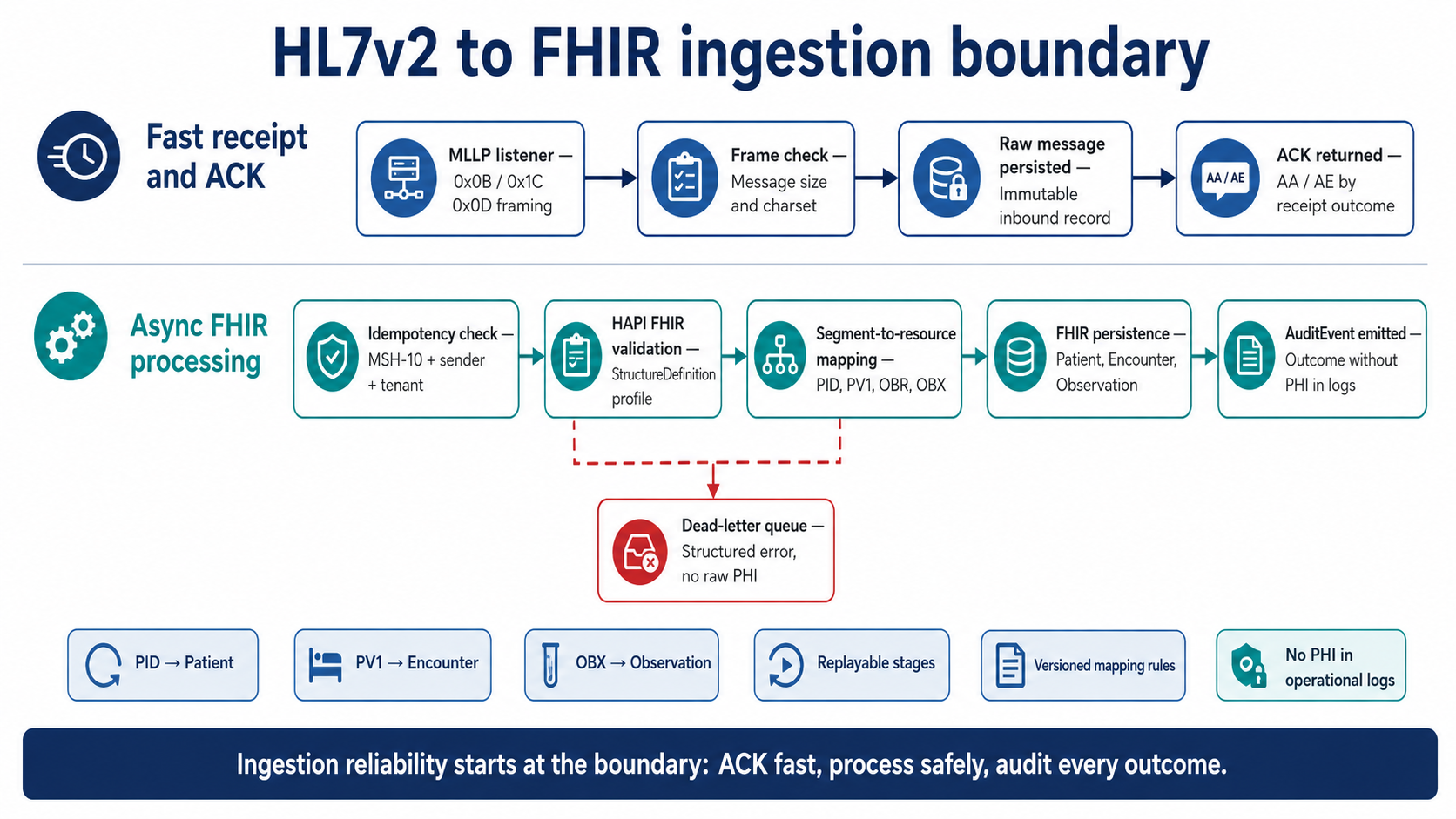
A reliable HL7v2 to FHIR ingestion boundary separates fast message receipt and ACK from asynchronous validation, mapping, persistence, audit, and error handling.
Audit, consent, and PHI minimisation on the ingestion path
On the ingestion path, audit and privacy have a narrower job than they do on the egress path. The team is not deciding whether a clinician may read a record — that decision belongs to the apps reading from FHIR. The ingestion path is responsible for three things: recording who or what sent each message, recording every validation and mapping decision the platform made, and never letting PHI leak into logs, dead-letter queues, or operational tooling.
AuditEvent at the ingestion boundary
Every successful persistence emits a FHIR AuditEvent — and so does every rejection. The agent reference identifies the sending system (typically the sender id from MSH-3 and MSH-4), the entity reference points to the resource that was created or rejected, and the outcome field distinguishes success from validation failure from mapping failure. The structural reference for this approach is the IHE Audit Trail and Node Authentication profile, documented in the official IHE Technical Framework: IHE ATNA profile. Audit events from ingestion should be searchable by sender, by MSH-10, and by patient identifier — a ten-minute incident review depends on being able to reconstruct a single message's path without leaving the audit store.
PHI in logs, errors, and dead-letter queues
Logs and DLQs are where ingestion platforms leak PHI most often. A naive logger writes the full HL7v2 payload on validation failure, including PID-5 names and PID-7 dates of birth. A DLQ keeps the raw message indefinitely 'for debugging'. The defensive defaults are to scrub identifiers from log entries, redact PHI in error messages by default, store raw messages in an encrypted bucket with a short retention policy, and require explicit elevation to read the unredacted payload. The general engineering posture for healthcare software engineering — HIPAA, GDPR, retention controls — folds into the same pattern.
Egress is a different problem
Consent enforcement, purpose-of-use checks, subscriber allowlisting, and minimal-payload delivery belong on the egress path, not the ingestion path. When the team is ready to publish FHIR changes to downstream consumers, the sibling article on event-driven FHIR delivery via Subscriptions covers REST-hook and WebSocket delivery, subscriber verification, and the audit decisions that apply once a record leaves the platform.
A 30-day rollout for one HL7v2 interface — and the signals that prove it works
A 30-day rollout for HL7v2 to FHIR ingestion works when the scope is one feed, one message type, and one downstream consumer. The temptation is to rebuild every interface at once; the result is usually a stalled programme. Pick the highest-volume or highest-risk feed — most teams choose either ADT from the primary EHR or ORU from the dominant LIS — and harden the boundary end-to-end before expanding.
Week 1 — Stabilise the MLLP boundary
Stand up an ACK-first MLLP listener, persist raw messages by sender and tenant, and add the dedupe table keyed by (sender, MSH-10) with a TTL matching the sender's retry window. Build a minimal status board showing backlog by message type, last processed timestamp per sender, and DLQ size. Write contract tests for one valid and three invalid examples of the chosen message type. The objective is not zero errors — it is visibility.
Week 2 — Enforce validation and mapping discipline
Point HAPI FHIR at a published StructureDefinition for each resource the interface produces, and fail fast on structural errors. Move mapping rules into code, with CI running the contract tests on every change. Make the parse-validate-map pipeline fully asynchronous behind a bounded queue, with retry budgets and jitter; the listener returns AA on receipt, not on persistence. Publish a one-page runbook: who owns the interface, what to check first when backlog rises, and which dashboards to read in what order.
Week 3 — Add audit and PHI guardrails
Emit a FHIR AuditEvent for every create, update, and rejection, with sender, MSH-10, and outcome. Wire the log pipeline to scrub identifiers by default, with elevation needed to read the unredacted message. Set retention windows on the raw message store, the dedupe table, and the DLQ, and verify they apply by running a test message through the full path and confirming it ages out on schedule.
Week 4 — Observability, replay, and a controlled expansion
Propagate a correlation ID — usually MSH-10 — through every stage and into the AuditEvent. Track p50, p95, and p99 latency from MLLP receipt to FHIR persistence, and alert on the p95 crossing a threshold the team has agreed with operations. Run a replay of one busy hour from the previous week and confirm that totals on downstream dashboards do not double. Add one more message type — for example, ADT discharges if the team started with ORU — using the same patterns and tests.
Signals that confirm the rollout worked
Key takeaways
- HL7v2 to FHIR integration in Java becomes reliable when the ingestion boundary enforces a contract: ACK fast on receipt, validate and map asynchronously, audit every decision.
- MSH-10 combined with sender and tenant identifiers is a workable composite idempotency key; a dedupe TTL matched to the partner's retry window prevents duplicate FHIR resources without trusting senders to be unique.
- Mapping rules belong in version-controlled code with fixture tests for every resource shape; spreadsheet-based mapping is the single biggest source of long-term interface debt.
- On the ingestion path, audit and PHI minimisation are about traceability and log hygiene; consent enforcement belongs on the egress path covered by the FHIR Subscriptions article.
- A 30-day rollout for one feed — one message type, one downstream — is the realistic unit of progress; programmes that try to rebuild every interface at once stall at the boundary.
Why the boundary deserves the design effort
The shape of an HL7v2 ingestion platform is set in the first month of building it. If the listener ACKs synchronously, if MSH-10 is ignored on the write path, if mapping rules live anywhere other than version-controlled code, the platform becomes the thing the team is paid to maintain rather than the thing it ships. The boundary-first model is not exotic and is not new; it is just a refusal to let the easy version of each decision become the default. Teams that have been around the loop a few times reach for these patterns early, because they are the difference between an interface that runs for years and one that gets rebuilt every two.
If the team is sizing the first feed or trying to stop a drifting one, the fastest first step is usually a short architecture review against this pattern. Request a clinical integration architecture review.
Summarize with AI
 ChatGPT
 Claude
 Gemini
 Grok
Grok Perplexity
FAQ











Interesting For You



Real Life Data Science Applications in Healthcare
Due to healthcare's importance to humanity and the amount of money concentrated in the industry, its representatives were among the first to see the immense benefits to be gained from innovative data science solutions. For healthcare providers, it’s not just about lower costs and faster decisions. Data science also helps provide better services to patients and makes doctors' work easier. But that’s theory, and today we’re looking at specifics.
Read article



Cloud transformation in regulated industries: integration that holds up under scrutiny
When a hospital IT director evaluates a new integration platform, the first question is rarely "how fast can we deploy?" It's "what happens if this fails an audit?" That distinction shapes every architectural decision in industries where data handling is not just a technical concern — it's a legal one. This article is for IT Directors and CTOs in healthcare, financial services, and legal tech who are evaluating cloud integration options for environments where compliance is non-negotiable. Next — a practical look at what makes Boomi a platform that clients in regulated industries choose, and how Bluepes, as an independent integration consulting company, approaches these projects. Cloud integration for regulated industries means more than connecting APIs. It means building data flows that can be audited, reversed, restricted, and documented at any point — across systems that were never designed to talk to each other. Boomi addresses this by building compliance logic into the platform itself, rather than requiring teams to layer it on afterward. That design assumption is the main reason it comes up frequently in regulated industry evaluations.
Read article



How companies are future-proofing their tech stacks with cloud-native integration
The average mid-market company runs dozens of business applications: an ERP, a CRM, a separate billing system, various cloud tools, and increasingly AI-powered services layered on top. Each of those systems generates data the others need. Keeping them connected is no longer an IT side project — it is a condition for the business to function. This article is for IT Directors, CTOs, and technical leads who are managing integration infrastructure built for a smaller, simpler stack. If your team spends more time fixing broken connections than building new capabilities, this is for you. Next — a look at what future-proofed companies actually do differently, and what a more sustainable architecture looks like. The short answer: companies that scale without constant integration disruption tend to have moved away from custom-built, point-to-point connections and toward managed integration platforms. Boomi is one of those platforms. Bluepes is an independent software consulting company that works with Boomi and other integration tools on behalf of clients — this article reflects that perspective, not Boomi's marketing position.
Read article