


Hybrid Integration Architecture with Boomi: Connecting Cloud and On-Prem Systems Without Disruption


Most enterprise environments are not fully in the cloud, and for good reason. ERP systems, compliance-sensitive databases, and internally hosted applications carry years of business logic that cannot be lifted and shifted without serious risk. The real architecture challenge is not choosing between cloud and on-prem — it is building a bridge between them that holds under production load.
Bluepes is an independent software consulting company that works with Boomi as one of our integration platforms. Hybrid architecture is among the most frequent scenarios our clients bring to us.
This article is for IT Directors and CTOs at mid-market companies who already operate mixed environments and need a clear picture of how hybrid integration actually works — the components involved, the security model, and where things break when the architecture is designed carelessly.
Hybrid integration connects cloud services with on-premises systems through a runtime layer that handles data exchange, transformation, and orchestration. Neither environment needs to change its core structure — the integration layer abstracts the differences between them.
Updated in April 2026
What hybrid integration architecture actually means
A hybrid integration architecture is a design pattern where data and processes flow between cloud-hosted and locally hosted systems through a shared middleware layer. This is distinct from cloud-first approaches where all infrastructure moves to external providers, and from pure on-prem models where nothing connects to the outside.
IBM's analysis of hybrid cloud adoption identifies the primary driver for hybrid models as system constraints, not cost. Regulated industries, manufacturers, and financial institutions often cannot move core systems to the cloud due to latency requirements, data residency laws, or application dependencies. The hybrid model preserves what cannot move while allowing new services to be built externally.
The key question for any architecture team is: where does the integration runtime live, and who controls it? Getting that answer right determines most of what follows.
How Boomi handles hybrid deployment
Boomi's approach to hybrid integration is built around a runtime unit called an Atom. An Atom is a lightweight, self-contained execution engine that can be installed locally — on-premises, inside a private data center, or within a cloud VPC. Once deployed, it communicates with the Boomi platform for process definitions and monitoring, but executes integrations locally, close to the source data.
This matters for data governance. When an Atom runs on-premises, sensitive records never have to leave the local network unless the integration process explicitly sends them to an external destination. Execution stays local; only metadata and logs travel to the central platform.
For higher-volume environments, Boomi offers a Molecule — a clustered runtime consisting of multiple Atom nodes that share load and provide failover. A Molecule behaves as a single logical unit, so processes do not need to be duplicated across nodes.
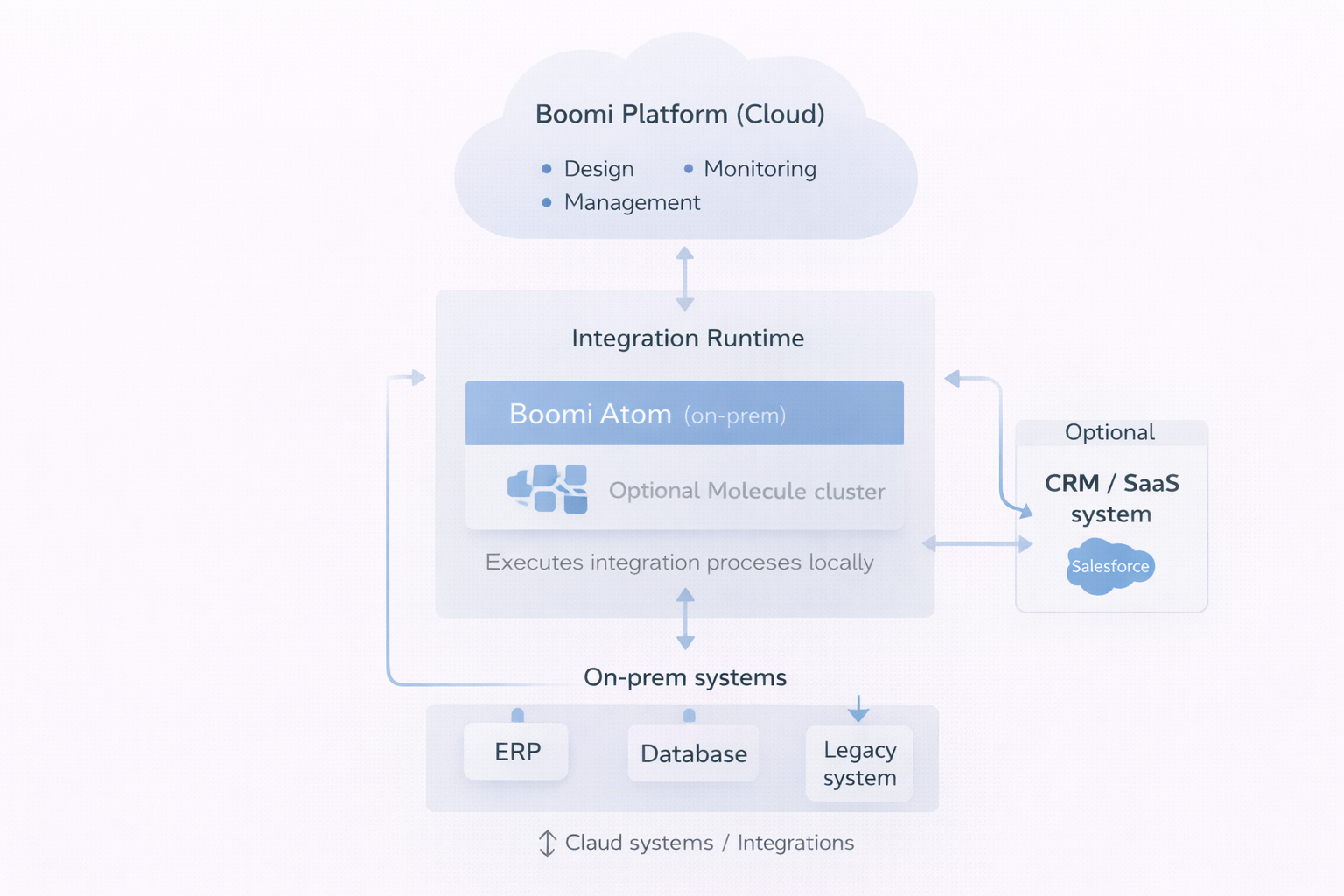
In a hybrid integration architecture, Boomi Atom executes processes locally while the platform handles design and monitoring centrally.
The separation between where processes run and where they are managed is what gives this model operational flexibility. Teams design and monitor everything from a central console while execution stays close to the data source.
Architecture patterns used in hybrid setups
Three patterns cover most real-world hybrid scenarios. Understanding which one fits a given situation determines a lot about how the integration holds up under load and future change.
Request-response with on-prem data sources
A cloud-hosted application calls an API that fronts a locally installed Atom. The Atom queries the on-prem database, applies transformation logic, and returns the result. The cloud application never touches the database directly. This pattern is common for CRM-to-ERP integrations where Salesforce or HubSpot needs product or pricing data from SAP — the Atom acts as the controlled bridge between them.
Event-driven synchronization
Events generated in one environment — a record created in a cloud CRM, or a transaction logged in an on-prem finance system — trigger a process that updates the other side. The Atom listens for these events and handles transformation and delivery. This removes the dependency on scheduled batch jobs and reduces stale-data problems. For financial services clients, this pattern works well for keeping internal payment records aligned with external reporting APIs, which we cover in more depth in financial data consistency in Boomi integrations.
Batch processing with selective cloud offload
Some operations are still best handled in bulk: nightly reconciliation, data warehouse loads, compliance reporting. A hybrid Atom can collect batch output from on-prem systems and deliver it to cloud storage or analytics platforms on a schedule. The advantage over a pure file-based approach is that the Atom handles transformation, error handling, and retry logic — removing a layer of fragile scripting that accumulates in most batch pipelines over time.
Security and compliance in hybrid architectures
When data crosses the boundary between on-prem and cloud, the security model needs to be explicit. Gaps at this boundary are where compliance failures typically originate.
Boomi's runtime model addresses several of the common risks:
- Encrypted transport: all communication between local Atoms and the Boomi platform uses TLS 1.3. No process data travels in plain text.
- Data residency control: the Atom executes locally, which means data subject to residency requirements under GDPR can be processed without leaving the jurisdiction. Data leaves the Atom only if the process explicitly sends it to an external destination.
- Centralized credential management: connection credentials are stored and managed within the platform, not embedded in process configurations. This reduces exposure from leaked configuration files.
- Role-based access: who can deploy or modify processes is controlled centrally, which matters in environments with multiple teams accessing the same integration layer.
For organizations in regulated sectors, this model supports HIPAA and GDPR compliance requirements more directly than approaches where data passes through a shared cloud intermediary. NIST's cloud security framework provides a reference for teams evaluating deployment models against compliance obligations.
From Bluepes's work on healthcare system integration with Boomi, these data locality controls are frequently the deciding factor when clients choose the hybrid model over a cloud-only approach.
Teams working on healthcare-specific integration can also find relevant context in our healthcare platform project case study.
If your team is already running a mixed cloud and on-prem environment and trying to decide how to connect it, talking to engineers who have built these architectures in production will save weeks of trial and error. Discuss your project with our engineering team for integration projects.
Where hybrid integration projects go wrong
The architecture itself is not the hard part. The problems that cause delays and rework usually fall into a few recurring categories.
- Underestimating Atom placement decisions. Installing Atoms in the wrong location — too far from the source system, or without adequate network access — creates latency and connection failures. Placement should be decided based on where data originates, not where it is most convenient to install the software.
- Treating the integration layer as an ETL tool. Hybrid integration platforms can handle transformation, but loading them with complex business logic creates a maintenance problem. Logic that belongs in the application layer tends to accumulate in integration processes during projects under time pressure, and it becomes very difficult to unpick later.
- Skipping monitoring from the start. Integration failures in hybrid environments are harder to diagnose because errors can originate in either environment. Building visibility in from day one — rather than retrofitting it — reduces incident resolution time significantly. The approach to integration observability with Boomi is worth reviewing before any production deployment.
- Not accounting for network policy changes. Firewall rules, VPN configurations, and network segmentation policies change. Integrations that depend on specific ports or IP ranges break when network teams update policies without knowing an integration depends on them. Documenting these dependencies takes an hour at the start of a project and prevents a class of incidents.
Deployment considerations for IT and engineering teams
Before deploying a hybrid integration, several decisions need to be made explicitly rather than left to emerge during the project.
- Atom sizing: the hardware or VM allocated to an Atom affects throughput. For low-volume, event-driven integrations, minimal resources suffice. For high-throughput batch processes, sizing matters and should be calculated against expected message volumes before deployment.
- Molecule vs. single Atom: single Atoms have no failover. If the server running the Atom goes down, integrations stop. For production systems with availability requirements, a Molecule with at least two nodes is the standard configuration.
- Version control for processes: Boomi's platform provides versioning, but how changes are reviewed, tested, and promoted to production needs to be agreed by the team before the first production deployment. Teams that skip this end up with ad-hoc change processes that create risk during incidents.
For teams evaluating whether to build internal capacity or bring in a dedicated integration engineering team for the initial build, the deciding factor is usually how long the internal team will maintain and extend the integration layer after the project completes. Initial builds that are handed off to teams unfamiliar with the architecture tend to accumulate technical debt quickly.
Key takeaways
- Hybrid integration architecture connects cloud services and on-prem systems through a shared runtime layer, without requiring either side to change its core infrastructure.
- Boomi's Atom model runs locally, which keeps sensitive data close to its source and simplifies compliance with data residency requirements.
- The three main patterns — request-response, event-driven sync, and batch with cloud offload — cover the majority of real hybrid scenarios.
- Security gaps in hybrid architectures almost always appear at the environment boundary; explicit transport encryption, credential management, and data residency controls are non-negotiable.
- Most hybrid integration problems come from deployment decisions made too quickly — Atom placement, failover configuration, and monitoring setup — not from platform limitations.
Conclusion
Hybrid integration is not a temporary workaround while companies complete their cloud migration. For a large portion of mid-market and enterprise organizations, it is the permanent operating model — and the architecture needs to reflect that reality from the start, not be retrofitted later.
Working with Boomi for hybrid deployments means the local execution layer stays close to the data while design and governance happen centrally. The model holds up well when deployment decisions are made deliberately: where Atoms sit, how credentials are managed, and how monitoring is built in from the beginning.
If your organization is planning a hybrid integration project and needs engineers who have worked through these decisions in production, reach out through Bluepes contact page. We work with clients in healthcare and financial services on integration architectures designed to hold up over time.
Boomi is a trademark of Boomi, LP. Bluepes is an independent software consulting company. We are not affiliated with, endorsed by, or certified by Boomi, LP.
Summarize with AI
 ChatGPT
 Claude
 Gemini
 Grok
Grok Perplexity
FAQ











Interesting For You



Why businesses are rethinking their integration strategy
Most IT teams don't notice integrations until something breaks at the worst possible moment. A new CRM rolls out, and three weeks later someone in finance discovers that customer data hasn't been syncing. An ERP upgrade ships on schedule and quietly disables five automated workflows that nobody documented. Revenue numbers look wrong in the dashboard because two systems are still running on different update cycles. This article is for CTOs, IT Directors, and VP Engineering roles who suspect their current integration architecture costs more to maintain than it should — in engineering hours, in delayed releases, and in recurring data quality incidents. Next — a clear breakdown of where standard approaches fail, what modern platforms actually offer, and how companies in healthcare, e-commerce, and finance are handling this shift in practice. Business integration modernization — replacing a fragmented collection of point-to-point connections with a centralised, scalable architecture — has become a priority for companies that have grown past their original tech stack. The pressure isn't coming from trend reports; it's coming from the compounding overhead of keeping legacy connections alive as systems multiply.
Read article


Why Agentic AI in the Enterprise Depends on the Integration Layer
Most enterprise AI projects do not fail because the models are inadequate. They fail because the data feeding those models is inconsistent, delayed, or simply unreachable. According to a 2025 analysis, why AI agent pilots fail in production comes down to one recurring problem: the absence of a structured integration layer between AI systems and enterprise data. This article is for CTOs and VPs of Engineering who are evaluating how to introduce AI agents into existing enterprise infrastructure. It addresses what integration architecture those agents actually require to work reliably — and where Boomi fits into that picture. The short answer: agentic AI needs a stable, governed integration layer to access enterprise data, trigger downstream processes, and log every action taken. Without that layer, agents either operate on incomplete information or become impossible to audit and explain.
Read article



The hidden costs of poor integration — and what it takes to fix them
Disconnected systems rarely appear as a line item in the budget. Their costs show up elsewhere — in the hours your finance team spends reconciling numbers that don't match, in the IT tickets opened every time a vendor updates their API, in the orders that fall through because inventory data was three hours out of date. This article is for IT directors, CTOs, and engineering leads who feel the friction of poor integration every week but haven't been able to put a clear number on it. The core issue: the real cost of poor integration is rarely the failed project or the vendor license. It's the accumulated operational drag — slower decisions, higher maintenance overhead, and revenue that leaks quietly through gaps between systems. Understanding that cost is the first step to justifying the investment in fixing it. For context on why companies reach that decision point, see why businesses are rethinking their integration strategy.
Read article