


Why Agentic AI in the Enterprise Depends on the Integration Layer


Most enterprise AI projects do not fail because the models are inadequate. They fail because the data feeding those models is inconsistent, delayed, or simply unreachable. According to a 2025 analysis, why AI agent pilots fail in production comes down to one recurring problem: the absence of a structured integration layer between AI systems and enterprise data.
This article is for CTOs and VPs of Engineering who are evaluating how to introduce AI agents into existing enterprise infrastructure. It addresses what integration architecture those agents actually require to work reliably — and where Boomi fits into that picture.
The short answer: agentic AI needs a stable, governed integration layer to access enterprise data, trigger downstream processes, and log every action taken. Without that layer, agents either operate on incomplete information or become impossible to audit and explain.
Updated in April 2026
What "Agentic AI" Actually Means in a Production Environment
Agentic AI — unlike a standard prompt-response model — describes software systems capable of executing multi-step tasks without human input at each stage. An agent can evaluate a situation, pull additional data from relevant systems, make a decision, and trigger a downstream process, all within a single workflow run.
A representative example: a customer service agent detects a recurring complaint pattern in support tickets, queries the ERP for related order records, identifies a supplier delay as the root cause, and creates a resolution task in the project management system — without a human reviewing each handoff.
That sounds operationally clean until you examine what it requires technically. The agent needs real-time access to CRM, ERP, and ticketing data through consistent, secured APIs. It needs reliable orchestration to coordinate each step in sequence. And it needs an audit trail showing exactly what happened and why each decision was made.
None of that exists by default. Most enterprise environments run 40 to 100 applications on different versions, protocols, and update cycles. Connecting an AI agent to that environment without a structured integration layer is an exercise in accumulating technical debt at high speed.
Why Integration Infrastructure Comes Before the AI Model
Teams evaluating AI agents tend to concentrate on model selection, prompt architecture, and output quality. Integration is treated as a secondary concern — something the IT team will sort out once the model is chosen. In practice, that ordering reverses itself the moment deployment begins.
The integration layer determines what data an agent can see, how current that data is, and whether the agent can act on it or only observe it. A risk-analysis agent that operates on day-old financial data is not useful in a trading context. A supply chain agent that cannot write back to the ERP after making a routing decision has no real autonomy — it can only advise.
This is where platforms like Boomi become directly relevant to AI project planning. As an iPaaS, Boomi provides three capabilities that directly enable agentic workflows:
- Unified connectivity. Boomi centralizes API management, pre-built connectors, and data flows. This means an agent can request information from multiple enterprise systems through a single, secured interface rather than calling each one through custom code. For a risk workflow spanning accounting, CRM, and compliance systems, this matters considerably when you factor in authentication, error handling, and versioning.
- Event-driven processing. Agentic workflows do not operate well on scheduled batch pulls. They need to respond to real conditions — a stock level dropping below threshold, a customer record updating, an invoice failing validation. Boomi's event-based architecture and streaming connectors support this kind of real-time reactivity in production. Our hybrid integration architecture with Boomi article covers how cloud and on-premises systems are typically connected for this kind of workload.
- Governance and traceability. Every agent action should be attributable, auditable, and reversible where necessary. Boomi's AtomSphere and Agent Control Tower tools provide role-based access controls, versioning, and structured audit trails. For clients in fintech and healthcare — where we see the highest practical demand for this work — these controls are not optional.
Enterprise AI automation projects rarely stall at the model level — they stall at the data and integration layer. If your team is already running Boomi in production and weighing where agents fit in, our AI and ML development services team can walk through your current architecture and identify realistic entry points. Reach out to discuss your setup.
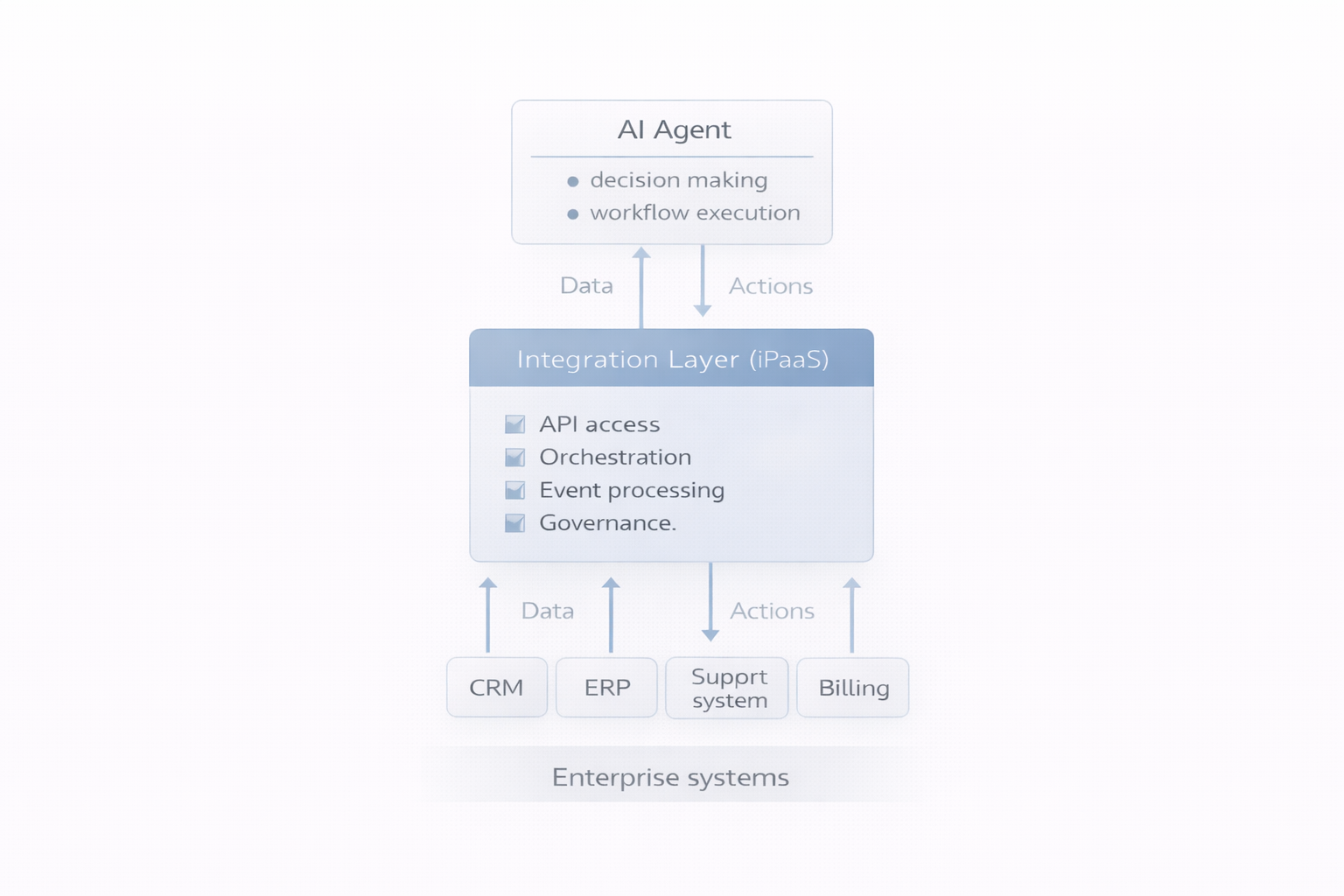
AI agents depend on a stable integration layer to access enterprise data, execute workflows, and maintain auditability across systems.
Three Enterprise Use Cases Where This Combination Works
The following cases illustrate how agentic AI performs when a mature integration layer is already in place.
- Predictive equipment maintenance. IoT sensors stream operational data into an ERP through Boomi. An AI agent continuously evaluates patterns indicating potential equipment failure. When defined thresholds are crossed, it triggers a maintenance order and alerts the relevant department — with no manual step required between detection and response. This workflow was documented by Sage IT during a Boomi-based automation deployment.
- Supply chain routing. A distribution company integrated ERP, CRM, and logistics systems through Boomi. AI modules processed live shipping data and adjusted delivery routes based on real-time delay information and current inventory levels. The integration layer was a prerequisite for the AI component — not an afterthought to be added later.
- Internal knowledge operations. Boomi's own internal tool, ChatB, connects HR, project management, and documentation systems. It helps employees locate information and submit requests without navigating between systems manually. The agent's usefulness depends entirely on clean, synchronized data flowing from each of those applications.
Data Quality: The Variable That Determines Whether Agents Are Useful or Harmful
AI agents are only as accurate as the data they receive. An agent processing unverified supplier records might trigger unnecessary purchase orders. One operating on outdated customer profiles might escalate issues that were resolved the previous day.
Boomi's Data Catalog and Preparation tools allow teams to profile data sources, detect duplicates and gaps, and standardize formats before data reaches any agent workflow. This is closer to data engineering than AI work — but it is precisely what makes the AI component reliable in practice.
Context matters separately from quality. An agent can process numeric values without understanding what those values represent. Boomi's integration fabric preserves relationships between datasets — linking customer, order, and transaction records so that agent logic interprets actions correctly rather than treating each data point in isolation. A flag on an invoice means something different depending on whether the customer is in a trial period or a long-standing contract. That context has to come from somewhere.
Governance and Compliance in Agent-Driven Workflows
Autonomous agents create a new category of compliance question: who is accountable when an AI makes a decision that affects a customer, a financial record, or a regulated dataset?
Answering that question requires technical infrastructure, not just policy. Boomi's governance tooling — Agent Control Tower, role-based permissions, data lineage tracking, and audit logging — allows organizations to define exactly what each agent can access and what actions it can initiate. Every decision and system interaction is recorded with timestamps, attribution, and context.
For GDPR compliance, this is operationally relevant: automated decisions affecting EU residents need to be explainable and traceable to a specific system action. For CCPA, similar requirements apply to California residents. Neither standard is satisfied by automation that runs without a structured log. The API governance practices for Boomi that already apply to API calls extend naturally into agentic contexts — the same principles of versioning, access control, and audit apply when an agent is the client.
A Practical Implementation Path
Organizations do not need to redesign existing systems to start working with AI agents in a Boomi environment. The implementations we find most effective build incrementally, starting with processes that already run through Boomi and have predictable, well-understood logic.
Boomi's official AI platform documentation covers how Agent Studio integrates into existing AtomSphere deployments, which reduces the configuration overhead of the initial setup.
If your engineering team is working through where AI automation fits into an existing enterprise architecture, our AI development services team can help scope the integration requirements and identify the right entry points.
Key Takeaways
- Agentic AI fails in production when integration is treated as an IT afterthought rather than a foundational design requirement.
- Boomi provides three capabilities critical for agentic workflows: unified API access, event-driven processing, and governed traceability.
- Data quality and contextual relationships — not model selection alone — determine whether AI agents produce useful outputs or expensive errors.
- Compliance requirements in regulated industries are technically addressable through Boomi's audit and governance architecture.
- Implementation works best when it starts with existing Boomi integrations and extends incrementally, not with a full platform redesign.
Conclusion
The gap between an AI agent that works in a controlled demo and one that works in a production enterprise environment is almost always an integration problem. Clean, governed, real-time access to enterprise data is what separates a reliable automation from a liability.
For organizations already running Boomi as an integration layer, extending toward agentic automation is largely a matter of deliberate architecture decisions and governance configuration — not rebuilding from scratch. The infrastructure that makes Boomi integrations predictable is the same infrastructure that makes AI agents trustworthy.
If your team is mapping out where AI-driven automation fits into your current stack, we are happy to work through the specifics. Reach out through our contact page and describe your situation — we respond to every inquiry within one business day.
Boomi is a trademark of Boomi, LP. Bluepes is an independent software consulting company. We are not affiliated with, endorsed by, or certified by Boomi, LP.
Summarize with AI
 ChatGPT
 Claude
 Gemini
 Grok
Grok Perplexity
FAQ











Interesting For You



Cloud transformation in regulated industries: integration that holds up under scrutiny
When a hospital IT director evaluates a new integration platform, the first question is rarely "how fast can we deploy?" It's "what happens if this fails an audit?" That distinction shapes every architectural decision in industries where data handling is not just a technical concern — it's a legal one. This article is for IT Directors and CTOs in healthcare, financial services, and legal tech who are evaluating cloud integration options for environments where compliance is non-negotiable. Next — a practical look at what makes Boomi a platform that clients in regulated industries choose, and how Bluepes, as an independent integration consulting company, approaches these projects. Cloud integration for regulated industries means more than connecting APIs. It means building data flows that can be audited, reversed, restricted, and documented at any point — across systems that were never designed to talk to each other. Boomi addresses this by building compliance logic into the platform itself, rather than requiring teams to layer it on afterward. That design assumption is the main reason it comes up frequently in regulated industry evaluations.
Read article


Why composable enterprise architecture requires a strong integration layer
Most IT modernization projects follow the same logic: replace monolithic platforms with best-in-class tools, gain flexibility, and move faster. It works — until you realize that a dozen disconnected tools create a different kind of problem. Composable enterprise architecture is the strategy; integration is what determines whether it succeeds or collapses. This article is for CTOs, IT directors, and architects who are building or evaluating modular IT environments. It addresses what happens when the integration layer is an afterthought — and what a well-designed one looks like in practice. Composable enterprise architecture is an IT strategy that treats business capabilities as modular, interchangeable components — each of which can be updated, replaced, or extended without disrupting the rest of the system. The challenge is that every component still needs to exchange data with the others in real time. That is where the integration layer, rather than the individual applications, becomes the critical infrastructure.
Read article



The hidden costs of poor integration — and what it takes to fix them
Disconnected systems rarely appear as a line item in the budget. Their costs show up elsewhere — in the hours your finance team spends reconciling numbers that don't match, in the IT tickets opened every time a vendor updates their API, in the orders that fall through because inventory data was three hours out of date. This article is for IT directors, CTOs, and engineering leads who feel the friction of poor integration every week but haven't been able to put a clear number on it. The core issue: the real cost of poor integration is rarely the failed project or the vendor license. It's the accumulated operational drag — slower decisions, higher maintenance overhead, and revenue that leaks quietly through gaps between systems. Understanding that cost is the first step to justifying the investment in fixing it. For context on why companies reach that decision point, see why businesses are rethinking their integration strategy.
Read article