


API governance in Boomi: how mid-market teams keep control


When a mid-market company runs 50 active integrations and six product teams pushing API changes independently, governance stops being a process question and becomes a risk question. One team overwrites a shared endpoint. Another deprecates a version without notifying consumers. A partner integration breaks at 2 a.m. with no clear owner to call.
Bluepes is an independent integration consulting company that works with Boomi as one of its core platforms. This article draws on that hands-on experience — not as Boomi's representative, but as a team that has debugged the consequences of missing governance and helped clients build the structures that prevent them.
This article is for CTOs, VP Engineering, and IT Directors at mid-market organizations who manage growing API catalogs and want a practical governance model they can implement incrementally. Next — a breakdown of the five governance layers, how each maps to Boomi's tooling, and where teams typically lose control.
API governance in Boomi means applying consistent rules for how interfaces are designed, secured, versioned, and retired. The Boomi API Management module provides the infrastructure. The design conventions, ownership assignments, and review cadences are decisions the engineering team makes. Organizations that get this right reduce integration failures, shorten partner onboarding, and make security audits straightforward rather than stressful.
Updated in April 2026
What API governance means in a Boomi environment
API governance is not a single feature — it is the set of policies, ownership structures, and operational habits that determine whether APIs stay manageable as an organization scales. Without it, teams experience predictable failures: inconsistent naming breaks downstream consumers, missing version control forces hard cutovers, and undocumented APIs create security blind spots that surface during audits rather than during development.
According to the Postman State of the API Report 2025, the average mid-size enterprise maintains more than 250 active APIs across products, internal systems, and partner integrations. Most governance failures trace back not to platform limitations but to the absence of agreed conventions — naming patterns, ownership rules, and documentation requirements that teams never formally established.
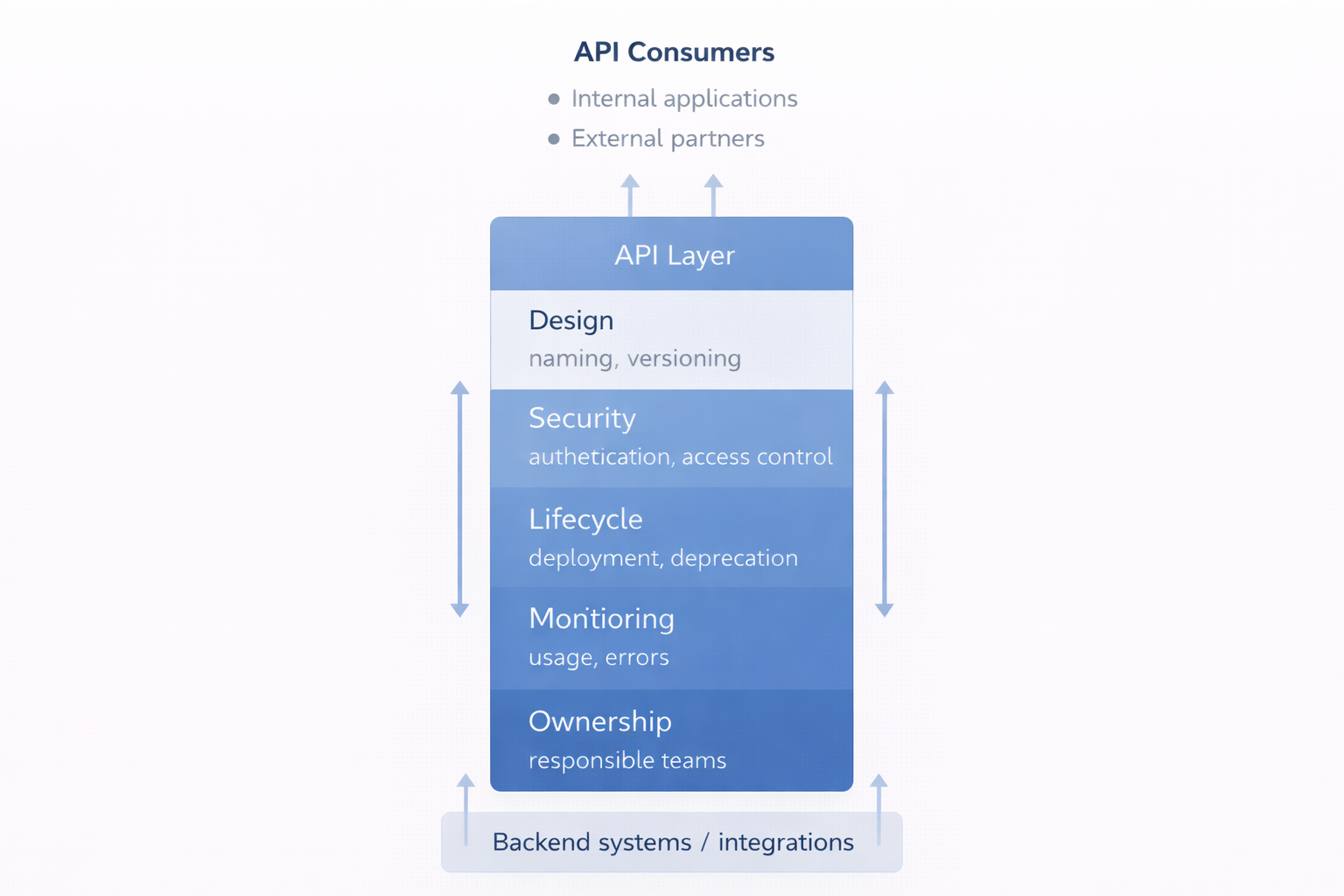
API governance operates as a layered control system covering design, security, lifecycle, monitoring, and ownership across the API layer.
Boomi's API Management module provides a structured foundation for governance, but the platform does not enforce governance by itself. The five layers a practical governance model needs to cover are: design standards, security policies, lifecycle management, monitoring, and ownership.
The table below maps each layer to the corresponding Boomi capability:
How to structure API design before development begins
Design governance determines whether your API catalog stays coherent six months after the first release. Three conventions produce the largest practical improvement, and all three can be enforced through Boomi's API Design component before a single line of integration logic is written.
Resource-oriented naming
Endpoints should describe resources, not actions. /patients/{id}/records communicates intent clearly; /getPatientRecords does not. This matters when multiple teams query the same catalog — clear naming reduces the time spent reading documentation for every new consumer, and it makes deprecation decisions traceable to actual usage patterns.
Versioning policy
Boomi supports explicit versioning via path segments (/v1/, /v2/) and through the API Design component's built-in version control. The operational rule that matters most in practice: no breaking change to an existing version without a deprecation window communicated to all known consumers. Teams that skip this step discover the breakage through failed partner integrations rather than through a planned cutover.
OpenAPI definitions as the contract
Boomi's API Design Tool supports OpenAPI schema definitions before implementation begins. When architects define schemas first, the mismatch between design intent and deployed logic — one of the primary causes of integration failures — is caught in design review rather than production. In a hybrid integration architecture where the same API serves both cloud and on-premise consumers simultaneously, this contract-first approach is not optional — it is the only way to manage backward compatibility across environments.
Security policies that actually get enforced
Security is where governance frameworks most frequently break down — not because the platform lacks capability but because policies are defined once and then not maintained. Boomi's API Gateway supports several policy layers that, together, address the main categories of API security risk:
- Authentication: OAuth 2.0 and SAML for both user-facing and service-to-service calls.
- Authorization: granular access control scoped to API groups or specific consumer types.
- Rate limiting and throttling: to prevent abuse and protect shared infrastructure.
- Audit logging: automatic recording of requests and responses, traceable for compliance review.
For organizations subject to GDPR or HIPAA requirements, Boomi's gateway integrates with external identity providers and encryption modules. NIST SP 800-204 defines the security architecture for API-based and microservices environments; Boomi's policy model maps to the majority of its authentication and authorization controls, which makes compliance documentation straightforward when policies are defined consistently from the start.
In a healthcare integration project involving insurance partner APIs, consistent audit logging and SAML-based authentication were applied across every environment during the design phase — not retrofitted afterward. Retrofitting security policies onto a live API catalog costs significantly more than defining them at the start, both in engineering time and in the risk exposure during the gap.
If your team is managing fragmented security policies across integration environments, a structured review of your current Boomi policy configuration can identify gaps before they become incidents. Discuss your integration architecture with our team.
Lifecycle management: from deployment to retirement
An API that served a purpose in 2023 may be actively harmful in 2026 if it still carries traffic after its replacement was deployed. Lifecycle management governs how APIs move through states: design, test, production, deprecated, and retired. Boomi's Environment Promotion feature controls the progression from development to test to production. Version control ensures rollback is possible without manual reconstruction.
The operational challenge is organizational, not technical. For each API domain, it is practical to define three governance roles:
- API owner: the team or individual accountable for the API's behavior and SLA.
- Consumer representative: someone who can communicate downstream impact before breaking changes ship.
- Governance reviewer: a cross-functional role that evaluates proposed changes against design standards.
These roles do not require separate headcount. In smaller organizations, the same engineers fill all three for different API domains. The important thing is that each API has a named owner who is reachable when something breaks — not a team alias, but a person. Without that, deprecation decisions stall and incident response takes hours longer than it should.
Teams running a dedicated integration team typically embed role assignments in the team's standard operating procedure for new API definitions. This keeps governance lightweight — a checklist at the design review stage rather than a separate approval process.
How monitoring supports governance decisions
Monitoring does more than surface errors — it produces the evidence base for governance decisions. Usage analytics reveal which API versions are still in active use, making deprecation decisions grounded in data rather than assumption. For a detailed view of how to structure monitoring Boomi integrations for operational visibility, the linked article covers the observability layer specifically.
Boomi's built-in dashboard provides request volume by API and version, error rates and response times, and consumer activity by account or API key. These metrics support three governance actions directly:
- Retirement decisions: if usage to a specific version is zero over 90 days and all known consumers have migrated, deprecation is safe.
- Performance baseline enforcement: if p99 latency exceeds the agreed SLA, the owning team is notified before a partner complains.
- Anomaly detection: unusual traffic patterns — volume spikes, unexpected error rates — trigger a security review rather than waiting for a breach report.
The gap in most organizations is not measurement — Boomi logs a significant amount by default — but review cadence. A monthly governance review of API metrics, even informal, changes team behavior because engineers know the data is being read. That awareness reduces the frequency of undocumented changes and version deprecations without consumer notification.
Operationalizing governance across distributed engineering teams
Governance frameworks that live in documents but not in workflows fail quickly. The practical question is: at which point in the development process is governance actually checked? The answer that holds up across different team structures: at the API design review, before implementation begins.
Once an API is deployed and consuming real traffic, structural changes become expensive. The design review — where naming conventions, versioning policy, security requirements, and ownership are confirmed — is the intervention point with the highest leverage per hour invested. For organizations running larger distributed integration engineering teams, a formal review board with a documented checklist may be appropriate. For smaller teams, the same checklist embedded in a pull request template achieves the same outcome at lower overhead.
The most common failure mode is treating governance as a compliance exercise rather than an engineering standard. Teams that internalize governance as a quality practice — equivalent to code review or automated testing — produce API catalogs that remain coherent as the organization changes. Teams that treat it as a reporting requirement produce catalogs that look governed on paper and break in production.
Key takeaways
- API governance in Boomi covers five layers — design, security, lifecycle, monitoring, and ownership. The platform provides the tooling; the team makes the decisions.
- Design conventions set the quality baseline before integration logic is written. Contract-first development with OpenAPI definitions reduces production failures.
- Security policies in Boomi's API Gateway are most effective when defined at design time. Retrofitting them onto live APIs is significantly more expensive.
- Each API domain benefits from three named roles: owner, consumer representative, and governance reviewer. These can overlap in smaller teams.
- Monitoring data is the evidence base for governance decisions. A regular review cadence converts Boomi's default logging into actionable deprecation and performance decisions.
Conclusion
API governance is not a feature you enable once — it is the operational discipline that keeps an integration platform coherent as the organization using it changes. Boomi provides the infrastructure through its API Management module, but the design standards, ownership structures, and review cadences are built by the teams that operate it.
For mid-market organizations managing growing API catalogs, the starting point is consistent: audit what you have, assign named ownership to every active API, and define the design conventions that all new APIs will follow before the next integration project begins. The governance model does not need to be complex to be effective.
If you want to understand where your current Boomi API governance has gaps — and what a practical remediation path looks like — our integration engineering team has worked through this in fintech, healthcare, and telecom environments. Start the conversation.
Boomi is a trademark of Boomi, LP. Bluepes is an independent software consulting company. We are not affiliated with, endorsed by, or certified by Boomi, LP.
Summarize with AI
 ChatGPT
 Claude
 Gemini
 Grok
Grok Perplexity
FAQ











Interesting For You



Cloud transformation in regulated industries: integration that holds up under scrutiny
When a hospital IT director evaluates a new integration platform, the first question is rarely "how fast can we deploy?" It's "what happens if this fails an audit?" That distinction shapes every architectural decision in industries where data handling is not just a technical concern — it's a legal one. This article is for IT Directors and CTOs in healthcare, financial services, and legal tech who are evaluating cloud integration options for environments where compliance is non-negotiable. Next — a practical look at what makes Boomi a platform that clients in regulated industries choose, and how Bluepes, as an independent integration consulting company, approaches these projects. Cloud integration for regulated industries means more than connecting APIs. It means building data flows that can be audited, reversed, restricted, and documented at any point — across systems that were never designed to talk to each other. Boomi addresses this by building compliance logic into the platform itself, rather than requiring teams to layer it on afterward. That design assumption is the main reason it comes up frequently in regulated industry evaluations.
Read article


Why Agentic AI in the Enterprise Depends on the Integration Layer
Most enterprise AI projects do not fail because the models are inadequate. They fail because the data feeding those models is inconsistent, delayed, or simply unreachable. According to a 2025 analysis, why AI agent pilots fail in production comes down to one recurring problem: the absence of a structured integration layer between AI systems and enterprise data. This article is for CTOs and VPs of Engineering who are evaluating how to introduce AI agents into existing enterprise infrastructure. It addresses what integration architecture those agents actually require to work reliably — and where Boomi fits into that picture. The short answer: agentic AI needs a stable, governed integration layer to access enterprise data, trigger downstream processes, and log every action taken. Without that layer, agents either operate on incomplete information or become impossible to audit and explain.
Read article



How companies are future-proofing their tech stacks with cloud-native integration
The average mid-market company runs dozens of business applications: an ERP, a CRM, a separate billing system, various cloud tools, and increasingly AI-powered services layered on top. Each of those systems generates data the others need. Keeping them connected is no longer an IT side project — it is a condition for the business to function. This article is for IT Directors, CTOs, and technical leads who are managing integration infrastructure built for a smaller, simpler stack. If your team spends more time fixing broken connections than building new capabilities, this is for you. Next — a look at what future-proofed companies actually do differently, and what a more sustainable architecture looks like. The short answer: companies that scale without constant integration disruption tend to have moved away from custom-built, point-to-point connections and toward managed integration platforms. Boomi is one of those platforms. Bluepes is an independent software consulting company that works with Boomi and other integration tools on behalf of clients — this article reflects that perspective, not Boomi's marketing position.
Read article