


Education data privacy requirements in the US and Europe for software


Education data privacy requirements create binding architectural constraints the moment a vendor touches a student record. FERPA, COPPA, state statutes, and GDPR each impose distinct obligations — on access design, data retention, sub-processor management, and deletion logic — and they frequently apply to the same system at the same time. This article is for IT directors, CTOs, and compliance leads at edtech vendors and school districts who are building or procuring student-facing platforms across U.S. and European markets. If your system stores, processes, or transmits student data in either jurisdiction, what follows maps the legal obligations directly to the technical decisions you need to make. The short answer: U.S. frameworks (primarily FERPA and state laws) focus on institutional control over disclosure and vendor accountability. GDPR centers on individual rights and enforceable technical measures. Both require compliance to be visible in system behavior — not policy documents. The architectural patterns that satisfy one framework partially overlap with the other, but the gaps matter and have caused failed procurement reviews.
What education data privacy requirements actually govern
Education data privacy requirements are the combined legal, architectural, and governance obligations that regulate how student data is collected, processed, stored, accessed, retained, and deleted within educational systems. They include statutory rules, contractual controls, role-based access enforcement, audit traceability, data minimization, and lifecycle management. Compliance is demonstrated through system behavior, not policy statements.
That distinction matters because most compliance failures in regulated education environments are not caused by missing documentation. They are caused by systems that technically allow what the contract prohibits — because the access model, logging design, or deletion logic was never aligned with the regulatory clause it was supposed to enforce.
Bluepes works with edtech product development teams to bridge exactly that gap: mapping legal obligation to system design before the procurement submission, not after the audit.
The US regulatory stack is layered, not unified
There is no single U.S. federal law governing education data privacy. FERPA sets the baseline for institutions receiving federal funding. COPPA adds age-specific constraints for children under 13. Each state may impose additional requirements that override or extend both. That combination requires vendors to treat compliance as a matrix, not a checklist.
A platform deployed to a Texas school district operates under FERPA, COPPA (for K–5), and the Texas Student Data Privacy Act simultaneously. Each layer may add contractual obligations to the vendor agreement, and the strictest clause governs. That cannot be handled through policy alone — it requires architectural enforcement from the first schema design.
FERPA: structural control of student records
The Family Educational Rights and Privacy Act regulates access to education records at institutions receiving federal funding. The law governs confidentiality and institutional control over disclosure — not specific encryption algorithms or infrastructure patterns.
Under FERPA, vendors may operate as “school officials” and access student data only if they perform institutional services, remain under direct institutional control, and use data exclusively for authorized educational purposes. The Student Privacy Policy Office guidance clarifies that institutional responsibility for vendor oversight does not transfer with a contract signature. The institution remains accountable.
Architectural implications include restricted data access aligned with institutional roles, no secondary data use, defined retention periods, and clear data ownership boundaries. District vendor addenda now routinely specify prohibition of advertising use, limits on redisclosure, automated deletion upon contract termination, and full sub-processor transparency.
COPPA and the K–5 layer
The Children’s Online Privacy Protection Act applies when personal data is collected from children under 13. In K–5 environments, COPPA requirements overlap with FERPA obligations and add constraints that go beyond disclosure control.
The Federal Trade Commission COPPA Rule defines requirements for parental consent, transparency in data practices, and limitations on behavioral tracking. In classroom-managed environments, schools may provide consent on behalf of parents for educational services. But vendors must restrict data collection strictly to educational purposes. Profiling for advertising or unrelated analytics creates direct regulatory exposure.
The architectural consequences are specific: disabling third-party tracking scripts in student-facing interfaces, limiting telemetry collection at the instrumentation layer, isolating student data from marketing systems at the schema level, and ensuring parental notice workflows exist where school consent is insufficient.
State laws: the operational layer above federal baseline
Most U.S. states have enacted student data protection statutes. California’s SOPIPA, Colorado’s Student Data Transparency and Security Act, and the Texas Student Data Privacy Act are among the better-known examples. Unlike FERPA, which defines principles, state laws frequently specify operational triggers.
State statutes typically require prohibition of targeted advertising, restrictions on data sale, defined breach notification timelines (often 30–72 hours), and explicit deletion upon district request. Vendor procurement questionnaires now include state-specific compliance matrices, and districts are increasingly using them to disqualify vendors who cannot provide technical evidence of compliance — not just contractual assurances.
If your platform operates across multiple states, you are managing a compliance stack where the most restrictive clause from any applicable statute governs for that deployment.
If your team is reviewing a district contract or preparing a vendor security questionnaire, the gap between what your contract states and what your system actually enforces is where audits fail. A technical review before the submission is faster and less costly than a remediation after award. Discuss your compliance architecture.
GDPR and student data in the European Union
In the European Union, student data processing is governed primarily by the General Data Protection Regulation. Public schools and universities typically act as data controllers. Vendors act as processors. That distinction determines who bears which obligation under Articles 28 and 82 — and it shapes every procurement conversation with a European institution.
The European Data Protection Board guidance clarifies controller and processor obligations in public-sector contexts. Unlike FERPA, GDPR defines explicit individual rights and administrative fines up to 4% of global annual turnover. Documentation alone is insufficient. Institutions must demonstrate technical and organizational measures.
GDPR compliance shapes database schemas, logging architecture, backup strategies, and cloud region selection. These are not configuration decisions made after the system is built. They are design decisions that need to be locked in at the architecture review, before the system enters procurement.
Data subject rights in the EU education context
GDPR grants students and parents specific rights: access, rectification, erasure, data portability, and restriction of processing. In education systems, these rights collide with academic record retention obligations. A deletion request cannot override a legal obligation to retain a student transcript. But it may apply to every other category of data attached to that student’s profile.
System architecture must therefore support selective deletion logic, record classification frameworks with metadata tagging of retention categories, and response workflows for access requests with defined SLAs. Blanket delete is rarely the right implementation. Deletion by data classification is the only approach that satisfies GDPR without violating institutional record-keeping obligations.
US vs EU education data privacy requirements: comparison
The table below summarises the structural differences across nine dimensions. Both environments require technical enforcement — the U.S. model puts institutional accountability at the center; the EU model puts individual rights at the center.
A system operating in both jurisdictions must satisfy both logics simultaneously. That requires careful architecture decisions around access control, logging, deletion, and hosting — not a single unified policy document.
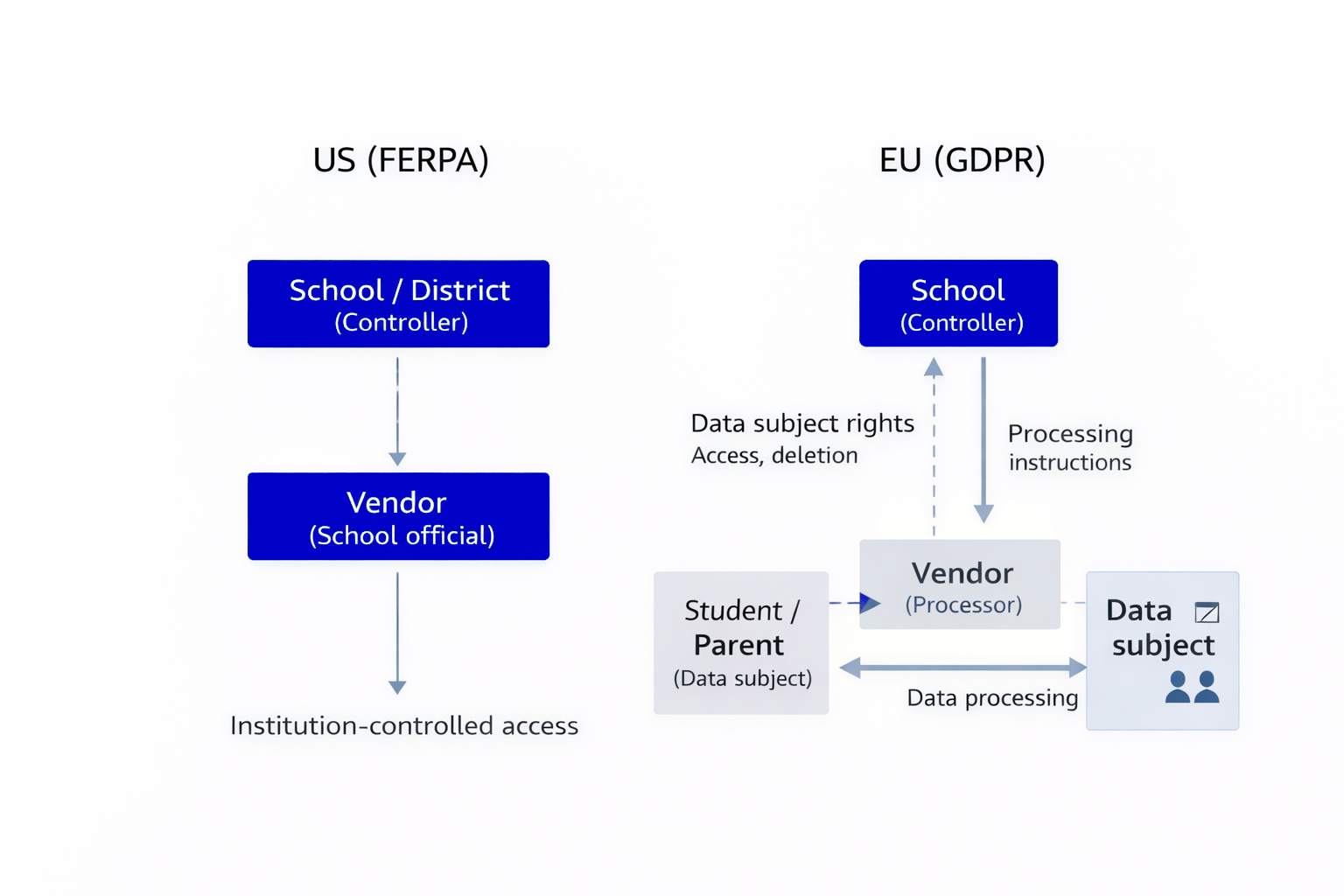
US and EU education data privacy frameworks define control differently: institutional access control under FERPA versus data subject rights and processor obligations under GDPR.
Role-based access and visibility boundaries
Role-based access control is central to education data privacy compliance in both frameworks. Access design must define teacher visibility boundaries, administrative escalation paths, district-level oversight, campus-level isolation, and parent access restrictions within clearly bounded scope.
In multi-campus districts, roles frequently overlap. A user who acts as teacher in one campus and administrator in another creates a permission intersection that most generic RBAC implementations do not handle correctly. Without contextual role resolution, that user may access student data across campuses they have no instructional relationship with — a FERPA violation that looks like a configuration choice.
Access logging must record data view events, export events, configuration changes, and privilege escalations with sufficient granularity to reconstruct who accessed what, when, and under which role. The design principles behind role-based access control in education systems extend this pattern in technical depth.
Data minimization and lifecycle governance
Data minimization requires collecting only information necessary for defined educational purposes. Over-collection happens when systems include behavioral analytics beyond instructional scope, location metadata, device identifiers, or unnecessary demographic attributes. Under GDPR, minimization is explicit and enforceable. Under FERPA, it is implied through purpose limitation and institutional control.
Retention logic must reflect both legal obligations and operational needs. Active use, archive, deletion trigger, backup expiration, and log retention duration each require explicit definitions. Deletion triggers must be specific: contract termination, district request, graduation after a defined interval, or a data subject erasure request in the EU context.
Backup systems must align with deletion policy. A retained backup that reintroduces deleted records during a restore operation creates compliance risk that is easy to miss until an audit surfaces it. For a practical breakdown of how retention and batch processing architecture intersects with compliance, see the edtech batch integration architecture post.
Encryption, infrastructure, and hosting responsibility
Encryption is a baseline technical safeguard in both jurisdictions. TLS in transit, encrypted storage at rest, managed key services, and restricted administrative access are table stakes. The NIST SP 800-53 security controls framework provides structured guidance on access control, encryption, and audit logging that maps to both FERPA and GDPR technical requirements.
In EU contexts, data residency affects cloud region selection. Standard Contractual Clauses and transfer impact assessments are required for cross-border data flows. Sub-processor transparency is contractual and auditable — a hosting provider’s sub-processors are your sub-processors under GDPR, and the institution will ask for the list. Our education-grade cybersecurity architecture services address the technical controls layer across both jurisdictions.
How to validate compliance readiness before procurement
- Map all data categories processed by the system and classify them by retention category.
- Assign institutional roles and vendor responsibilities against each data category.
- Document retention and deletion logic with explicit triggers for every category.
- Review sub-processor contracts and confirm hosting region compliance with applicable laws.
- Simulate an audit scenario using real log data to validate that access events are traceable.
- Cross-reference state-specific requirements if the deployment spans multiple U.S. states.
For an assessment of how this checklist applies at the platform architecture level before you submit an RFP response, see the edtech pilot containment strategy framework.
Common structural compliance failures
The failures that surface during contract renewal cycles rather than initial pilot follow a consistent pattern: collecting diagnostic telemetry beyond instructional necessity, using shared administrative accounts without individual traceability, leaving deletion triggers undefined, storing logs without a review policy, hosting data cross-border without contractual safeguards, and maintaining no formal sub-processor registry. Each of these is an architectural gap, not a documentation gap.
Key takeaways
- Education data privacy requirements must be enforced through system architecture, not policy documents — both FERPA and GDPR require demonstrable technical controls.
- U.S. compliance is a layered stack: FERPA sets the federal baseline, COPPA adds age-specific constraints for under-13 users, and state laws impose the most operationally specific requirements.
- GDPR expands compliance obligations to include individual rights management, mandatory DPOs for public institutions, and cross-border transfer governance — none of which has a direct FERPA equivalent.
- Role-based access control and access logging are compliance requirements in both frameworks, not optional design choices.
- Retention and deletion logic must be explicit, automated, and aligned with backup policy — a retained backup that reintroduces deleted records creates separate regulatory exposure.
Conclusion
Education data privacy requirements define binding architectural constraints for any system operating in K–5, K–12, or higher education in the U.S. or Europe. The frameworks differ — FERPA prioritizes institutional control over disclosure; GDPR centers on individual rights and enforceable technical measures — but both require compliance to be visible in system behavior from the first deployment.
Vendors who enter procurement cycles without validated access models, defined deletion logic, and documented sub-processor governance consistently fail district reviews or face remediation costs after award. The technical gap between what a contract states and what a system enforces is where most failures originate.
Bluepes helps edtech vendors and institutions map regulatory obligations to technical controls before procurement — not after the audit. If you need a structured review of your compliance architecture, reach out to our engineering team for a technical assessment.
Summarize with AI
 ChatGPT
 Claude
 Gemini
 Grok
Grok Perplexity
FAQ











Interesting For You



Why Most EdTech Pilots Fail: Designing a Contained Learning Path Pilot in Regulated Education
A contained learning path pilot is a structured, limited-scope validation phase designed to test instructional logic, sequencing rules, and mastery criteria without building a full production system. In K–5, K–12, and higher education environments, pilot containment reduces instructional and technical risk while preserving architectural clarity for future scaling. Overextending early pilots often increases adoption friction and governance complexity. This article explains how to define pilot scope, isolate variables, and align validation metrics with long-term system strategy. It is relevant for school leaders, EdTech founders, curriculum architects, and technology directors evaluating instructional pilots.
Read article


Instructional Orchestration vs. Software Automation in Regulated Education Systems
Instructional orchestration defines how learning sequences, mastery rules, and teacher intervention logic are structured within a digital system. Automation alone does not guarantee pedagogical alignment; orchestration requires mapping educational theory to system behavior. In K–5 and K–12 environments, sequencing logic directly affects learning progression, while in higher education it impacts curriculum pathways and credit logic. This article explains how mastery modeling, teacher override controls, and system constraints intersect in regulated learning environments. It is relevant for instructional designers, academic technology teams, and EdTech product leaders building structured learning systems.
Read article


Education technology pilot strategy for institutional scale
Most EdTech pilots succeed technically and fail institutionally. A platform hits its uptime targets, educators respond positively, integration flows run without errors — and then the renewal review stalls. The reason is almost always the same: the pilot was designed to validate features, not to survive a procurement committee. This article is for IT directors, CTOs, and procurement leads at educational institutions and EdTech vendors who are preparing — or already stuck in — the transition from a controlled pilot to multi-campus or district-wide deployment. Next — you will find a structured framework covering governance ownership, regional compliance requirements, integration durability, and funding transition, with direct comparisons between U.S. and European institutional contexts. An education technology pilot strategy that accounts for renewal criteria from the start reduces friction during expansion reviews. The variables that matter most are not classroom metrics. They are governance continuity, regulatory alignment (FERPA in the U.S., GDPR in the EU), integration capacity at institutional load, and the ability to move from grant-based to operational funding without re-tendering.
Read article