


Why Most EdTech Pilots Fail: Designing a Contained Learning Path Pilot in Regulated Education


A contained learning path pilot is a structured, limited-scope validation phase designed to test instructional logic, sequencing rules, and mastery criteria without building a full production system. In K–5, K–12, and higher education environments, pilot containment reduces instructional and technical risk while preserving architectural clarity for future scaling. Overextending early pilots often increases adoption friction and governance complexity. This article explains how to define pilot scope, isolate variables, and align validation metrics with long-term system strategy. It is relevant for school leaders, EdTech founders, curriculum architects, and technology directors evaluating instructional pilots.
What an EdTech Pilot Is Supposed to Achieve
An EdTech pilot exists to validate instructional assumptions under real classroom conditions. The purpose of a pilot is not to demonstrate the full technical capabilities of a system. Instead, it allows educators and technology teams to observe how a learning model behaves when real teachers and students interact with it.
In many regulated education environments, pilot projects are the first moment when theoretical curriculum design meets classroom behavior. Instructional sequences that appear correct in documentation often behave differently once teachers begin using them with diverse groups of learners. A pilot provides the controlled conditions required to observe those differences.
For a learning path pilot, validation typically focuses on several measurable aspects of instructional behavior:
- Mastery sequencing accuracy The system should reflect the intended curriculum progression. If the sequencing logic is correct, students move through the learning path at a pace that matches the pedagogical model rather than technical assumptions.
- Progression logic under real pacing Students rarely progress through content at uniform speed. Some complete activities quickly, while others require repeated attempts. A pilot reveals whether the progression logic supports realistic classroom pacing.
- Teacher override feasibility Teachers must be able to intervene when algorithmic progression conflicts with instructional judgment. Observing how often teachers override system decisions provides valuable signals about the maturity of the learning logic.
- Minimal data visibility required for decisions During a pilot, educators should receive only the information necessary to evaluate progress. Excessive analytics and dashboards introduce noise without improving instructional insight.
A pilot therefore operates as a controlled validation environment rather than a partial enterprise rollout.
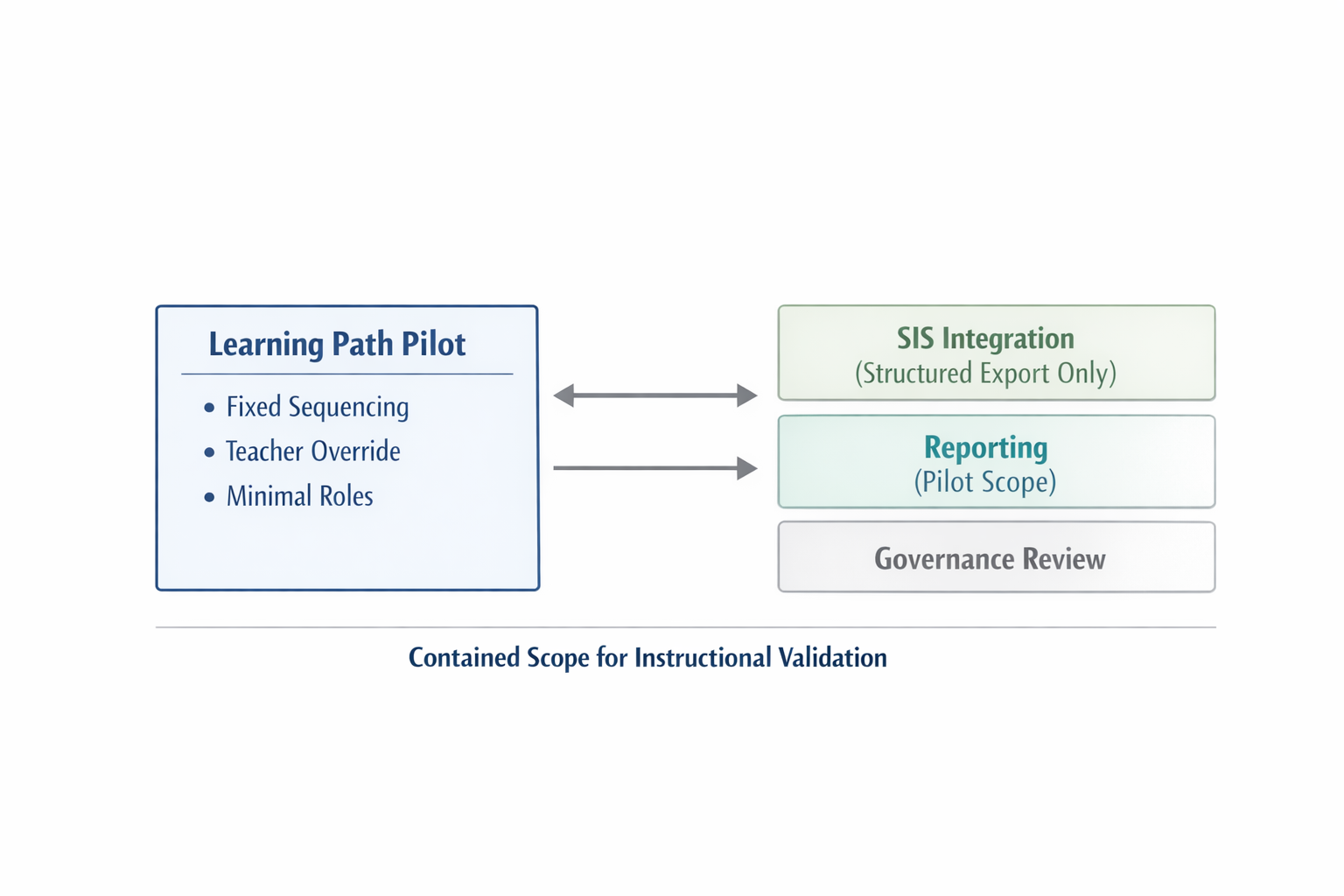
An EdTech pilot containment strategy defines the boundaries required to keep this validation measurable and interpretable.
Containment typically defines:
- Which sequencing rules remain fixed
- Which integrations are included
- Which roles are provisioned
- Which processes remain manual
- Which automation layers are postponed
When these boundaries are explicit, pilot observations become significantly easier to interpret. If sequencing logic fails, the cause is usually instructional design rather than architectural complexity.
Without containment, pilots accumulate structural complexity before instructional proof exists. Once multiple integrations, automation layers, and analytics systems are introduced, it becomes difficult to determine which variable influences the observed outcome.
Why Most EdTech Pilots Expand Too Early
The pressure to expand the scope of a pilot usually comes from several directions at the same time. Product teams may want to showcase the flexibility of the platform, district IT departments often request compatibility with existing systems, and procurement teams frequently ask for documentation of enterprise capabilities early in the process.
Each of these expectations is understandable on its own, yet addressing them all during the pilot phase gradually shifts the project away from controlled instructional validation and toward an early form of enterprise deployment.
Across regulated education systems, several escalation patterns recur:
- Configurable rule engines are introduced before sequencing logic is validated.
- Enterprise-wide role hierarchies are provisioned during classroom-level pilots.
- Edge-case automation is implemented before observing real exception patterns.
- Multiple system integrations are added before confirming minimal required data flows.
Each addition increases operational variability.
In K–12 districts, IT governance teams review:
- Access control matrices
- Student data handling practices
- Data retention expectations
- Vendor classification under FERPA
In higher education, review often includes:
- Integration stability
- Data ownership clarity
- Departmental visibility boundaries
The Family Educational Rights and Privacy Act (FERPA) outlines vendor responsibilities under the school official framework: FERPA official guidance.
Expanding architecture during pilot phase increases review scope.
Software Build and Instructional Validation Are Different Objectives
In many EdTech projects, product development and instructional validation are treated as if they were the same process. In practice, they pursue different goals and follow different timelines. A software build focuses on system capabilities, scalability, and technical flexibility. Instructional validation focuses on whether the learning model actually works in a real educational setting.
A software build typically optimizes for adaptability. Engineers design systems that support multiple configurations, flexible rule engines, and integrations with surrounding infrastructure. These capabilities are essential for long-term deployment, but they are not always necessary during early instructional testing.
Instructional validation, by contrast, requires controlled conditions. The goal is to observe how a specific learning sequence behaves when students and teachers interact with it in real classroom contexts.
During the pilot phase, the objective is to observe:
- Whether mastery progression reflects curriculum design
- Whether teachers realistically use override mechanisms
- Whether sequencing improves learning outcomes
These observations reveal whether the pedagogical model works before the system architecture expands.
In K–5 environments, progression logic may depend on age-based mastery thresholds and teacher-guided pacing. Younger learners often require adaptive intervention from educators, which means automated progression must allow for instructional discretion.
In higher education, progression rules frequently depend on prerequisite structures defined by departmental policy. These policies can vary across faculties and programs, which makes it important to validate sequencing logic before implementing broad configuration frameworks.
These variables are pedagogical rather than technical. They relate to how learning is structured and delivered, not to how the platform itself scales.
For that reason, automation should follow validation. Once instructional sequencing stabilizes, system capabilities can expand to support larger cohorts, additional roles, and more complex integrations.
An EdTech pilot containment strategy ensures that instructional logic stabilizes before structural expansion introduces additional variables.
Structural Risks in Regulated Education Pilots
Regulated education systems introduce layered governance constraints.
These include:
- Student record confidentiality requirements
- Data minimization expectations
- Audit logging obligations
- Controlled visibility of personally identifiable information
For younger learners, FTC COPPA guidance outlines under-13 data requirements.
When pilots include broad integration and automation, compliance review becomes more complex.
Overbuilding increases:
- Audit surface
- Documentation requirements
- Internal IT review cycles
- Legal assessment duration
A contained pilot limits regulatory exposure while preserving validation value.
What to Fix, What to Limit, What to Keep Manual
A practical EdTech pilot containment strategy requires clear boundaries around what should remain stable during the pilot, what should be intentionally limited, and which activities should remain manual. Without this separation, pilots tend to accumulate unnecessary automation and configuration layers before instructional behavior has been properly observed.
Dividing pilot scope into these three categories helps teams protect the integrity of the validation phase while still preparing for future expansion.
Fix Early
Some elements must remain stable throughout the pilot so that instructional outcomes can be measured consistently. When core progression rules change during the pilot, it becomes difficult to determine whether observed results reflect instructional design or system modifications.
- Mastery sequencing logic
- Core progression thresholds
- Essential user roles (student, teacher, limited pilot admin)
- Minimal structured data integration
These variables should remain stable during pilot measurement.
Limit Scope
Certain capabilities may be technically attractive but add unnecessary complexity during early validation. Limiting them allows teams to observe how the learning model performs before introducing flexible configuration layers.
- Broad configurability engines
- Cross-school data normalization
- Advanced analytics dashboards
- Multi-layer role inheritance
These elements increase architectural complexity without improving early validation clarity.
Keep Manual
Manual checkpoints play an important role during pilot phases. They allow educators and administrators to observe how the system behaves in situations that may later require automation. Keeping these processes manual during early stages helps identify patterns before committing to technical implementation.
- Teacher override confirmation
- Exception handling review
- Selective reconciliation of progress data
- Role provisioning adjustments
Manual processes often provide clearer validation signals than early automation. Once consistent patterns emerge, these activities can be gradually translated into automated workflows.
Comparison: Contained Pilot vs Expanding Pilot
Contained Pilot vs Expanding Pilot
Steps to Design a Contained Learning Path Pilot
- Define validation metrics before defining feature scope.
- Freeze mastery sequencing rules for the pilot duration.
- Integrate only structured data required for progression decisions.
- Provision essential pilot roles only.
- Document manual override and exception checkpoints.
- Define a post-pilot expansion roadmap separately.
These steps form a practical EdTech pilot containment strategy for regulated education systems.
If you require external architectural review before launching a learning path pilot, Bluepes provides EdTech system architecture consulting aligned with staged expansion models.
Limitations of a Pilot Containment Strategy
A containment approach works best when institutions are able to run a pilot as a controlled validation phase before broader deployment. In some education environments, however, institutional constraints, contractual obligations, or policy requirements make phased expansion difficult. When a project must immediately operate at full operational scope, the advantages of pilot containment become harder to realize.
Pilot containment may therefore be less suitable in situations such as:
- Immediate enterprise-wide deployment is contractually required
- Full audit coverage is mandated from day one
- Multiple schools must launch simultaneously
- Institutional policy prohibits phased expansion
In these scenarios, teams often need to design the system with enterprise architecture and full compliance controls already in place. Containment strategies assume that validation and scaling can occur in separate stages, which is not always compatible with institutional procurement or governance models.
Governance Exposure and Procurement Review Cycles
In regulated environments, procurement evaluates structural risk alongside functionality.
When a pilot includes enterprise-level automation and broad integrations, review scope increases.
Typical procurement assessment includes:
- Data protection evaluation
- Role-based access verification
- Infrastructure ownership review
- Retention and deletion policy analysis
- Vendor classification documentation
The Consortium for School Networking provides guidance on governance practices in K–12 IT environments: CoSN governance resources.
A contained pilot narrows review to necessary validation scope.
Operational and Financial Implications
Premature expansion increases:
- Development effort
- Maintenance complexity
- Documentation overhead
- Review cycle duration
Financial risk appears both in direct cost and in delayed expansion approval.
An EdTech pilot containment strategy reduces unnecessary technical overhead during validation.
Key Takeaways
- An EdTech pilot containment strategy defines structural limits before development expands.
- Instructional validation should precede enterprise-level automation.
- Over-architecture increases governance and procurement exposure.
- Manual checkpoints reduce systemic uncertainty.
- Contained pilots support clearer post-validation expansion decisions.
Final Perspective
Education institutions operate under regulatory, financial, and reputational constraints. Pilot design must reflect these realities.
A contained learning path pilot stabilizes sequencing, limits integration surface, and narrows automation scope. It creates observable instructional proof before structural expansion.
Bluepes works with K–5 schools, K–12 districts, and higher education institutions to design regulated learning systems where pilot scope is controlled, validation is measurable, and expansion is sequenced responsibly.
If you are preparing a regulated learning path pilot and need architectural clarity before development begins, contact Bluepes to schedule a structured pilot containment review.
Updated for 2026 to reflect current regulatory and procurement expectations in regulated education systems.
Summarize with AI
 ChatGPT
 Claude
 Gemini
 Grok
Grok Perplexity
FAQ











Interesting For You



Deep Learning Platforms
Artificial neural networks (ANN) have become very popular among data scientists in recent years. Despite the fact that ANNs have existed since the 1940s, their current popularity is due to the emergence of algorithms with modern architecture, such as CNNs (Convolutional deep neural networks) and RNNs (Recurrent neural networks). CNNs and RNNs have shown their exceptional superiority over other Machine Learning algorithms in computer vision, speech recognition, acoustic modeling, language modeling, and natural language processing (NLP). Machine Learning algorithms based on ANNs are attributed to Deep Learning.
Read article



Event-driven architecture security: scaling without compromise
A system that can handle 10x its normal load but exposes a new attack surface with every new integration isn't a scaling win — it's a delayed incident. This is the trade-off that most architecture discussions skip: scaling changes your threat model, and your security posture has to evolve right alongside it. This article is for CTOs and VPs of Engineering who are scaling distributed or event-driven systems and need to understand where the real security gaps appear — not the theoretical ones. Next — a structured breakdown of how scalability decisions affect attack surface, which security patterns hold under load, and what implementation looks like across fintech, telecom, and healthcare environments. Event-driven architecture security refers to the set of controls, protocols, and monitoring practices required to protect systems built around asynchronous message flows, streaming pipelines, and API-connected components — where traditional perimeter-based defenses are structurally inadequate. When everything communicates through events and APIs, the security model has to be distributed too. Perimeter thinking doesn't map onto broker topics, service meshes, or auto-scaling groups.
Read article


2025 Cybersecurity Trends: Threats That Are Already Affecting Mid-Market Teams
The gap between how companies think about cybersecurity and what attackers are actually doing has widened considerably over the past two years. Organizations that built their defenses around firewalls, VPNs, and periodic audits are finding that the model no longer holds — not because those tools are worthless, but because the attack surface has expanded in ways that perimeter thinking was never designed to handle.
Read article