


Instructional Orchestration vs. Software Automation in Regulated Education Systems


Instructional orchestration defines how learning sequences, mastery rules, and teacher intervention logic are structured within a digital system. Automation alone does not guarantee pedagogical alignment; orchestration requires mapping educational theory to system behavior. In K–5 and K–12 environments, sequencing logic directly affects learning progression, while in higher education it impacts curriculum pathways and credit logic. This article explains how mastery modeling, teacher override controls, and system constraints intersect in regulated learning environments. It is relevant for instructional designers, academic technology teams, and EdTech product leaders building structured learning systems.
What Is Instructional Orchestration?
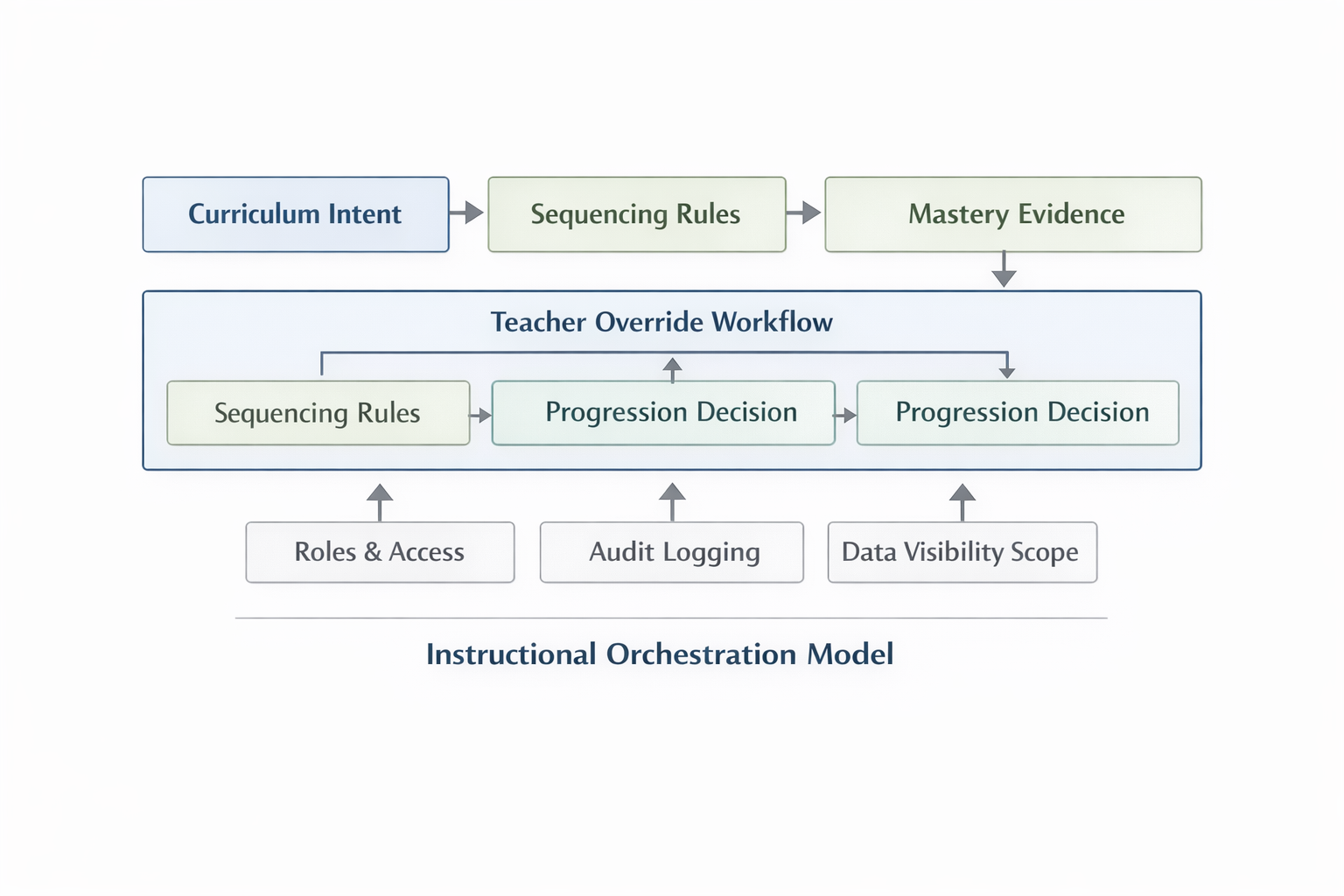
Instructional orchestration describes how a learning system organizes progression, mastery decisions, and educator intervention. In other words, it is the layer that connects curriculum intent with the actual behavior of the platform students and teachers use every day.
When a learning platform is introduced in a school or university, the technology does more than simply deliver content. It controls when students can move forward, how mastery is measured, and what happens when a learner struggles or moves faster than expected. Instructional orchestration defines these rules before the system begins automating them.
It defines:
- how students move through content
- how mastery is determined
- when educators intervene
- how exceptions are handled
- what data informs progression decisions
In practice, this model ensures that technical behavior follows educational design rather than the other way around. Curriculum teams, teachers, and academic administrators usually already have expectations about how learning should progress. Instructional orchestration translates those expectations into system behavior that developers can implement.
An instructional orchestration model therefore aligns technical implementation with curriculum design and institutional policy.
Automation enforces rules.
Orchestration defines which rules should exist and why.
Without orchestration, automation risks implementing progression logic that technically works but does not reflect how teaching and learning actually happen in the classroom.
Why Sequencing Is Not Just Logic
Sequencing is often implemented as a rule set:
- Complete Module A to unlock Module B
- Achieve 80% to progress
- Retry limit of three attempts
These structures appear neutral. In practice, they represent pedagogical assumptions.
In K–5 environments:
- Mastery thresholds may reflect developmental readiness.
- Teacher pacing flexibility is critical.
- Parental visibility must align with school policy.
In higher education:
- Prerequisite chains reflect departmental governance.
- Faculty may require override autonomy.
- Course credit progression can carry institutional implications.
Sequencing logic must align with these instructional realities.
The National Center for Education Statistics (NCES) outlines the importance of structured educational data governance that reflects institutional policy: NCES data governance guidance.
A system that automates sequencing without instructional alignment risks operational friction.
Software Automation Without Orchestration
In many learning platforms, automation is introduced early because it makes the system look technically complete. Progression rules, dashboards, and reporting layers are often implemented quickly so that the platform can demonstrate clear system behavior. The problem is that these elements are sometimes designed from a technical perspective rather than an instructional one.
When orchestration is not defined first, automation tends to reflect assumptions made by developers or product teams instead of educators. Over time this leads to systems that behave predictably from a technical standpoint but do not fully match how teaching and learning actually work in practice.
Common structural patterns observed in learning systems:
- Mastery thresholds defined without educator validation
- Automatic unlock rules that ignore pacing variation
- Override functions hidden in administrative layers
- Reporting layers exposing data without contextual interpretation
These implementations increase technical completeness but do not guarantee instructional alignment. A system may appear well-structured, with clear rules and automated progression, while still producing friction for teachers who are trying to manage real classrooms.
Automation optimizes efficiency.
Instructional orchestration optimizes learning governance.
Automation becomes valuable when it enforces rules that already reflect instructional design. When those rules are unclear or poorly aligned with classroom practice, automation simply scales the problem.
Without orchestration, automation can:
- Enforce premature progression
- Restrict teacher discretion
- Create compliance ambiguity around intervention logging
- Generate data visibility beyond instructional necessity
In regulated education environments, these issues can have operational consequences. Teachers may start working around the system, override actions may not be documented consistently, and data access may extend beyond what is actually required for instructional decision-making. Over time this reduces trust in the platform and makes adoption more difficult across schools or departments.
Teacher Override as a Structural Component
Teacher override is frequently implemented as a secondary feature. In regulated education systems, it is a primary governance element.
A structured override model defines:
- Who can override progression
- Under what documented conditions
- What data is logged
- How progression resumes
- How override events appear in reporting
In K–12 districts, override documentation may intersect with student record governance. The Family Educational Rights and Privacy Act (FERPA) requires responsible handling of student records and role-based access: FERPA official guidance.
In higher education, override events may intersect with departmental policy and accreditation standards.
An instructional orchestration model integrates override as a first-class workflow element rather than a hidden control.
Governance Implications of Learning Logic
Learning systems operate within regulatory and institutional constraints.
Governance considerations include:
- Role-based access control
- Audit logging of progression changes
- Data minimization principles
- Retention and deletion policies
In environments serving learners under 13, FTC COPPA requirements impose additional data handling expectations.
Automation layers that expand data visibility without instructional justification increase governance exposure.
An instructional orchestration model constrains data access to educational purpose.
Comparison: Instructional Orchestration vs Software Automation
The difference between instructional orchestration and automation-first design becomes clearer when looking at how learning systems structure progression, governance, and data visibility. Both approaches can produce technically functional platforms, but they start from different priorities. One begins with instructional design and institutional policy, while the other focuses on system capabilities and configuration flexibility.
The following comparison illustrates how these two approaches typically differ in practice.
Looking at these differences, the key distinction is not technical capability but the order in which decisions are made. In an orchestration model, instructional rules and governance constraints are defined first, and the technology enforces them. In automation-first designs, the system often introduces configurable logic early, while educational alignment and governance considerations are addressed later.
This difference becomes visible in everyday use. When sequencing is aligned with curriculum design and override workflows are clearly structured, teachers tend to trust the system and use it consistently. When progression rules are purely technical configurations, educators may experience the platform as rigid or disconnected from classroom practice.
Instructional orchestration provides structural clarity.
Automation-first approaches prioritize technical flexibility.
Both capabilities are useful, but they serve different stages of system maturity. Automation can scale a learning platform efficiently once instructional logic has been validated. Orchestration ensures that the logic being automated actually reflects how learning should progress in the first place.
Structural Risks of Automation-First Design
When automation precedes orchestration:
- Progression rules may conflict with classroom practice
- Teachers may circumvent the system
- Override logging may become inconsistent
- Governance review may identify undocumented flows
- Institutional adoption may slow
In higher education, departments may reject centralized progression rules. In K–5 environments, rigid sequencing may conflict with differentiated instruction practices.
An instructional orchestration model mitigates these risks by defining governance boundaries early.
Designing an Instructional Orchestration Model
A structured approach includes:
- Define mastery evidence requirements with educators.
- Stabilize sequencing logic before broad configurability.
- Document override conditions and logging standards.
- Align role-based visibility with institutional policy.
- Limit automation to validated progression paths.
- Separate pilot validation from enterprise scaling.
These steps support governance-aligned learning architecture.
If your institution is reviewing sequencing logic or override workflows in a regulated environment, Bluepes provides education technology consulting services aligned with institutional governance requirements.
You can Contact Bluepes education technology consultants for a structured architecture assessment.
K–5, K–12, and Higher Education: Contextual Differences in Orchestration
While the structural principles of an instructional orchestration model remain consistent, institutional context shapes implementation.
K–5 Environments
- Teacher-mediated pacing is central.
- Parental visibility must align with school policy.
- Mastery often reflects developmental readiness rather than strict percentage thresholds.
- Intervention decisions may involve classroom-level judgment rather than automated progression triggers.
Override workflows must remain simple and visible. Excessive automation can restrict instructional flexibility.
K–12 Districts
- Cross-school consistency may be required.
- District IT governance reviews data access structures.
- Progression logic may intersect with reporting expectations.
- Audit logging requirements are more formalized.
Sequencing decisions must align with district-level policy while preserving classroom-level discretion.
Higher Education Institutions
- Departments often maintain autonomy over prerequisite structures.
- Faculty may require broader override authority.
- Learning systems integrate with Student Information Systems (SIS) and departmental tools.
- Progression decisions can influence credit accumulation and academic standing.
In higher education, orchestration must respect departmental governance and academic policy frameworks.
Data Flow and Visibility Boundaries
An instructional orchestration model defines which data informs progression decisions.
Structured data inputs typically include:
- Enrollment status
- Assessment results
- Completion markers
- Intervention flags
Automation layers frequently expand visibility into:
- Historical performance
- Cross-course analytics
- Comparative dashboards
In regulated environments, visibility must remain proportionate to educational purpose.
The Consortium for School Networking (CoSN) outlines governance considerations for K–12 IT environments: CoSN governance resources.
Expanding dashboards without instructional necessity increases governance review scope and operational complexity.
An instructional orchestration model constrains visibility to what supports instructional decision-making.
Operational Alignment and Teacher Adoption
Learning systems succeed when educators use them consistently.
Automation-first designs often encounter:
- Informal teacher workarounds
- Manual tracking outside the system
- Inconsistent override logging
- Reduced trust in automated progression
Instructional orchestration addresses these adoption risks.
By defining:
- Clear override pathways
- Transparent progression rules
- Logged intervention actions
- Stable sequencing logic
Educators operate within predictable system behavior.
Adoption improves when system behavior mirrors classroom intent.
Steps to Evaluate an Existing Learning Platform
Institutions reviewing an existing learning system often need a practical way to determine whether the platform reflects instructional design or whether automation has grown faster than governance and curriculum alignment.
In many cases the system may function technically well, yet still create friction for educators because progression logic and override workflows were not designed with instructional input.
A simple evaluation framework can help identify whether orchestration principles are present in the system.
Institutions reviewing an existing learning system can assess orchestration maturity using the following framework:
- Are mastery thresholds defined with educator input?
- Is override authority documented and logged?
- Are progression rules stable across academic cycles?
- Does data visibility align with instructional necessity?
- Is sequencing logic separate from reporting layers?
These questions focus on how progression decisions are actually governed inside the platform. They also help reveal whether teachers and administrators understand how the system behaves.
If answers are unclear, automation may have outpaced orchestration.
Limitations of Instructional Orchestration Models
Instructional orchestration does not eliminate all complexity.
Limitations include:
- Institutional resistance to sequencing standardization
- Conflicting departmental policies
- Integration constraints with legacy systems
- Resource limitations for override monitoring
Orchestration provides structure. It does not replace institutional governance decision-making.
Key Takeaways
- An instructional orchestration model defines sequencing and intervention before automation expands.
- Sequencing encodes pedagogical decisions and institutional policy.
- Teacher override is a governance element, not an optional feature.
- Data visibility must align with instructional purpose.
- Automation without orchestration increases operational and compliance risk.
Conclusion
Learning systems in K–5, K–12, and higher education environments operate within regulatory, operational, and instructional constraints. Automation can enforce progression rules, but it cannot determine pedagogical alignment.
An instructional orchestration model establishes sequencing stability, defines override governance, and constrains data visibility before automation scales. This approach reduces operational ambiguity and supports institutional compliance.
Bluepes works with regulated education providers to design learning architectures where sequencing logic, teacher intervention workflows, and governance requirements are structurally aligned.
If your institution is evaluating progression automation or redesigning learning workflows, contact Bluepes to schedule a structured instructional orchestration review aligned with your institutional context.
Summarize with AI
 ChatGPT
 Claude
 Gemini
 Grok
Grok Perplexity
FAQ











Interesting For You



Why Most EdTech Pilots Fail: Designing a Contained Learning Path Pilot in Regulated Education
A contained learning path pilot is a structured, limited-scope validation phase designed to test instructional logic, sequencing rules, and mastery criteria without building a full production system. In K–5, K–12, and higher education environments, pilot containment reduces instructional and technical risk while preserving architectural clarity for future scaling. Overextending early pilots often increases adoption friction and governance complexity. This article explains how to define pilot scope, isolate variables, and align validation metrics with long-term system strategy. It is relevant for school leaders, EdTech founders, curriculum architects, and technology directors evaluating instructional pilots.
Read article



2025 Cybersecurity Trends: Threats That Are Already Affecting Mid-Market Teams
The gap between how companies think about cybersecurity and what attackers are actually doing has widened considerably over the past two years. Organizations that built their defenses around firewalls, VPNs, and periodic audits are finding that the model no longer holds — not because those tools are worthless, but because the attack surface has expanded in ways that perimeter thinking was never designed to handle.
Read article


Why businesses are rethinking their integration strategy
Most IT teams don't notice integrations until something breaks at the worst possible moment. A new CRM rolls out, and three weeks later someone in finance discovers that customer data hasn't been syncing. An ERP upgrade ships on schedule and quietly disables five automated workflows that nobody documented. Revenue numbers look wrong in the dashboard because two systems are still running on different update cycles. This article is for CTOs, IT Directors, and VP Engineering roles who suspect their current integration architecture costs more to maintain than it should — in engineering hours, in delayed releases, and in recurring data quality incidents. Next — a clear breakdown of where standard approaches fail, what modern platforms actually offer, and how companies in healthcare, e-commerce, and finance are handling this shift in practice. Business integration modernization — replacing a fragmented collection of point-to-point connections with a centralised, scalable architecture — has become a priority for companies that have grown past their original tech stack. The pressure isn't coming from trend reports; it's coming from the compounding overhead of keeping legacy connections alive as systems multiply.
Read article