


AI document ingestion in EdTech: what breaks first


The PDF uploaded without an error, the AI answered confidently, and the table containing the key decision rule never reached the model. The team only discovers the loss after inspecting the ingestion trace. AI document ingestion becomes a production concern when a file appears processed while the model receives an incomplete representation of what the user submitted.
A reliable ingestion layer identifies the input, extracts text and structure, validates what was recovered, records partial failures, and passes a normalized representation downstream. The model should receive content whose origin and extraction state are known, with enough source context to trace an answer back to the document. Prompt changes cannot restore tables, fields, pages, or embedded content that disappeared earlier in the pipeline.
Education software receives institutional policies, faculty handbooks, admissions records, support knowledge, assessment material, administrative forms, and user-uploaded files. The key engineering questions are where structure can be lost, which failures should stop processing, and which checks belong in deterministic code before an LLM is called. Those decisions determine whether the feature remains debuggable when clean demo files give way to real inputs.
Why AI document ingestion fails before model execution
AI document ingestion fails early when a pipeline reduces every file to raw text and loses layout, metadata, or extraction status before the AI stage begins. A PDF page with a table, a scanned form, and a DOCX policy document may all produce text, yet the relationships between headings, cells, fields, and source locations carry part of the meaning. A parser that returns a string without describing what it recovered creates an information gap the model cannot inspect.
Current document-analysis services make this distinction explicit. Microsoft Document Intelligence v4.0 can return paragraphs, paragraph roles, tables, selection marks, sections, and other layout elements from supported document types; Amazon Textract exposes text, forms, tables, queries, and layout; Google Cloud Document AI describes its layout parser as preserving tables, figures, lists, headers, and contextual relationships. These capabilities differ by service and format, yet they reflect the same architectural requirement: preserve the structure that downstream logic may need.
Microsoft’s current Document Intelligence layout documentation, Amazon’s Textract documentation, and Google Cloud’s Document AI layout parser documentation all show document processing as structured extraction rather than a plain-text step.
Structure changes what the content means
Consider a policy document where a heading applies to the three paragraphs beneath it, or a form where the label “Effective date” belongs to one value and “Expiry date” belongs to another. Flattening both examples into undifferentiated text can preserve every word while weakening the relationships the application needs. The same issue appears in tables, where row and column boundaries often encode the meaning of individual values.
Education content can also arrive in domain-specific structured formats. 1EdTech’s QTI standard packages assessment items and tests so they can move between conformant applications while preserving rich assessment structure. The practical implication is broader than assessment software: an ingestion layer should recognize when structure already exists and avoid destroying it before AI processing begins.
The 1EdTech QTI standard is one public example of structured education content whose relationships carry application meaning.
How a reliable ingestion pipeline should be structured
A reliable ingestion pipeline separates file handling, extraction, validation, normalization, and AI execution into observable stages. Each stage should produce a clear status and enough metadata for the next stage to decide whether processing can continue. This prevents one parser error from being misclassified as an AI-quality issue and keeps retries focused on the component that actually failed.
The exact components depend on the product, yet the responsibilities stay consistent across admissions systems, knowledge assistants, support tooling, administrative workflows, and content platforms. Bluepes’ broader EdTech software engineering work is relevant here because document ingestion sits inside a larger product boundary that also includes permissions, integrations, storage, user workflows, and operational support.
If document uploads already produce inconsistent AI results, another prompt iteration may hide the real failure for a while. A short architecture review can map the ingestion stages, parser assumptions, validation states, and retry boundaries before the team changes the model again. Discuss an EdTech AI ingestion architecture.
Which document failures should stop the AI workflow
The AI workflow should stop when the application cannot establish that the extracted representation is fit for the downstream task. A parser returning some text is insufficient evidence of success because partial extraction can remove exactly the section a model needs. The safer design uses explicit processing states and lets product logic decide which states are acceptable for each use case.
A support search assistant may tolerate a missing decorative image, while a form-processing workflow may need every required field before it can continue. The validation rule should therefore reflect the downstream action and the cost of a wrong answer. The same document can be acceptable for keyword search and unacceptable for an automated decision that depends on a missing table.
Typical stop or escalation conditions:
- Password-protected or encrypted files that the parser cannot read.
- Partial parses where pages, tables, attachments, or embedded objects are missing from the extraction result.
- Unsupported formats or malformed files that trigger fallback behavior without a validated conversion path.
- Low-quality scans where OCR confidence or readability checks fall below the product’s acceptance rule.
- Duplicate documents or conflicting versions where the system cannot identify which source should be authoritative.
These conditions should produce visible states such as rejected, partial, retryable, or needs review, rather than a generic “processed” flag. That state becomes part of the audit trail and gives support teams a concrete reason for the outcome. It also prevents the model from producing polished text from an input the application already knows is incomplete.
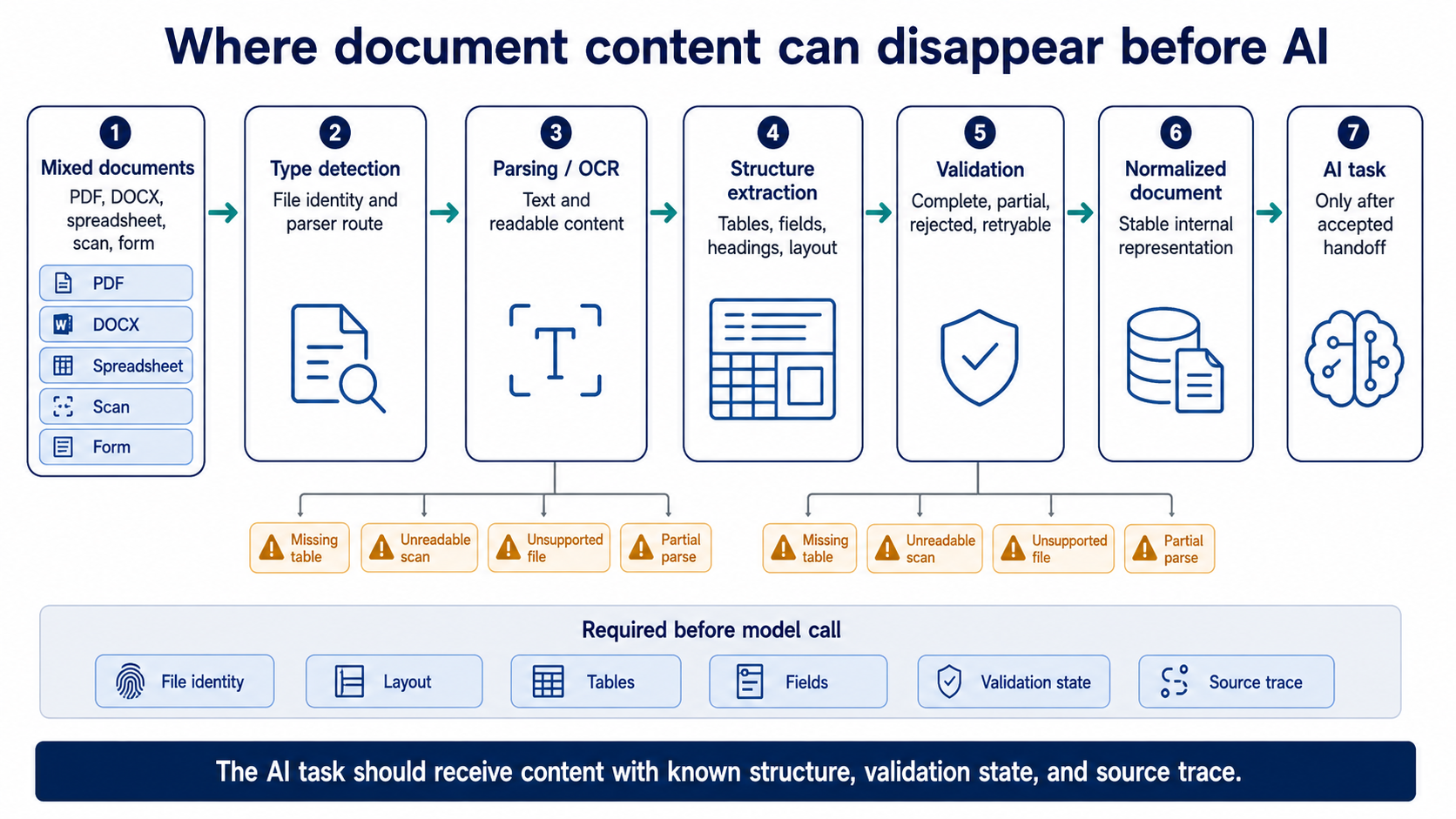
Flat technical pipeline diagram showing where mixed EdTech documents can lose structure or fail validation before reaching an AI task.
Why structure preservation matters for AI output quality
Structure preservation matters because downstream AI often depends on relationships that raw text cannot express reliably. A table value may only make sense under its column header, a checkbox needs its associated label, and a paragraph may inherit meaning from the section heading above it. When extraction preserves those relationships, the application can build prompts, retrieval chunks, and validation rules around explicit document elements instead of guessing from proximity in a flattened string.
This also improves traceability. A normalized document object can carry page numbers, section identifiers, table coordinates, field names, or source spans alongside the extracted content. An answer can then reference the exact source element used, and a reviewer can distinguish an AI reasoning error from a parsing error.
The data-preparation layer is part of the AI feature and deserves its own testable boundary. Bluepes’ AI and ML development services cover the model layer together with data processing and integration, which is the relevant boundary when an AI feature depends on mixed unstructured and semi-structured inputs. The architecture should make the handoff between extraction and model execution explicit enough to test independently.
Where deterministic processing should stay outside the LLM
Deterministic processing should handle checks where the expected outcome is known from file properties, parser output, or product rules. File hashing, duplicate detection, MIME validation, required-field checks, parser error codes, size limits, encryption detection, and version selection do not benefit from probabilistic reasoning. Keeping these controls in ordinary application logic makes failures reproducible and reduces unnecessary model calls.
The LLM becomes useful when the task requires semantic interpretation after the document has passed those gates. Examples include classifying a free-form document whose type cannot be inferred reliably from metadata, summarizing accepted content, extracting a concept that lacks a fixed schema, or answering a question across validated source material. Even then, the application should retain the deterministic evidence that describes what document was analyzed and how it was prepared.
This distinction also helps teams reason about retries. If OCR timed out, retry the extraction job; if normalization rejected a malformed table, route it to the parser or review path; if the model returned an invalid output schema, retry or escalate at the AI layer. The adjacent deterministic EdTech ingestion patterns article applies the same principle to scheduled structured files, while the document pipeline here deals with unstructured and semi-structured content.
How to make document ingestion observable in production
Production observability should let an engineer reconstruct what happened to a document without storing unnecessary copies of the document itself. A useful trace links the upload or source event to the parser selected, parser version, extraction status, validation result, retry history, normalized object version, and downstream AI request. When a user reports a bad answer, that trace narrows the problem to input quality, parsing, normalization, validation, or model behavior.
NIST’s AI Resource Center describes testing, evaluation, verification, and validation as part of operationalizing the AI Risk Management Framework. For document-based AI, that principle starts before the model call: teams need test fixtures for representative files, expected extraction states, regression checks for parser changes, and monitoring for failure classes that increase after deployment. NIST’s AI Resource Center provides the broader TEVV context for those controls.
Logging design also needs a data boundary. A trace can record document IDs, hashes, parser metadata, error codes, page counts, and validation outcomes without copying full sensitive payloads into application logs. When the documents may contain student or institutional data, the existing Bluepes guidance on education data privacy requirements provides the regulatory context for access, retention, sub-processors, and deletion decisions.
Key takeaways
- AI document ingestion should expose file identity, extraction structure, validation state, and source trace before content reaches the model.
- Plain text can preserve words while losing the relationships encoded in tables, fields, headings, pages, and document layout.
- Partial parsing needs its own visible state because a document can appear processed while critical content is missing.
- Deterministic checks such as file validation, deduplication, encryption detection, and parser error handling should stay in application logic.
- Production traces should separate document-processing failures from model failures so teams can debug the correct layer.
Reliable AI starts at the document boundary
A document-based AI feature inherits every mistake made before the model receives its input. If the ingestion layer removes structure, accepts partial extraction as success, or hides parser failures behind one generic status, the AI stage receives a problem it cannot diagnose. Reliable behavior comes from treating document intake as an engineered boundary with explicit stages, validation states, traceability, and failure ownership.
That boundary also keeps the architecture adaptable. Teams can change OCR services, parsers, storage, or models while the application continues to work against a stable normalized document representation and known processing states. The result is easier to test, easier to support, and far easier to investigate when real documents behave differently from the examples used during development.
If your EdTech product is adding AI on top of mixed documents, Bluepes can review the ingestion path, backend processing, validation states, and model handoff as one engineering problem. Discuss software engineering for document-based AI when you need an architecture review before expanding the feature into production.
Summarize with AI
 ChatGPT
 Claude
 Gemini
 Grok
Grok Perplexity
FAQ











Interesting For You



Instructional Orchestration vs. Software Automation in Regulated Education Systems
Instructional orchestration defines how learning sequences, mastery rules, and teacher intervention logic are structured within a digital system. Automation alone does not guarantee pedagogical alignment; orchestration requires mapping educational theory to system behavior. In K–5 and K–12 environments, sequencing logic directly affects learning progression, while in higher education it impacts curriculum pathways and credit logic. This article explains how mastery modeling, teacher override controls, and system constraints intersect in regulated learning environments. It is relevant for instructional designers, academic technology teams, and EdTech product leaders building structured learning systems.
Read article


Education technology pilot strategy for institutional scale
Most EdTech pilots succeed technically and fail institutionally. A platform hits its uptime targets, educators respond positively, integration flows run without errors — and then the renewal review stalls. The reason is almost always the same: the pilot was designed to validate features, not to survive a procurement committee. This article is for IT directors, CTOs, and procurement leads at educational institutions and EdTech vendors who are preparing — or already stuck in — the transition from a controlled pilot to multi-campus or district-wide deployment. Next — you will find a structured framework covering governance ownership, regional compliance requirements, integration durability, and funding transition, with direct comparisons between U.S. and European institutional contexts. An education technology pilot strategy that accounts for renewal criteria from the start reduces friction during expansion reviews. The variables that matter most are not classroom metrics. They are governance continuity, regulatory alignment (FERPA in the U.S., GDPR in the EU), integration capacity at institutional load, and the ability to move from grant-based to operational funding without re-tendering.
Read article

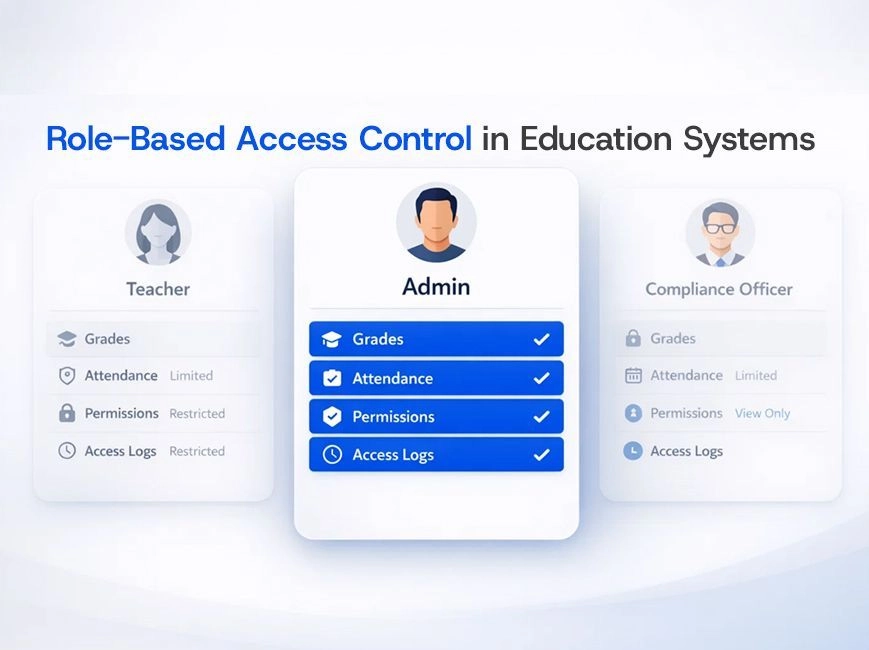
Role-based access control in education systems
Student data visibility is not a configuration choice — it is a governance decision with regulatory consequences. When role-based access control in education systems is designed without clear boundaries, what starts as a flexible pilot setup quickly becomes an audit liability. School districts and institutions reviewing vendor platforms now ask precise questions during procurement: who can see student records, under what permission rules, and what the logs confirm. The access model either answers those questions or it delays the deal. This article is for CTOs, VPs of Engineering, and IT directors building or deploying education platforms who need their permission models to hold up under institutional compliance review. Next — a practical framework for structuring roles, permission matrices, and logging in alignment with FERPA and COPPA requirements. Role-based access control (RBAC) in education systems is a structured permission framework that assigns data visibility and action rights according to instructional, administrative, and governance responsibilities, aligned with regulatory obligations. Getting this architecture right reduces audit exposure, simplifies vendor classification under FERPA, and prevents the informal permission drift that compounds across deployment phases. Teams working through education product development often find that access design is the first question institutional clients raise — before features, pricing, or SLAs.
Read article