


Human-in-the-loop AI in EdTech: where review belongs


The support copilot drafts a reply that a staff member can edit in seconds. The next AI feature can update an authoritative record from the same interface. If both workflows use the same approval rule, one becomes unnecessarily slow while the other receives too little control. Human-in-the-loop AI needs a clearer decision model before product teams wire approval buttons into every workflow.
Human-in-the-loop AI works best when review is assigned by consequence, reversibility, and uncertainty. Low-impact actions that are easy to undo can often run automatically with logging and correction paths. Actions with material downstream effects need a reviewer who can inspect context, change the result, stop execution, or escalate the case.
The engineering question is therefore where human judgement enters the state machine and what authority that person actually has. A credible design defines review states, reviewer permissions, audit events, exception handling, and queue behavior before production traffic arrives. That lets an EdTech team protect higher-risk decisions without turning every suggestion, classification, or draft into a manual bottleneck.
Human-in-the-loop AI starts with action risk
Human-in-the-loop AI is a workflow design in which a person participates at a defined decision point before, during, or after an AI-assisted action. The right position depends on what the action can change and who carries the consequence when it is wrong. NIST calls for policies and procedures that define and differentiate roles and responsibilities for human-AI configurations and oversight, a principle reflected in the NIST AI RMF Core.
Education adds a specific reason to make that choice deliberately because AI can support low-impact internal work as well as decisions that affect people. The UNESCO guidance for generative AI in education and research advocates a human-centred approach that protects human agency. The U.S. Department of Education report on AI and teaching and learning likewise recommends keeping humans in the loop and retaining human judgement and control.
EdTech software development for AI-assisted workflows therefore needs control design around the workflow itself: data access, action boundaries, review states, and downstream system effects. The model may produce a recommendation, while permissions and state transitions determine whether that recommendation becomes an action. Review placement should therefore be specified in architecture and workflow design before implementation.
How consequence, reversibility, and uncertainty set the review level
Three questions usually determine the review level:
- what happens if the output is wrong
- how easily the action can be reversed
- how much uncertainty the system can expose before acting.
This approach gives product teams a practical control model without assuming that every AI feature needs the same approval pattern. It also gives engineering, product, and governance teams a shared basis for discussing where automation should stop.
The table is an engineering decision model rather than a legal classification. For EU deployments, the Artificial Intelligence Act creates additional obligations for systems that fall within its high-risk categories. The current consolidated text lists specific education uses in Annex III, including access or admission, evaluation of learning outcomes, assessment of education level, and monitoring prohibited behavior during tests.
For high-risk systems, Article 14 requires effective human oversight and says the measures should be proportionate to the risk, autonomy, and context of use. The oversight role must also support actions such as disregarding, overriding, or reversing AI output where appropriate. See the EU Artificial Intelligence Act, Article 14 and Annex III.
What makes human review meaningful instead of routine approval
Meaningful review requires a reviewer who can understand the task, see enough context, and genuinely change the outcome. A screen that presents one recommended answer and an obvious Approve button can produce fast throughput while encouraging automation bias. The control exists in the interface, yet the workflow may still behave as though the AI made the decision.
The UK Information Commissioner’s Office gives a useful operational test: reviewers should have appropriate knowledge, experience, authority, and independence to challenge decisions. Its human-review guidance also calls for documented review procedures, manageable working conditions, and logging of challenges or overrides. Check for ICO human review guidance.
A review interface should give the person four capabilities. Each capability should reduce the chance that the reviewer becomes a passive approver. The interface should make these actions available without technical workarounds:
- See the relevant source context and the action the system proposes to take.
- Change, reject, or stop the proposed action without needing a technical workaround.
- Escalate cases that exceed their authority or contain information the workflow cannot resolve.
- Record a reason when the final decision materially differs from the AI output.
Reviewer authority also depends on data access. A staff member cannot meaningfully evaluate a recommendation if permissions hide the information needed to check it, while granting broad access creates its own risk. Bluepes covers that permission model separately in role-based access control in education systems.
If your AI feature already has approval steps but the team cannot explain which actions require them, the workflow needs a risk and state review before more automation is added. Map the consequences, reviewer authority, escalation path, and audit events against the real product flow. Discuss your AI workflow controls.
Design approval, edit, override, and escalation as workflow states
Human oversight becomes implementable when review is represented as explicit workflow states instead of a generic approval checkbox. Each state should define who can enter it, what data the reviewer sees, which transitions are allowed, and what happens to downstream systems. Those rules also give QA a concrete state machine to test before the workflow reaches production.
A common state model starts with an AI proposal and then branches according to risk. The reviewer may confirm the action, edit it before execution, reject it, override the recommendation with a different action, or escalate the case to another role. The final state should remain distinguishable from the original model output so later audits can reconstruct what the machine proposed and what a person decided.
A 2026 EDUCAUSE Review article describes a higher-education advisor pattern in which AI prepares suggested actions and pauses before transactions are finalized. The public example is useful because the pause happens at the transaction boundary, where the workflow can still be stopped or changed.
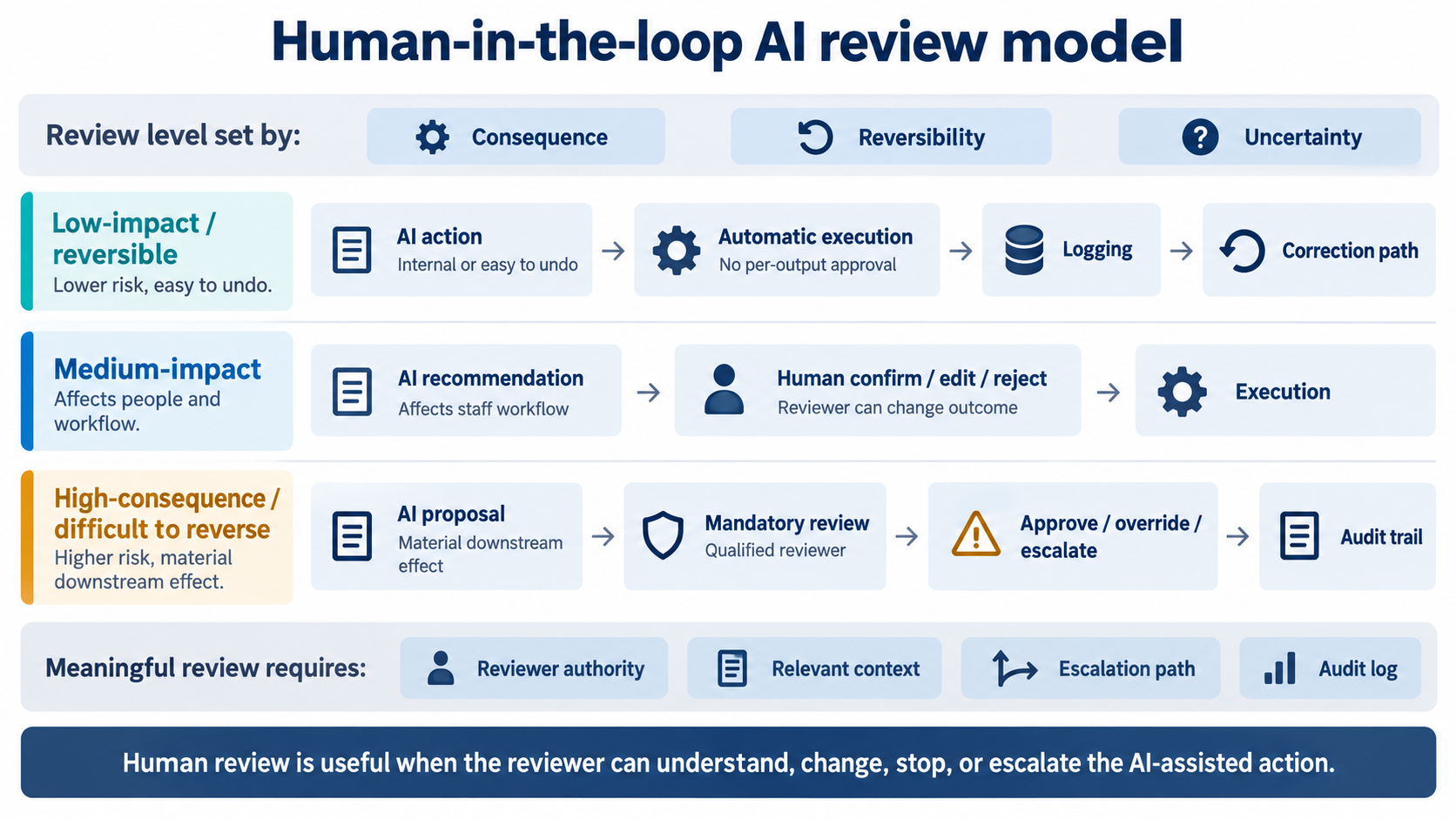
Diagram showing risk-based human review in an EdTech AI workflow, from automatic low-impact actions to approval, override, escalation, and audit trail for higher-risk actions.
How to keep the review queue from becoming the new bottleneck
A review queue stays useful when it receives the cases that genuinely need judgement. Routing every AI output to a person creates repetitive work, increases waiting time, and can train reviewers to approve suggestions mechanically. The queue design should therefore follow the same risk model used to place the review step.
Low-impact actions can use automated execution with logging and a correction path. Moderate-risk workflows can route exceptions or uncertain cases to review while allowing clear cases to proceed under defined rules. Higher-consequence actions can require review every time, with priority based on operational urgency and the ability to pause execution when the queue cannot keep up.
The ICO audit framework explicitly warns that human reviewers need a manageable caseload and enough time to conduct meaningful review. That is an engineering concern as much as a staffing concern because the system controls queue priority, context presentation, handoff, and fallback behavior.
Teams should also review the quality of human decisions. Overrides, re-reviews, escalations, and disagreement patterns can reveal where the AI output is weak, where reviewer guidance is unclear, or where the workflow has assigned the wrong role. Human participation adds a control point, and that control still needs testing.
What an audit trail should record for AI-assisted decisions
A useful audit trail separates the AI proposal, the human action, and the final workflow outcome. If those events collapse into one record, the team loses the ability to reconstruct who changed what and why. That becomes especially costly when a user disputes an outcome, a reviewer needs to revisit a case, or the product team investigates an incident.
For a reviewable workflow, the event record should capture several layers of the decision path. The goal is to reconstruct what the system proposed, what a person changed, and what ultimately happened.
The following fields form a useful minimum:
- A workflow or decision identifier and the action the system proposed.
- References to the source data used for the proposal, without duplicating sensitive payloads unnecessarily.
- The model, prompt, rule, or workflow configuration version needed to reproduce the run.
- The reviewer role and the action taken: approve, edit, reject, override, or escalate.
- A reason or note for material overrides and escalations, plus the final state and timestamps.
Logging should respect data-minimization and access rules. An audit trail needs enough information to reconstruct the decision path, while raw student or staff data should not be copied into logs simply because it is technically available. The same event model can later support incident review, product evaluation, and operational reporting.
NIST places post-deployment monitoring, defined oversight roles, and documented impact management inside the AI risk lifecycle. For systems that affect individuals, a clear escalation or contest path also matters because the product must have somewhere for unresolved cases to go.
When per-output human approval adds friction without useful control
Per-output approval can be unnecessary for low-impact actions that are easy to reverse and remain inside a bounded internal workflow. Examples include drafting an internal summary, applying a search tag, suggesting metadata, or preparing text that a staff member will later use as one input among several. For these cases, logging, monitoring, and a clear correction path can provide more useful control than routine confirmation.
The absence of per-output approval still leaves product ownership, monitoring, and correction responsibilities in place. Teams should define which actions the AI can take, how users correct errors, what gets logged, and which conditions move a case into manual review. That creates a controlled automated path rather than a queue of routine confirmations.
Instructional systems have a separate set of human-control questions when software influences sequencing, mastery logic, or teacher decisions. Those patterns are covered in Bluepes’ article on instructional orchestration in education systems. This article stays with broader AI-assisted operational workflows, where the same core decision remains: place the human at the point where judgement changes the safety or validity of the outcome.
Key takeaways
- Human-in-the-loop AI should assign review according to consequence, reversibility, and uncertainty rather than apply one approval rule to every output.
- Meaningful reviewers need context, authority, time, and a real ability to reject, change, stop, or escalate an AI-assisted action.
- Approval, edit, reject, override, and escalation work best as explicit workflow states with defined permissions and transitions.
- Review queues remain useful when low-impact work can proceed under bounded automation and higher-risk cases receive the available human attention.
- Audit trails should preserve the machine proposal, human decision, final state, and configuration needed to reconstruct what happened.
Human oversight works when control matches consequence
The strongest human-review design starts before the UI team adds an Approve button. Product and engineering teams need to classify the action, decide what the reviewer must know, define the authority to change course, and make the final state auditable. That design lets human judgement remain effective where the consequence warrants it.
For EdTech products, the operating model also has to fit institutional permissions, support capacity, and the legal context of the deployment. Some workflows can remain automated inside clear boundaries, while others need mandatory confirmation and escalation. The architecture should make that distinction explicit rather than leave it to user habit.
Generative AI and LLM development for production workflows can include review-state design, tool boundaries, evaluation, guardrails, and observability when an AI feature operates inside real business processes.
For teams moving from suggestion to action, the useful starting point is a review of action boundaries, reviewer authority, and escalation states. That keeps implementation decisions tied to the actual consequence of the workflow.
Summarize with AI
 ChatGPT
 Claude
 Gemini
 Grok
Grok Perplexity
FAQ











Interesting For You


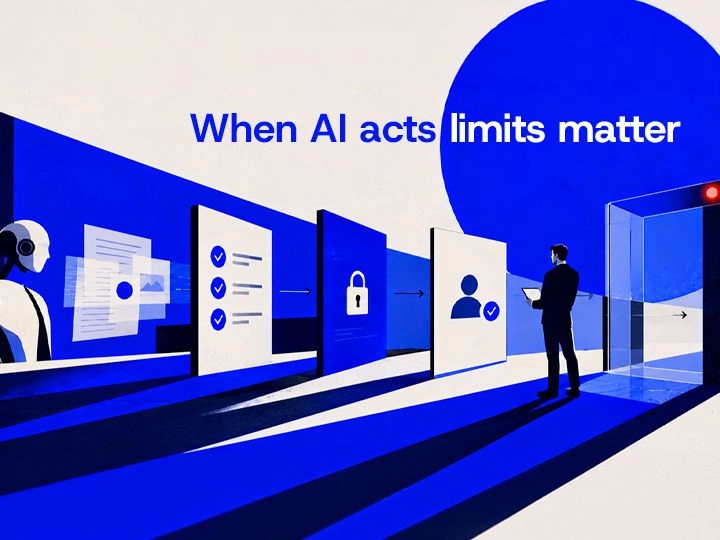
When an AI agent does something it shouldn't: approval gates and blast-radius limits
You can give an agent real authority without betting the business on its judgment. Grant it the minimum tools and access its job needs, require a human to approve anything irreversible, and cap what any single action can touch. Log every action with its reason, so a mistake stays visible and undoable.
Read article

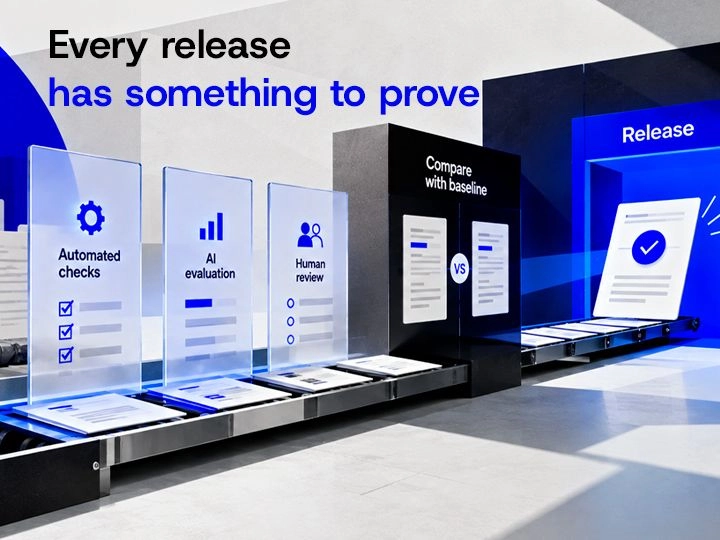
AI testing in EdTech: how to catch regressions before launch
The prompt change fixed the support assistant’s bad answer on Tuesday; by Friday, the same release had broken citation accuracy in cases nobody retested. AI testing in EdTech has to catch that kind of regression before users discover it. A conventional test suite can confirm that APIs return 200 responses and schemas remain valid. The generated answer can still become less accurate, less complete, or less grounded after a model, prompt, retrieval, or data-source change.
Read article

EdTech Data Architecture for AI Across Education Systems
The practical question is therefore wider than “How do we connect the SIS to the LMS?” A CTO or product lead needs to decide which system owns each entity, how standards fit the integration surface, how local mappings are versioned, and what the platform should do when sources disagree. Those decisions determine whether AI receives usable context or merely collects more contradictions.
Read article