


EdTech Data Architecture for AI Across Education Systems


The support assistant says a learner is active, the SIS confirms a current enrollment, the LMS has no matching account, and the CRM still carries last term’s status. The disagreement already existed; the AI simply surfaced it. EdTech data architecture becomes the deciding layer once an AI feature needs context from several institutional systems at the same time. Without clear ownership, identifiers, and update rules, the application can assemble a technically valid prompt from data that describes different versions of the same reality.
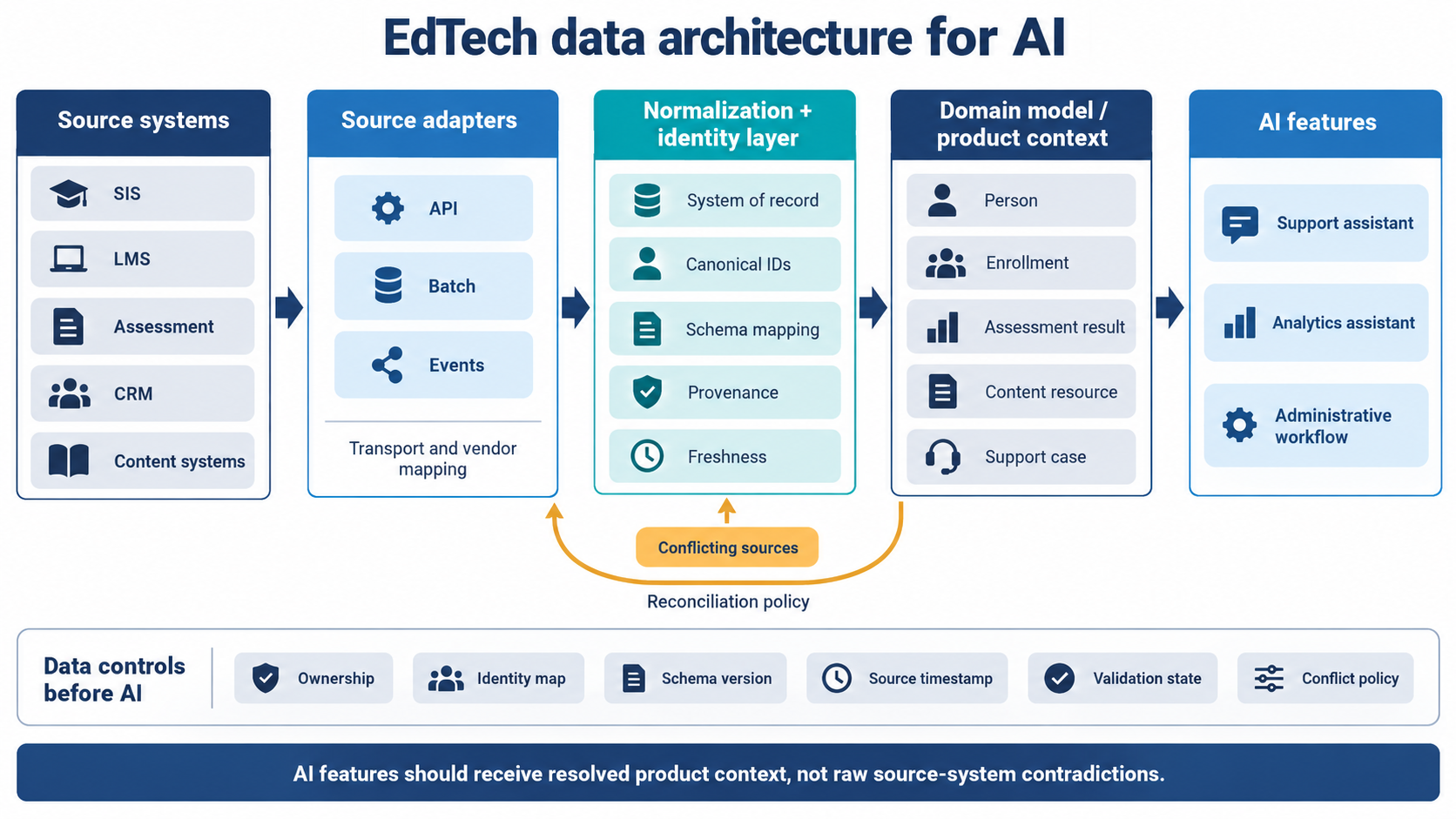
An AI-ready education data architecture gives each important fact an authoritative source, maps source-specific identifiers to stable internal entities, and records where each value came from and when it was last updated. Source adapters can use APIs, scheduled files, or events, while the product and AI layers consume a consistent internal representation. This separation prevents vendor-specific schemas from spreading through business rules and makes stale or conflicting data visible before it reaches a model.
The practical question is therefore wider than “How do we connect the SIS to the LMS?” A CTO or product lead needs to decide which system owns each entity, how standards fit the integration surface, how local mappings are versioned, and what the platform should do when sources disagree. Those decisions determine whether AI receives usable context or merely collects more contradictions.
What makes EdTech data architecture AI-ready?
AI-ready EdTech data architecture provides a controlled path from source systems to a shared product context, with explicit ownership, identity, provenance, and freshness rules. The model or agent sits downstream of those decisions; it should not decide which source is authoritative while generating a response. A useful architecture therefore treats SIS, LMS, assessment, CRM, content, and administrative platforms as independent sources with distinct responsibilities.
This problem has become more visible as institutions test AI across existing technology estates. According to EDUCAUSE Review in 2026, higher-education AI adoption is constrained by data, siloed systems, legacy infrastructure, and governance. The EDUCAUSE analysis of AI in higher education describes data architecture as a central impediment to meaningful AI deployment. That observation matters because an AI feature can only be as current and internally consistent as the systems feeding it.
For Bluepes, this fits the wider EdTech software architecture and integration context: the integration layer has to support both conventional application behavior and AI features. A support assistant may need enrollment status and service history; an analytics assistant may need assessment results and organizational context. The data architecture should supply those facts through controlled interfaces, rather than making every new feature re-implement source-specific logic.
Start by deciding which system owns each fact
A system-of-record map is the first design artifact because the same concept often exists in several platforms with different meanings and update cycles. Enrollment may originate in the SIS, course activity in the LMS, assessment outcomes in a testing platform, and support interactions in the CRM. If the architecture leaves ownership implicit, the team will eventually encode precedence rules inside individual integrations, reports, or prompts, creating several incompatible definitions of “current.”
Ownership needs to be defined at the field or business-concept level rather than only at the application level. A CRM can hold a learner email for communication while the SIS remains authoritative for institutional identity; the LMS can hold a display name without becoming the identity master. The same principle applies to program membership, completion state, accommodations, organization hierarchy, and content metadata. Each downstream consumer should know which value is authoritative, which values are copies, and what freshness window is acceptable for its use case.
A small ownership matrix prevents large integration disputes
The exact source varies by institution and product, so the table is a decision pattern rather than a universal mapping. What matters is making the decision explicit and testable. Once ownership is documented, integration code can enforce the rule consistently and the AI layer can receive a clear provenance marker instead of guessing from timestamps or field names.
How canonical identifiers prevent cross-system identity errors
Canonical identifiers give the product a stable internal way to refer to people, organizations, offerings, content, and assessments while preserving each source system’s local ID. Reusing an email address, display name, or vendor-specific primary key as the cross-system identity creates brittle joins because those values can change or collide. The safer pattern is an internal entity ID plus an identity map that records the corresponding SIS, LMS, CRM, assessment, and content identifiers.
The identity map also needs lifecycle rules. Merged records, re-enrollment, account recreation, institution transfers, and vendor migrations can all produce a new source identifier for an existing real-world entity. A canonical layer should preserve history and record when a mapping became valid, rather than overwrite the old relationship. This becomes especially important for AI features that assemble context over time, because a mistaken identity join can combine data from different people without any model error.
Standards can supply identifiers without replacing local identity design
1EdTech Edu-API defines sourcedId values as interoperability identifiers and expects systems to map local IDs to them. That is useful guidance, yet an institution still needs its own rules for identity lifecycle, duplicates, and authoritative matching across products. The internal canonical ID can align with a standard where that fits the deployment, or it can remain an application-level identifier with standards-specific mappings at the adapter boundary.
If your AI feature already depends on several education systems, map ownership and identity before adding more connectors. Bluepes can review the source boundaries, canonical entities, and integration contracts with your team through software architecture and system integration engineering, so the AI layer starts from data rules the application can actually enforce.
Where education interoperability standards help and where local mapping remains
Education standards reduce the amount of custom vocabulary and transport logic a team has to invent, although they cover different slices of the ecosystem and rarely remove local mapping decisions. The 1EdTech standards catalogue lists Edu-API for exchange between administrative and teaching-and-learning systems, LTI for connecting learning tools with platforms, OneRoster for roster and grade exchange, and QTI for assessment content and results. Choosing a standard should follow the actual data contract rather than a desire to put every integration behind one specification.
A second layer of standardization concerns vocabulary and shared data models. The Common Education Data Standards resources describe CEDS as a common vocabulary and data-model resource for aligning education information across P-20W systems. In K-12, the Ed-Fi Data Standard uses a Unifying Data Model to support interoperability across education systems. These models are valuable reference points when a team defines canonical entities, because they reduce arbitrary naming and expose relationships the product may otherwise model inconsistently.
Standards solve compatibility at defined boundaries
The practical limit appears when a local requirement has no direct standard representation or when two products implement the same standard differently around optional fields and extensions. Ed-Fi documents this tension explicitly: extensibility is necessary in education even though every extension increases integration complexity. Teams should keep those extensions at well-defined boundaries so the common model remains understandable instead of becoming a collection of vendor exceptions.
How to isolate source adapters from AI and business logic
Source adapters should translate vendor or transport specifics into a controlled internal contract before business rules or AI code consume the data. An adapter can read a REST API, scheduled CSV, event stream, or vendor webhook, validate the payload, attach source metadata, and map it into canonical entities. The domain layer then works with concepts such as person, enrollment, organization, assessment result, or content resource without knowing which supplier schema produced them.
This separation also prevents an AI integration from becoming the place where data cleanup happens. Prompt templates, retrieval logic, agents, and model calls should receive structured context that has already passed identity, ownership, and freshness checks. Bluepes describes this wider pattern in applied AI integrated into existing systems: AI features are connected to existing services and permissions rather than treated as isolated demos. The same boundary keeps model changes from forcing a rewrite of SIS or LMS adapters.
Transport is a separate concern from the canonical model. Some institutions can use APIs or events, while others rely on scheduled files; the latter case needs idempotency, validation, and reconciliation. Bluepes covers those mechanics separately in EdTech batch integration architecture. Keeping the transport concern in its own adapter lets the wider data model remain stable when a source later moves from batch export to API access.
What to do when sources disagree or arrive late
Conflicting or stale data needs an explicit policy because silent precedence rules turn integration defects into confident AI answers. The platform should know the source, source timestamp, ingestion timestamp, schema version, and confidence or validation state for each material fact. NIST’s AI RMF Core calls for documenting data availability, representativeness, suitability, and deployment context as part of AI risk management. For an EdTech product, provenance and freshness are practical controls that help the application decide whether context is safe to use.
A useful policy distinguishes disagreement from delay. If the SIS is authoritative for enrollment and the LMS copy is twelve hours behind, the application can use the SIS value while recording the stale secondary record. If two authoritative workflows can legitimately produce competing states, such as an assessment score under review versus a published grade, the domain model needs an explicit state machine or precedence rule. An LLM should never resolve that ambiguity by interpreting whichever text happens to arrive last.
Four failure conditions deserve visible handling because each requires a different operational response:
- Stale source: the value may be valid, but its age exceeds the threshold for the current AI task.
- Conflicting sources: two systems claim different values for the same business fact and the precedence rule cannot resolve them automatically.
- Schema drift: a source changes field names, types, enumerations, or required properties and the adapter no longer maps safely.
- Partial context: one required source is unavailable, so the AI workflow must continue with an explicit limitation, defer, or stop according to product rules.
These states should surface in monitoring and support tooling as integration conditions. Keeping them separate from model-quality defects shortens diagnosis because the team can see whether the model received wrong context, incomplete context, or valid context and still produced a poor answer.
How much normalization is enough?
A canonical model should normalize the concepts the product needs to reason about across systems, while preserving source-specific details that matter for traceability or downstream behavior. Over-normalization creates another problem: the common model becomes so abstract that teams lose useful distinctions between an SIS enrollment, an LMS membership, and a CRM contact relationship. Those records may refer to the same person, yet they represent different operational facts and should remain distinguishable.
The safest design starts from business capabilities and AI use cases, then defines only the shared entities and relationships needed across them. Keep raw source payloads or source-specific extensions where audit, debugging, or future remapping requires them. Version the canonical schema when meaning changes, and make adapters responsible for translating old and new source formats into that versioned contract. This produces enough consistency for cross-system context without pretending that every education platform expresses the same domain semantics.
The architecture should also stay open to additional sources. A product may begin with SIS and LMS context, then add assessment, CRM, content, identity, or analytics data later. If source-specific assumptions remain inside adapters and the canonical model has clear ownership rules, adding a new system becomes a mapping decision rather than a rewrite of every AI feature.
Key takeaways
- AI-ready EdTech data architecture assigns each important fact an authoritative source, stable identity, provenance, and freshness rule before the data reaches a model.
- Canonical identifiers should map local SIS, LMS, CRM, assessment, and content IDs without treating mutable fields such as email or display name as cross-system identity.
- Edu-API, LTI, OneRoster, QTI, CEDS, and Ed-Fi reduce custom interoperability work at defined boundaries, while local ownership and extension rules still require architecture decisions.
- Source adapters should contain transport and vendor-specific mapping so business logic and AI features consume a versioned internal contract.
- Stale, conflicting, drifted, or partial context should produce explicit application states instead of silently becoming AI input.
Reliable AI context starts with explicit data ownership
Connecting more education systems gives an AI feature access to more data, yet value only appears when the application understands what each record means, who owns it, and how current it is. The core architecture work is therefore identity, ownership, normalization, provenance, and reconciliation. Standards help reduce custom integration effort, while the product still needs local decisions for precedence, extensions, timing, and lifecycle.
For CTOs and product teams, this is also a useful boundary for scope. A controlled context layer can support AI without rebuilding every institutional system into one database. It should explain which sources contributed to a decision and stop or degrade safely when those sources are incomplete.
If your team is planning cross-system AI or already debugging contradictory institutional data, review your EdTech data architecture with Bluepes before the model layer absorbs integration logic that belongs elsewhere.
Summarize with AI
 ChatGPT
 Claude
 Gemini
 Grok
Grok Perplexity
FAQ











Interesting For You


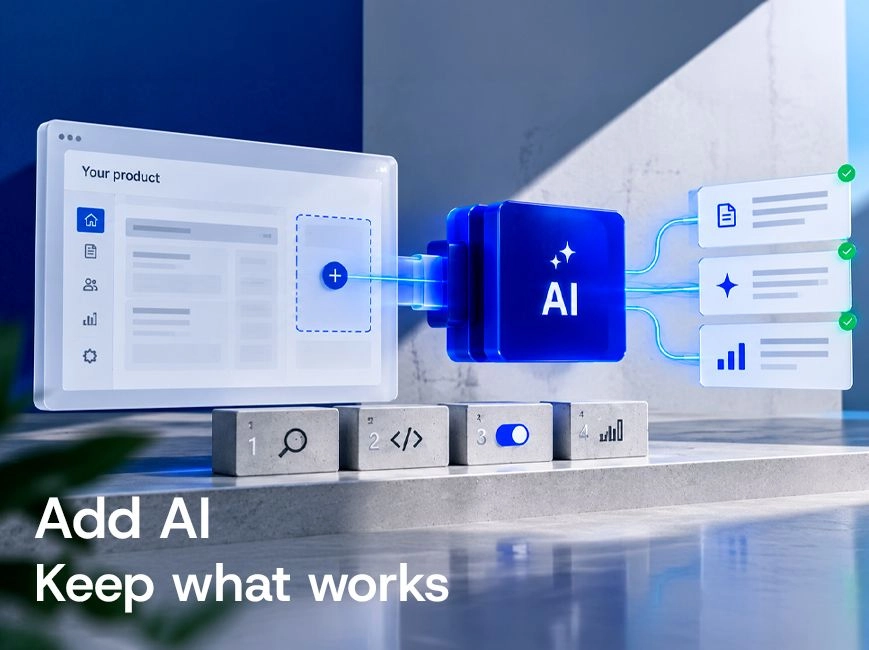
Adding an AI feature to a live product without a rewrite
The pattern below is how experienced engineers move an AI feature from demo into production. It also marks where that path tends to break.
Read article

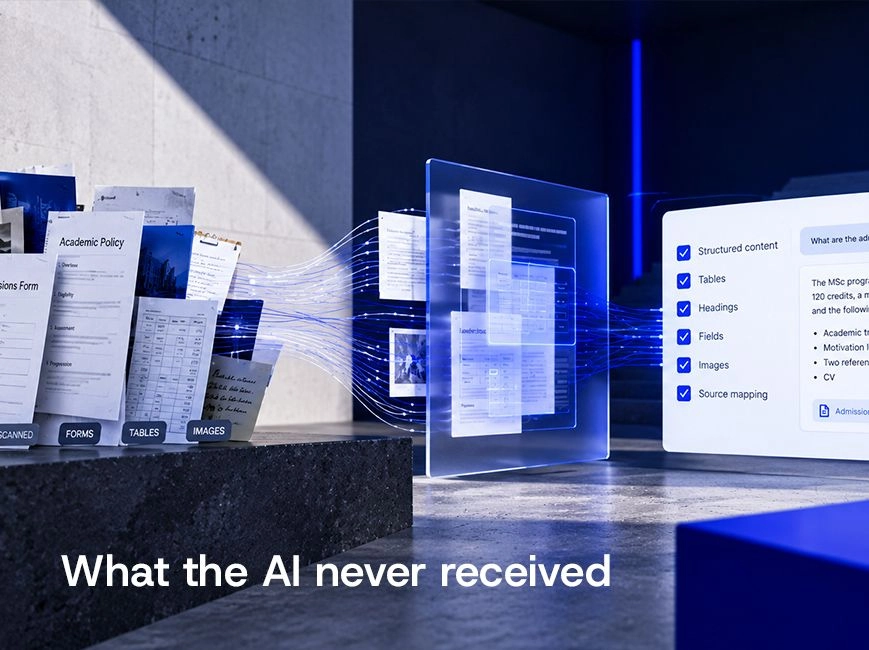
AI document ingestion in EdTech: what breaks first
Education software receives institutional policies, faculty handbooks, admissions records, support knowledge, assessment material, administrative forms, and user-uploaded files. The key engineering questions are where structure can be lost, which failures should stop processing, and which checks belong in deterministic code before an LLM is called. Those decisions determine whether the feature remains debuggable when clean demo files give way to real inputs.
Read article


Why Most EdTech Pilots Fail: Designing a Contained Learning Path Pilot in Regulated Education
A contained learning path pilot is a structured, limited-scope validation phase designed to test instructional logic, sequencing rules, and mastery criteria without building a full production system. In K–5, K–12, and higher education environments, pilot containment reduces instructional and technical risk while preserving architectural clarity for future scaling. Overextending early pilots often increases adoption friction and governance complexity. This article explains how to define pilot scope, isolate variables, and align validation metrics with long-term system strategy. It is relevant for school leaders, EdTech founders, curriculum architects, and technology directors evaluating instructional pilots.
Read article