


AI testing in EdTech: how to catch regressions before launch


The prompt change fixed the support assistant’s bad answer on Tuesday; by Friday, the same release had broken citation accuracy in cases nobody retested. AI testing in EdTech has to catch that kind of regression before users discover it. A conventional test suite can confirm that APIs return 200 responses and schemas remain valid. The generated answer can still become less accurate, less complete, or less grounded after a model, prompt, retrieval, or data-source change.
A production AI feature therefore needs a repeatable evaluation set, task-specific acceptance criteria, and a baseline that every meaningful change is tested against. Deterministic checks should verify what software can judge exactly, while qualitative evaluators and human reviewers cover output quality that cannot be reduced to a single assertion. The release decision should also record which model, prompt, retrieval configuration, and data-pipeline version produced the result.
For a CTO or product lead, the useful question is whether the team can explain why a new AI build is safe to release and which cases became better or worse. The framework below covers evaluation datasets, metrics, regression checks, failure diagnosis, human review, and the release gate that connects pre-production testing to production monitoring.
What AI testing in EdTech has to measure before release
AI testing in EdTech has to measure the behavior of the complete feature under realistic conditions, including the deterministic application layers and the probabilistic AI output. The test target may include input processing, retrieval, the model response, output parsing, business rules, and escalation behavior. Testing only the final text mixes several failure sources together.
NIST’s AI Risk Management Framework makes this lifecycle view explicit. Its Measure function calls for documented test sets and metrics, evaluation under conditions similar to deployment, regular assessment, and production monitoring. It also recommends tracking performance improvements or declines over time, which is why a release baseline matters. The detailed requirements are in the AI RMF Measure function.
The higher-education context adds a concrete reason to formalize this work. In EDUCAUSE’s 2026 report on AI and work in higher education, 41% of respondents selected inability to evaluate AI-generated content as an urgent risk. Institutions therefore need a repeatable way to distinguish fluent output from output that satisfies the task. The market context is documented in the EDUCAUSE 2026 report on AI work in higher education. Bluepes also describes evaluation sets and regression checks within its AI and LLM development with evaluation service.
How to build an evaluation set that reflects real use
A useful evaluation set represents the product’s actual tasks, known failures, difficult inputs, and expected refusal or escalation cases. It should be stable enough to compare releases while still growing when production reveals a new failure mode. Random prompt collections are weak baselines because they rarely encode acceptable product behavior.
Google’s current evaluation guidance recommends defining criteria around desired behavior and failure cases, then building datasets that include normal use, edge cases, and adversarial examples. It also separates regression sets, which protect existing quality, from challenge sets that target areas the team wants to improve. A release can pass the regression suite while still carrying open challenge cases for later work. Google documents this approach in its evaluation best practices.
In EdTech, representative does not mean copying production records into a test repository. A support copilot can be tested with synthetic or de-identified cases that preserve the decision pattern without retaining unnecessary student identifiers. If evaluation data contains education records or institutional data, the test repository should follow the product’s access, retention, and deletion boundaries. The relevant data-handling constraints are covered in Bluepes’ education data privacy requirements article.
A practical evaluation set usually contains:
- Baseline cases that represent the common product path and should remain stable across releases.
- Known failure cases captured from QA, support, or controlled testing after the underlying data has been made suitable for reuse.
- Edge cases with incomplete, conflicting, unusually long, or ambiguous input.
- Safety and refusal cases where the correct behavior is to decline, constrain, or escalate the request.
- Challenge cases that target a quality area the team is actively trying to improve.
Which metrics belong to which AI task
The right metric depends on the task, because correctness for classification is different from quality for summarization or grounded answers. Teams should prefer exact checks where a requirement is binary and use qualitative scoring only where the requirement genuinely depends on language quality, context, or judgement. One aggregate score can hide the failure category engineers need to fix.
Microsoft Foundry reflects this mixed evaluation model in current tooling: teams can run evaluations over model, agent, dataset, or trace targets with built-in or custom evaluators, then compare runs. Its comparison view can flag statistically significant improvement or degradation across evaluation runs. Microsoft documents the workflow in its generative AI evaluation documentation.
If your AI feature still relies on manual spot checks before release, the next useful step is to turn real product failures into a repeatable evaluation baseline. Bluepes can review the test set, acceptance criteria, and release checks with your engineering and QA team. Discuss an AI evaluation setup.
How regression testing catches quality loss after AI changes
Regression testing catches quality loss by running the same controlled cases against the old and new AI configurations, then comparing the results by metric and failure category. The comparison has to include the configuration that generated each result: model identifier, prompt version, retrieval configuration, parser or data-pipeline version, tool definitions, and output schema. Without those records, a failed case tells the team that something changed but not where to look.
The release baseline should also separate intentional behavior changes from accidental degradation. A stricter refusal rule may lower completion rate while improving safety, and a retrieval change may improve citation accuracy while increasing latency. Those trade-offs need explicit acceptance criteria instead of a blanket requirement that every metric improves. Bluepes can support this release discipline through QA specialists for regression and release testing.
A useful release report therefore groups regressions by cause and business impact. A failed citation format carries a different risk from a factual contradiction or a permission breach. Teams should make the release decision from that distribution of failures instead of averaging all cases into one score.
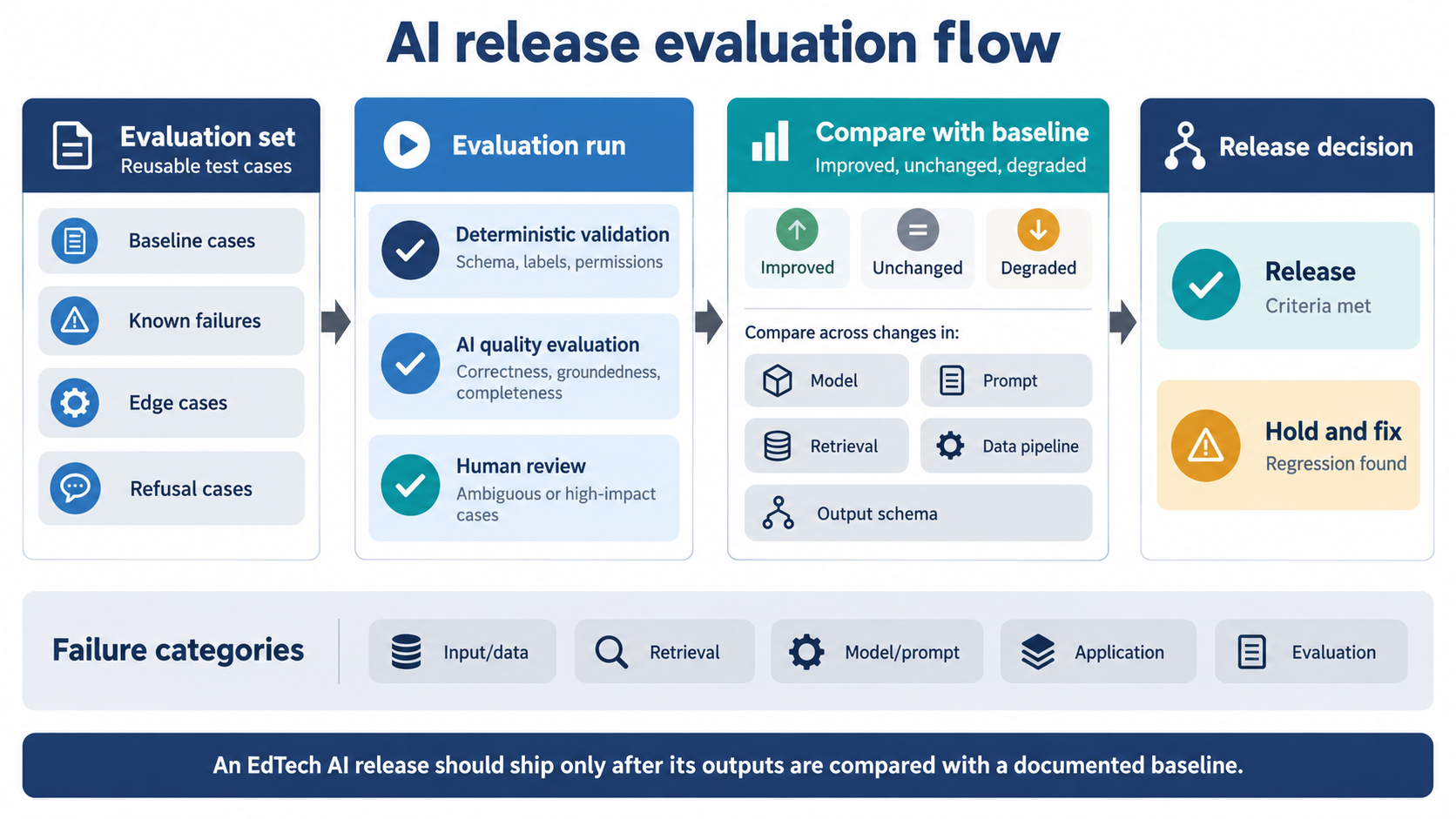
Diagram showing an EdTech AI release evaluation flow from a reusable test set through deterministic validation, AI quality evaluation, human review, baseline comparison, and release decision.
How to separate model failures from data and application failures
A bad AI result should be traced through the pipeline before the team classifies it as a model failure. The same incorrect answer can start with missing input, stale retrieval, a prompt regression, tool failure, malformed output parsing, or the model itself. Treating all of those as one “AI quality” bucket leads to expensive model changes that leave the actual defect untouched.
The evaluation harness should therefore capture intermediate evidence where the architecture allows it. For a retrieval-based assistant, retain the retrieval outcome or reference IDs used by the test run. For classification, keep the normalized input and parsed output; for an agent, record tool selection separately from the final response. Sensitive payloads should be minimized or masked according to the product’s data policy.
A simple failure taxonomy keeps triage actionable:
- Input/data failure: required context is missing, stale, malformed, or incorrectly normalized.
- Retrieval failure: the system fetched the wrong source, missed the right source, or applied the wrong access boundary.
- Model/prompt failure: the supplied context is adequate, but the generated output misses the task requirement.
- Application failure: parsing, schema handling, tool orchestration, permissions, or downstream logic changes the correct model output into an incorrect product result.
- Evaluation failure: the metric or judge rewards the wrong behavior, so the test itself gives a misleading pass or fail signal.
This separation also clarifies what belongs in continuous integration. Schema validation, allowed labels, permission checks, and deterministic transformations can fail a build immediately. Qualitative scores may use thresholds or review queues because the outputs have legitimate variation.
Where automated evaluators stop being enough
Automated evaluators are useful when they measure a clearly defined criterion consistently, but some product decisions still need human review. Human reviewers are especially useful for ambiguous cases, domain-sensitive wording, disputes between automated signals, and situations where a model judge cannot reliably distinguish a technically correct answer from a contextually appropriate one. The goal is to reserve expert time for cases where it adds information that automated checks cannot provide.
Amazon Bedrock’s current evaluation tooling illustrates the mix. Teams can provide custom prompt datasets, run automatic evaluations, use an LLM as a judge, evaluate RAG systems, or bring human workers into model evaluation. Several modes are useful because one evaluator type rarely covers every product requirement. AWS documents the available modes in Amazon Bedrock model evaluation.
Human review also needs its own acceptance instructions. Reviewers should know what each rating means, which evidence they may use, how to handle uncertainty, and when to escalate. Otherwise the team replaces model variability with reviewer variability and still cannot compare releases reliably.
What a production AI release gate should contain
A production AI release gate should combine deterministic software checks, AI evaluation results, known-risk review, and an explicit decision rule. The gate should state which regressions block release, which deviations are acceptable, and which unresolved cases can move into monitored production with an owner. A dashboard full of scores is useful only when someone has defined what those scores mean for release. For education products, this sits inside the wider EdTech software engineering context, where AI features coexist with integration, access, and institutional constraints.
The final pre-production run should use the intended model and configuration in conditions close to deployment, matching NIST’s recommendation to evaluate AI systems under deployment-like conditions. It should also include stress or adversarial cases for known failure modes, with coverage derived from the product’s actual risk profile.
Release does not end evaluation. The same baseline and failure taxonomy should continue into production monitoring so field reports can become new regression cases. This creates a controlled feedback loop. A production failure becomes a sanitized regression case, and the next release is measured against the full baseline.
Key takeaways
- AI testing in EdTech needs a stable evaluation set that represents common use, edge cases, known failures, refusal cases, and targeted challenge cases.
- Task-specific metrics are more useful than one aggregate quality score because classification, summarization, grounded answers, and drafting fail in different ways.
- Every evaluation run should record model, prompt, retrieval, data-pipeline, and output-schema versions so regressions can be traced to a change.
- Failure triage should separate data, retrieval, model, application, and evaluation defects before the team changes the model or prompt.
- Human review belongs where automated checks cannot judge ambiguity, domain context, or consequence reliably, while deterministic checks should remain automated.
A release decision needs evidence that survives the next model change
An AI feature is ready for production when the team can reproduce its evaluation, explain the acceptance criteria, and show how the proposed build compares with the baseline. That standard turns AI quality into an engineering artifact that product, QA, and technical leadership can review together. It also gives the team a way to respond when a future model or retrieval change shifts behavior without changing the surrounding application code.
The useful operating model is simple: preserve a representative baseline, make metrics task-specific, classify failures by source, and carry production failures back into the regression suite. Generative systems still carry uncertainty; this approach gives the organization a documented basis for deciding what can ship and what still needs work.
A short external review can help when the team has a working prototype but no agreed release baseline.
Review your AI testing and release criteria with Bluepes. The goal is a test system your QA and engineering teams can keep using after the initial launch.
Summarize with AI
 ChatGPT
 Claude
 Gemini
 Grok
Grok Perplexity
FAQ











Interesting For You



Confident, wrong answers: fixing retrieval before you blame the model
A wrong answer from an AI assistant would be easy to catch if it looked unsure, and it never does. Three colleagues forward the same screenshot: the internal assistant answered a policy question with complete confidence, and it was wrong. After a few of those, people stop asking it and go back to messaging each other.
Read article


EdTech Data Architecture for AI Across Education Systems
The practical question is therefore wider than “How do we connect the SIS to the LMS?” A CTO or product lead needs to decide which system owns each entity, how standards fit the integration surface, how local mappings are versioned, and what the platform should do when sources disagree. Those decisions determine whether AI receives usable context or merely collects more contradictions.
Read article


Adding an AI feature to a live product without a rewrite
The pattern below is how experienced engineers move an AI feature from demo into production. It also marks where that path tends to break.
Read article