


Product bundle pricing: snapshotting and vendor rules


On one marketplace we built, packaged products account for 80 to 85% of total sales. At that share, product bundle pricing is the core of how the business sells, well past the point of a merchandising experiment. Most writing on the topic is aimed at marketers — discount math, perceived value, anchor pricing — and that side matters. On a multi-vendor marketplace, the part that decides whether bundles work is the architecture underneath them.
Product bundle pricing is the practice of selling several products together as one priced unit, usually below the sum of the parts. Building it well on a marketplace means deciding who can create bundles, which vendors may sell them, how their price stays consistent, and how an order preserves what a customer actually bought when the bundle changes later. Those decisions shape whether a platform succeeds or slowly accumulates broken data, more than the size of the discount does.
This piece is written for both sides of that conversation: the product or marketing lead deciding whether to add bundles, and the engineer who has to build them without breaking historical orders or constraining vendors. It draws on a marketplace where packages drive most of the revenue, and it covers the rules, the pricing models, and the one engineering choice — snapshotting — that quietly determines whether your order history stays honest.
What bundle pricing is, and the models you can choose
Bundle pricing sells several products together as one priced unit, usually for less than the parts would cost separately, and the first real decision is how that price is set. Commerce platforms model a bundle as a composite product made of component products, with two common pricing models. A fixed price gives the bundle its own number, independent of the components. A dynamic price derives from the selected components, optionally discounted.
Adobe Commerce documents both directly: with bundle pricing set to fixed or dynamic, a fixed bundle carries its own catalog price, while a dynamic bundle has no price of its own and is calculated from the items inside it. The choice is not cosmetic — it changes how you advertise the price and how the price behaves when component costs move.
Why a marketplace makes bundle pricing harder
On a single-seller store, a bundle is mostly a catalog feature: create the composite product, set the price, publish. On a marketplace with many vendors, the same feature raises governance questions a single store never has to answer. Who is allowed to create a bundle? Which vendors can sell it? If two vendors list the same package, may they price it differently?
Platforms represent bundles as composite products in slightly different ways — Shopify, for instance, extends its product and variant model to handle them — but none of them resolves the multi-vendor governance questions, because a single store has no competing sellers. This is part of why teams outgrow generic bundle features: the decision of when to move from a plugin to a purpose-built platform often turns on exactly these rules that off-the-shelf bundling does not cover.
The marketplace rules: who creates, who sells, what price
The governance comes down to a few rules you set on purpose, before the first bundle ships. On the marketplace we built, these were deliberate choices rather than platform defaults:
Automatic price propagation is the rule platforms handle most differently. On the marketplace we built, an admin changes a package price once and every vendor’s listing updates. Some platforms do the opposite by default: with Shopify’s native bundles, a change to a component’s price does not update the bundle’s price, which has to be edited by hand. Neither is wrong, but a marketplace selling one package across many vendors usually wants a single price that moves everywhere at once.
If bundles are becoming a real share of your revenue and your catalog was built for single products, these rules are easier to get right before launch than to retrofit. Our e-commerce engineering team has built marketplace bundle systems with centralized pricing and clean vendor controls, and can map the rules to your platform.
Snapshotting: the engineering choice that keeps history honest
The single most important engineering decision in bundle pricing is to snapshot the bundle into the order at the moment it is placed. When a customer buys a package, copy its definition and price into the order line right then, instead of pointing the order at the package record that lives in the catalog.
The reason becomes obvious the first time an admin edits a package. If the order holds a live reference, changing the package’s price or swapping a component silently rewrites what every past order appears to contain, and last quarter’s numbers stop matching what customers paid. A snapshot makes the order a record of what happened, which is the same principle behind event sourcing: history is an append-only set of facts, not a live projection that mutates when the present changes.
A useful order snapshot captures, at minimum:
- the bundle’s component list as it was at the time of purchase
- the quantity of each component
- the price charged for the bundle
- any per-component price allocation needed for tax, refunds, or accounting
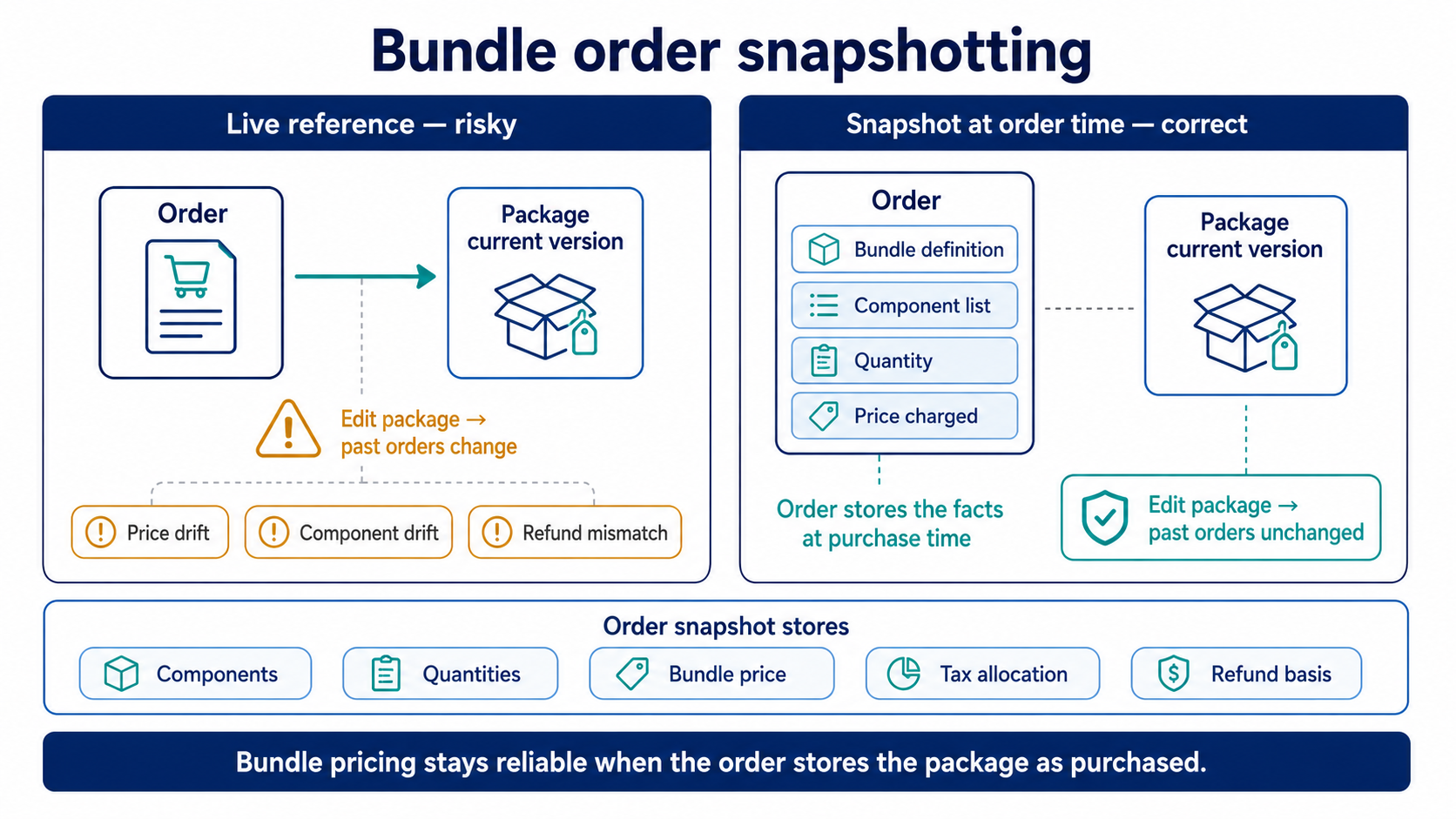
Bundle orders should store the package definition and price at order creation, so later catalogue edits do not change historical orders.
Skipping this is a quiet failure mode. Everything works in the demo, and the problem only surfaces months later, when someone edits a popular package and finance asks why historical revenue shifted. Designing the snapshot in from the start costs little; adding it after the data has drifted means reconstructing what orders should have said.
Cart rules and flow compatibility
A package and a standalone product do not share a cart cleanly, so most marketplaces keep them apart. The marketplace we built enforces a simple rule: a cart holds either package products or normal products, not a mix. Combining them turns ordinary operations into edge cases:
- pricing becomes ambiguous when a fixed-price package sits beside individually priced items
- fulfillment can split, since a package may ship as a unit while loose items ship separately
- returns get messy when a customer wants to send back one item from a package
- discount attribution blurs across the package boundary
Most multi-vendor e-commerce platforms accept that slightly more restrictive checkout in exchange for predictable pricing and fulfillment. Bundles also interact with preorder and group-buying flows, where the timing of payment and the cart rules combine in their own ways — those are subjects in their own right, covered in upcoming pieces.
Is bundle pricing illegal?
Generally, no. The legal concern attached to bundling is tying, which the FTC describes as conditioning the sale of one product on the purchase of another; it can raise antitrust issues when the seller has market power in the first product, and courts increasingly judge it case by case under a rule-of-reason analysis. An ordinary discounted bundle that customers can still decline is a long way from that. Bluepes is not a legal advisor, so treat this as orientation rather than advice, and consult counsel for any specific concern.
Key takeaways
- On a marketplace where bundles drive a large share of sales, product bundle pricing is an architecture decision, not only a merchandising one.
- Choose a pricing model deliberately: a fixed bundle price stays stable and advertisable, while a dynamic price tracks its components.
- Set the marketplace rules up front — who creates bundles, who sells them, one consistent price, and how price changes propagate.
- Snapshot the bundle’s definition and price into the order at creation, so editing the bundle later never changes what past customers bought.
- Keep packages and standalone products in separate carts to avoid pricing, fulfillment, and return edge cases.
Designing bundles so the order history never lies
Bundle pricing earns its place when it is built as architecture rather than bolted onto a single-product catalog. Pick a pricing model that matches whether the bundle is curated or configurable. Set the marketplace rules — creation, selling rights, one consistent price, and propagation — before launch. And snapshot every bundle into its order, because the marketing upside of bundles driving most of your sales only holds if the data underneath stays accurate. The platforms that struggle are usually the ones that got the discount right and the history wrong.
If you are adding bundles to a marketplace and want the pricing rules and the order model designed together, a short scoping conversation will save a painful migration later. Talk through your bundle architecture.
Summarize with AI
 ChatGPT
 Claude
 Gemini
 Grok
Grok Perplexity
FAQ











Interesting For You



Peppol e-invoicing for B2B platforms: the architecture
This is an integration walkthrough, vendor-neutral by design, written for teams that need to understand how Peppol fits their platform without becoming Peppol specialists. The reference points come from a Norwegian marketplace whose chain customers are invoiced over EHF, the local Peppol format, with each invoice handed off to downstream accounting. By the end you should know what a Peppol-ready invoice flow involves and which decisions are yours to make.
Read article


Code freeze: release management for seasonal peaks
Two things tend to surprise teams new to this. First, for a seasonal business the freeze rarely fits in a long weekend around Black Friday; it can run for months, as long as the peak itself. Second, the freeze reshapes the roadmap, because anything large has to land before it starts. The examples here come from a seasonal firewood marketplace whose peak runs through autumn and winter, with the rest of the year reserved for the bigger work.
Read article


Dynamic route optimization when indexes aren't enough
This is an engineering case rather than a tutorial. It draws on a Norwegian firewood-delivery marketplace where route recalculation dropped from five-to-seven seconds to under one, and a multi-condition availability query fell from three-to-five seconds to about one. The numbers matter less than the reasoning behind them: how to tell when the answer is a better algorithm, when it is caching, and when it is simplifying the work itself.
Read article