


Marketplace plugin vs purpose-built platform: when to move


The plugin took three months to launch the marketplace. Eighteen months later, the same team spends most sprints patching it. Vendors miss orders no one can reproduce in staging. Multi-currency payouts need manual corrections every cycle. Engineering and vendor support point at each other, and the team cannot tell whether the problem is the plugin's limit or how it was configured. The question on the table is whether to migrate to a purpose-built platform — and whether that decision is architectural necessity or sales pressure from migration agencies.
Marketplace plugin vs purpose-built platform is not a feature comparison. A plugin is an adapter over someone else's commerce architecture. At low volume the adapter holds. As the operating model grows — multi-jurisdiction payouts, custom routing, per-vendor pricing and inventory variation — the gap between what the plugin allows and what the business needs widens into operational cost. At that point the architecture decides the next eighteen months of the business, not the feature roadmap.
What follows are the three patterns where plugins typically become the ceiling, a comparison of plugin-on-SaaS, headless commerce, and purpose-built platforms, a five-question diagnostic to apply to a specific marketplace, and an honest account of what migration actually costs.
Why the plugin works at launch — and why it stops
A plugin works at launch because it externalises nearly every architectural decision. The operator chooses categories, themes, and basic payout rules; the plugin vendor owns the runtime, the data model, the integration surface, and how the system fails. That is a fair trade at zero to dozens of vendors, where the operator's bandwidth belongs to product-market fit, not architecture.
The ceiling appears later, when the operating model starts needing decisions the plugin was not designed to expose. Three things usually go wrong at once:
- The plugin treats operational edge cases as configuration. Edge cases stop being rare when the marketplace adds vendors, currencies, or fulfilment paths.
- Debugging is limited to what the plugin's logs expose. A vendor reports a missing order; the team can confirm that the order was submitted and acknowledged, but not what the plugin did between those two states.
- The integration surface is set by the plugin vendor. The marketplace's billing system, CRM, and BI stack have to fit what the plugin can emit, not the other way around. Adjacent failure patterns appear in silent ERP integration failures in e-commerce — same root mechanism, different surface.
That last point is usually where operating cost compounds. Once reconciliation, vendor reporting, and BI all bend to the plugin's data shape, the cost of switching grows every quarter, even before the classic break points hit.
Where plugins break first: three architectural patterns
Three patterns predict where plugin-based marketplaces hit the ceiling. Each follows the same shape — what the business is trying to do, what the plugin allows, where the gap surfaces in daily operations.
Vendor payouts across jurisdictions
Payout logic is usually the first system to fail at scale because it accumulates jurisdiction-by-jurisdiction complexity that plugins were not built to model. A single-currency, single-jurisdiction payout cycle runs cleanly inside most plugins: vendor X is owed Y, dispatched on a schedule.
The model breaks once the marketplace adds multi-currency, partial refunds, VAT regimes that differ by country, and order-level splits where a single refund touches three vendors at different rates. A partial refund on a multi-vendor order in a different currency than the original transaction now requires logic the plugin does not expose, so the operations team reconciles in a spreadsheet every cycle.
The cost is not the spreadsheet. The cost is that the spreadsheet becomes the system of record. Audit, finance reporting, and vendor disputes all eventually depend on it, and the plugin stops being the source of truth for the financial side of the marketplace.
Custom order routing logic
Order routing breaks at the point where the marketplace needs rule-based assignment instead of round-robin or random.
Plugins typically support simple routing strategies — assign to a randomly selected vendor, or rotate. That works while every vendor in a category is interchangeable. It stops working when routing depends on per-vendor inventory (vendor A has the SKU today, vendor B does not), geography (assign to the supplier nearest the buyer), or capacity (vendor X is at fulfilment capacity for the day).
Geo-based or capacity-based routing usually requires the marketplace to own routing logic outright, not configure it. Plugins expose configuration; what is needed is code. The Kortreistved firewood platform routes orders to the supplier nearest the buyer's address — architecturally simple, but workable only because routing lives inside the platform code, not inside a plugin settings panel.
Per-vendor product variations
Plugins model products as shared objects with vendor-level overrides; mature marketplaces eventually need each vendor to own its own product instance.
Inside a plugin, a product is typically a global object. Vendors can override price, stock level, sometimes delivery window. That model collapses the moment the same product needs to behave differently per vendor — different availability windows, different fulfilment SLAs, different return policies, different bundled options. Marketplaces working with perishable, regulated, geographically constrained, or luxury inventory tend to hit this first.
The workaround is duplication: create the same product five times, one per vendor. The operational consequence is catalogue drift. Within a year, the five duplicates have diverged in title, description, and image, and search results show all five variants competing with each other.
If the team is already running spreadsheet workarounds for payouts, manual routing fixes, or catalogue duplication to handle per-vendor variation, the plugin is no longer the launch advantage it was — it has become an operating cost. A short call with an engineering team that has built marketplaces from architecture up, rather than retrofitted plugins, is usually faster than another round of patching. Discuss your marketplace architecture.
Plugin, headless, or purpose-built: what breaks first under load
Three architecture choices dominate the marketplace conversation, and the useful question is not which is "best" — it is which fails first against a given operating model.
Plugin-on-SaaS keeps every commerce decision inside a host platform's plugin contract. Headless commerce decouples the storefront from the commerce engine, giving the operator control over the front end while leaving most commerce logic in the SaaS engine. Purpose-built platforms own both — storefront, commerce logic, data model, routing, payouts, vendor model.
The MACH Alliance, a vendor-neutral industry body, defines composable commerce as an architectural approach where each commerce capability is replaceable. commercetools, one of the early reference implementations, distinguishes the layers cleanly: headless decouples presentation from commerce logic; composable commerce makes each capability independently replaceable. For marketplaces, the relevant difference is how much of the multi-vendor model the operator wants to own.
The integration layer that connects any of these architectures to ERP, payments, and BI is its own discipline; the patterns are covered in e-commerce integration architecture across ERP, marketplaces and payments.
The pattern reads cleanly. Plugin-on-SaaS optimises for time-to-launch. Purpose-built optimises for operating cost at scale. Headless is the middle path for operators who need frontend control but not full model ownership. The choice depends less on technical preference than on which dimension is already the daily constraint.
Five questions that show the plugin is the ceiling
A short diagnostic is usually more useful than feature comparison because it forces the team to look at what is happening operationally, not what the plugin documentation claims. Apply these five questions to the marketplace as it operates today, not as it ran a year ago.
- Are vendors reporting missing or mis-routed orders that the team cannot reproduce in staging? This usually means the plugin's routing is operating in a state the team cannot inspect.
- Does the payout cycle require manual corrections every period? One-off corrections are normal. Every cycle is structural.
- Are critical operational workflows — vendor onboarding, reconciliation, custom payouts — living in spreadsheets outside the platform? Spreadsheets-as-system-of-record is a strong signal that the platform's data model no longer fits the operation.
- Is the catalogue growing through duplication rather than per-vendor variation of the same product? Duplication is a workaround for plugin limits on the product model.
- When something breaks, can the team see what the plugin did, or only what it returned? A limited debugging surface multiplies the cost of every incident.
Two or more "yes" answers means the plugin is already operating as a ceiling. That alone does not automatically justify migration — it does mean that the operational cost of staying is no longer trivial, and the migration question is now real engineering, not vendor narrative.
When a plugin is still the right choice
A plugin remains the right architecture under three specific conditions, even when migration sales pressure suggests otherwise.
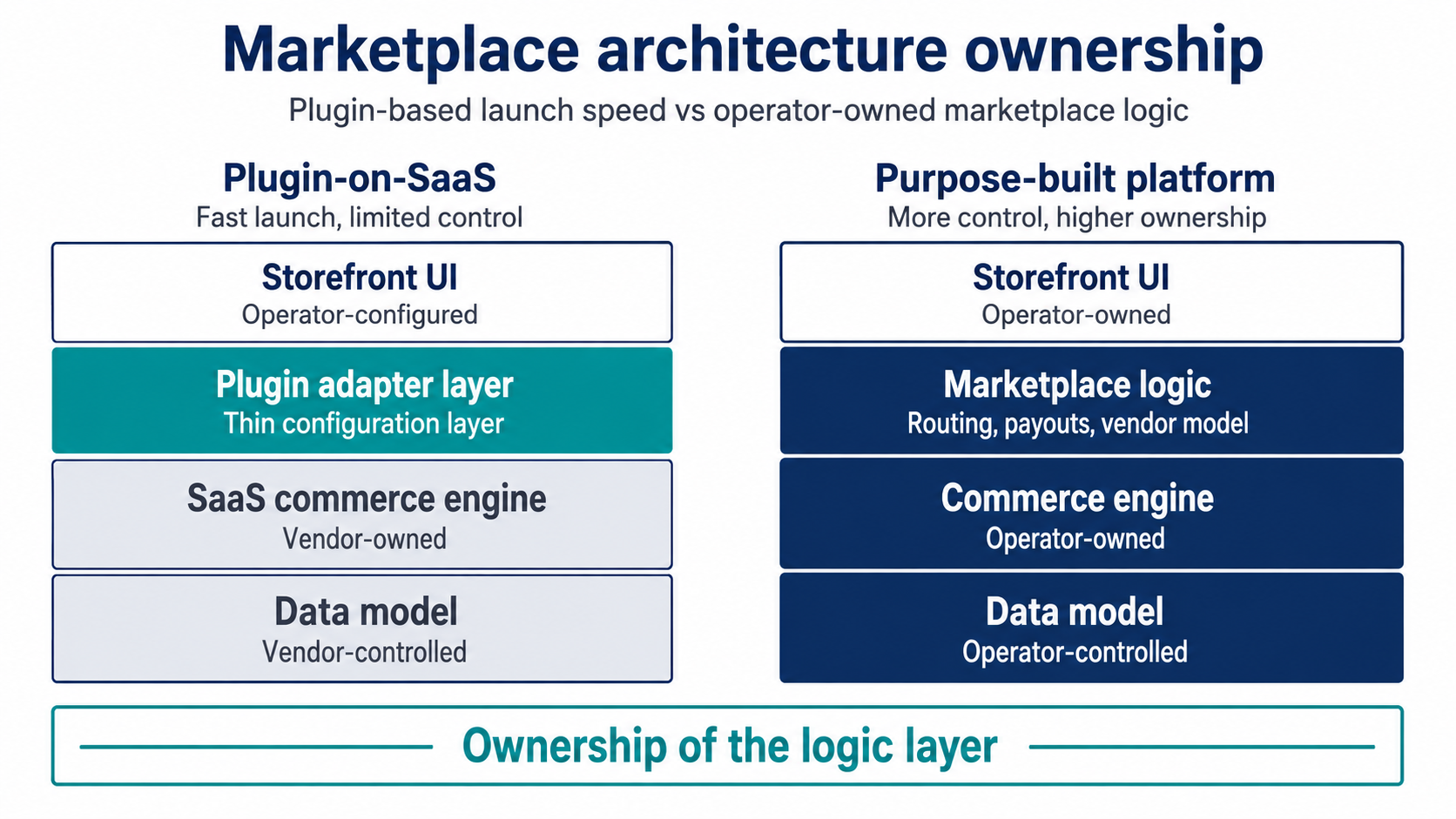
The architectural difference is ownership: plugin-based marketplaces depend on vendor-controlled logic and data models; purpose-built platforms move routing, payouts, vendor rules, and data structure into the operator’s architecture.
- First, fewer than ten active vendors with no near-term growth plan. At this volume the operational edge cases the plugin handles poorly are still genuinely rare, and the plugin's configuration model is fast to set up and maintain.
- Second, a single jurisdiction with uniform payout logic. Multi-currency, VAT-by-country, partial-refund splits — the operational drivers of plugin failure — do not apply. The plugin's payout model is enough.
- Third, no custom order routing and no per-vendor product variation. Random or round-robin routing is sufficient; products behave identically across vendors. In this case the plugin's shared-product model maps cleanly to how the business actually operates.
Outside these three conditions, the question becomes whether the operational cost of staying on the plugin is lower than the cost of migrating. That is rarely a question of architectural elegance. It is a question of where the team's hours go each week. If most of them go to plugin patching, reconciliation, or vendor support cases caused by plugin limits, the cost has already moved.
The real cost of migration — and where purpose-built does not fit
The honest cost of migration is the parallel-operation period, not the rebuild itself.
Building a purpose-built marketplace is a known engineering effort — scopeable, estimable, deliverable. The cost that surprises operators is the period during which both systems run in production: the new platform handles new vendors and orders while the legacy plugin is still closing open transactions, payout cycles, and vendor disputes. During that window, operations supports two systems, data is reconciled across both, and vendors are re-onboarded on a schedule that respects their own integration capacity.
Two costs usually get underestimated. The first is data reconciliation: orders, vendors, payouts, and catalogue state on the plugin have to map cleanly to the new platform's model, and reconciliation surfaces inconsistencies that were never visible inside the plugin. The second is vendor friction: vendors who learned the plugin's UI now have to learn the new platform's, and smaller vendors typically need direct support to do so.
Purpose-built also does not fit every case. A team too small to maintain a custom platform long-term will struggle with on-call, security patches, and feature roadmap. A regulated environment where a certified SaaS platform is easier to audit may make plugin-on-certified-SaaS the lower-risk path. A marketplace model still likely to pivot in the next twelve months — different vertical, different unit economics — should validate the new direction before locking architecture.
Validating before migration is the practical step. A focused proof-of-concept against the marketplace's actual failure modes models the two or three patterns the plugin is failing on — payout logic, routing, product variation — and proves the new architecture handles them before the operator commits to a full rebuild.
What purpose-built looks like in practice
Purpose-built marketplaces are recognisable not by feature lists but by which decisions sit inside platform code instead of vendor configuration.
Kortreistved, a Norwegian platform connecting local firewood suppliers with buyers, was built from the start as a purpose-built marketplace rather than retrofitted from a plugin. The published architecture covers four web surfaces — admin panel, supplier dashboard, client webshop, and a B2B chain-customer webshop — plus a mobile application for suppliers managing their sales and deliveries. Order routing is location-based: orders go to the supplier nearest the buyer's address, with routing logic living in the platform's own code rather than in a configuration panel.
The architectural takeaway is not that PHP/Laravel or any particular stack is the answer. It is that the multi-portal structure, the geo-based routing, and the per-supplier operational workflows were design decisions made before code was written. That is the difference between purpose-built and plugin-with-customisations: ownership of the design, not just the implementation. For operators considering a similar move within custom multi-vendor marketplace development, the early step is defining which decisions the business needs to own — and then sizing the build accordingly.
Key takeaways
- A marketplace plugin is an adapter over someone else's architecture; its cost scales with operational complexity, not with vendor count.
- The three classic break points are vendor payouts across jurisdictions, custom order routing, and per-vendor product variation. Hitting two or more at once is the strongest single signal that the plugin has become the ceiling.
- The choice is not plugin versus purpose-built in isolation; headless commerce occupies the middle ground for operators who need frontend control without full model ownership.
- The real cost of migration is the parallel-operation period — data reconciliation, vendor re-onboarding, dual support — not the rebuild itself.
- A short proof-of-concept against the marketplace's actual failure modes answers the migration question faster than another round of feature comparison.
Architecture is the decision, not the feature list
The question behind plugin-versus-purpose-built is rarely about which stack wins. It is whether the marketplace's operating model has outgrown the architectural decisions someone else made for it. A plugin is a shared architecture; a purpose-built platform is one whose decisions the business owns. Marketplaces past the launch phase usually hit the moment when that ownership starts to matter — most often around payouts, sometimes around routing, sometimes around the product model.
What makes the decision useful is treating it as architectural reasoning, not a generic buy-versus-build comparison. The criteria in this article — operational break points, the headless middle tier, the cost of parallel operation, the conditions where a plugin remains correct — map onto a specific marketplace's situation, not onto an abstract industry one. For teams who want a second opinion on whether their plugin has actually become the ceiling, marketplace platform engineering is the engagement to scope a proof-of-concept against the real failure modes — before any migration commitment.
If your marketplace has reached the point where plugin workarounds are shaping the roadmap, Bluepes can help review the architecture, validate the migration case, and define a realistic platform path. Discuss your marketplace architecture with Bluepes when you need an engineering view before committing to a rebuild.
Summarize with AI
 ChatGPT
 Claude
 Gemini
 Grok
Grok Perplexity
FAQ











Interesting For You


Why Your ERP Integration Fails Silently Under Load
These ERP integration failures are the most expensive category of integration problem in e-commerce because they don’t generate tickets or on-call pages. They surface as accounting discrepancies weeks after the data diverged, when the cost of diagnosis and correction has already multiplied. Almost always, they trace back to four architectural decisions that were either made implicitly or not made at all when the integration first went live: field-level data ownership, sync model selection per data type, bidirectional idempotency, and pre-incident observability. Each gap is diagnosable in a running integration, and each has a fix that does not require a full rewrite.
Read article

How eCommerce Businesses Integrate ERP, Marketplaces, and Payments Without Breaking Under Scale
Most scaling problems in eCommerce don't appear on the storefront. Modern UI frameworks and SaaS tools absorb traffic growth without much friction. The real pressure accumulates behind the scenes, where orders, payments, inventory updates, and fulfillment statuses travel across four or five independent systems that were never designed to talk to each other. When eCommerce system integration is built without a long-term structure, the first sign is small: a manual check here, a reconciliation task there. Six months later, it's a recurring operational problem that surfaces every time you add a new marketplace or payment method. This article is for CTOs and engineering leads who manage eCommerce platforms where integration overhead is growing faster than the business itself. Below you will find a breakdown of where integrations typically fail, what architecture patterns address those failures, and how an iPaaS layer changes the maintenance equation. The short version: eCommerce data integration fails under scale not because of the individual systems, but because point-to-point connections between them multiply faster than teams can maintain them. A central integration layer — built around event-driven flows and a clear system-of-record model — resolves this. The platform choice matters less than the architecture decisions made early on.
Read article



Data Science in E-Commerce
More than 20 years ago, e-commerce was just a novel concept, until Amazon sold their very first book in 1995. Nowadays, the e-commerce market is a significant part of the world’s economy. The revenue and retail worldwide expectations of e-commerce in 2019 were $2.03 trillion and $3.5 trillion respectively. This market is developed and diverse both geographically and in terms of business models. In 2018, the two biggest e-commerce markets were China and the United States, with revenues of $636.1 billion and $504.6 billion respectively. Currently, the Asia-Pacific region shows a better growth tendency for e-commerce retail in relation to the rest of the world. Companies use various types of e-commerce in their business models: Business-to-Business (B2B), Business-to-Consumer (B2C), Consumer-to-Consumer (C2C), Consumer-to-Business (C2B), Business-to-Government (B2G), and others. This diversity has emerged because e-commerce platforms provide ready-made connections between buyers and sellers. This is also the reason that B2B’s global online sales dominate B2C: $10.6 trillion to $2.8 trillion. Rapid development of e-commerce generates high competition. Therefore, it’s important to follow major trends in order to drive business sales and create a more personalized customer experience. While using big data analytics may seem like a current trend, for many companies, data science techniques have already been customary tools of doing business for some time. There are several reasons for the efficiency of big data analytics: · Large datasets make it easier to apply data analytics; · The high computational power of modern machines even allows data-driven decisions to be made in real time; · Methods in the field of data science have been well-developed. This article will illustrate the impact of using data science in e-commerce and the importance of data collection, starting from the initial stage of your business.
Read article