


How eCommerce Businesses Integrate ERP, Marketplaces, and Payments Without Breaking Under Scale


Most scaling problems in eCommerce don't appear on the storefront. Modern UI frameworks and SaaS tools absorb traffic growth without much friction. The real pressure accumulates behind the scenes, where orders, payments, inventory updates, and fulfillment statuses travel across four or five independent systems that were never designed to talk to each other. When eCommerce system integration is built without a long-term structure, the first sign is small: a manual check here, a reconciliation task there. Six months later, it's a recurring operational problem that surfaces every time you add a new marketplace or payment method.
This article is for CTOs and engineering leads who manage eCommerce platforms where integration overhead is growing faster than the business itself. Below you will find a breakdown of where integrations typically fail, what architecture patterns address those failures, and how an iPaaS layer changes the maintenance equation.
The short version: eCommerce data integration fails under scale not because of the individual systems, but because point-to-point connections between them multiply faster than teams can maintain them. A central integration layer — built around event-driven flows and a clear system-of-record model — resolves this. The platform choice matters less than the architecture decisions made early on.
Updated in April 2026
The Modern eCommerce System Landscape
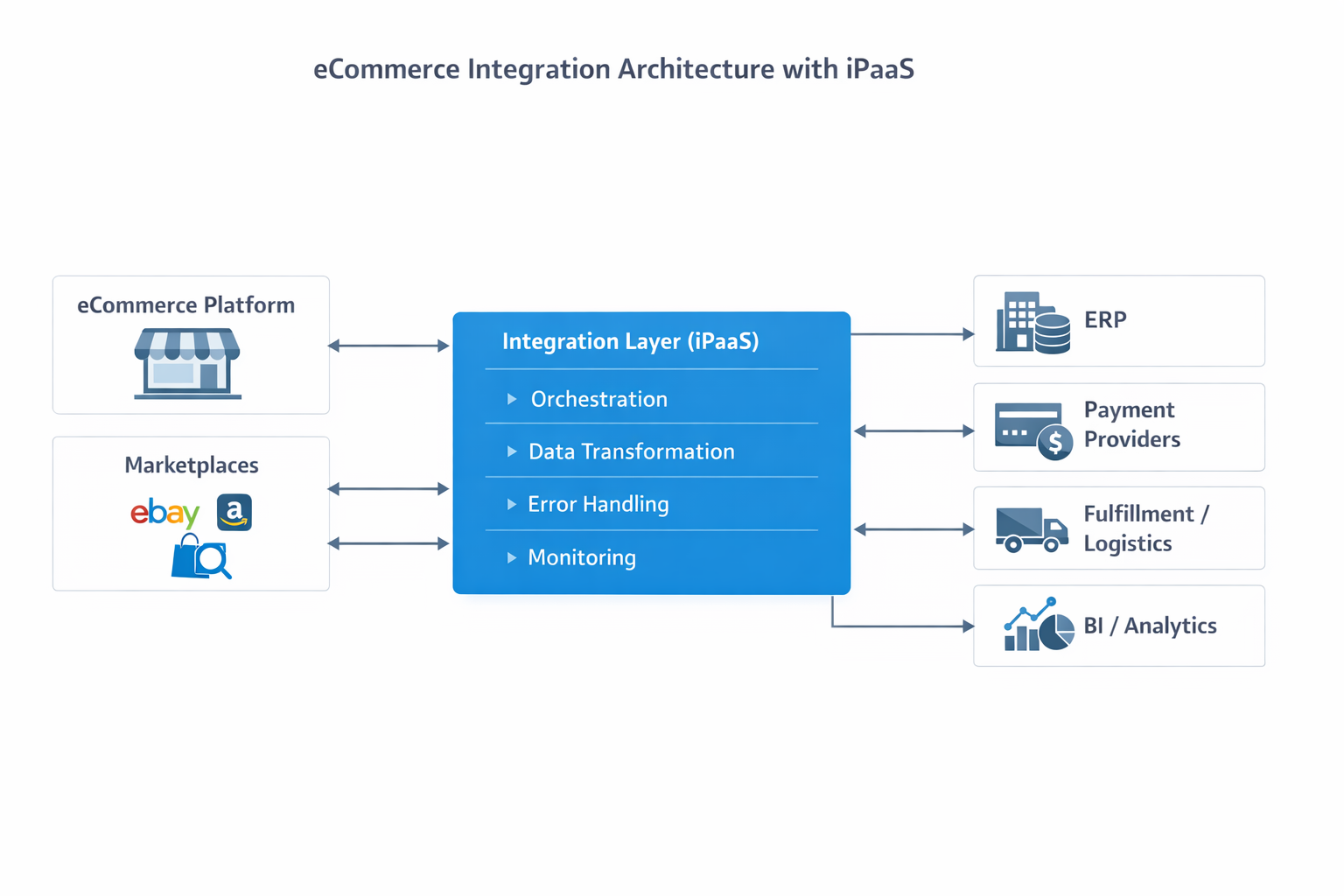
A typical eCommerce architecture consists of several independent systems, each optimized for a specific function. The list is familiar: eCommerce platform, ERP, payment providers, marketplaces, logistics partners, and BI tools. What is less obvious is how each of these evolves on its own timeline.
New pricing models, regional tax rules, API versions, and marketplace requirements arrive continuously. Integrations absorb these changes — or fail to. The risk is not fragmentation itself, which is the default state for any growing eCommerce operation. The risk is when that fragmentation is held together by isolated point-to-point connections that nobody fully owns.
Teams doing serious eCommerce integration work tend to invest early in integration architecture precisely because retrofitting it later is expensive — both in engineering time and in operational errors that accumulate in the meantime.
Common integration risks by system type
Where eCommerce Integrations Break Under Scale
Integration failures rarely show up during early stages. They become visible when transaction volume increases, when a second or third marketplace is added, or when the business expands across regions with different tax and fulfillment requirements.
The pressure points are consistent across most mid-market eCommerce environments:
- Multi-marketplace order ingestion, where duplicate detection and routing logic lives in different places
- Inventory synchronization that depends on polling intervals rather than event triggers
- Payment confirmation delays that create gaps between order state in the storefront and ERP
- Financial data mismatches that require manual reconciliation before month-end close
- Reporting that reflects yesterday's state rather than current operations
Point-to-point integrations amplify every one of these issues. Each new channel, payment method, or logistics provider adds more connections. Each connection increases maintenance surface and failure risk — without adding any centralized visibility into what is happening across the full data flow.
Event-Driven Integration Patterns in eCommerce
Modern eCommerce integration architecture increasingly uses event-driven flows rather than synchronous request-response calls. Orders, payments, inventory updates, and shipment confirmations are treated as events that trigger downstream processes — rather than requests that must succeed immediately or block the entire chain.
Martin Fowler's foundational work on event-driven architecture patterns describes the core advantage: systems become decoupled from each other. A temporary outage in one system does not block the rest. Retry logic can be applied selectively. Processing can scale independently per domain.
That said, event-driven architectures introduce complexity of their own. Events must be ordered correctly where sequence matters. Duplicates must be detected and suppressed. Partial failures must surface in a way that allows intervention without data loss. Without a structured integration layer managing these concerns, teams end up building the same logic repeatedly across individual connections.
How event-driven flows change operational behavior
When an order is placed, the event propagates to payment processing, inventory reservation, and fulfillment in parallel — each system reacting independently. If payment fails, the inventory reservation is released through a compensating event rather than through a direct rollback call. The business logic stays in the integration layer, not embedded in each system.
This separation matters most during growth. Adding a new marketplace or payment method means connecting it to the event backbone, not rebuilding existing flows.
Using iPaaS as an Integration Backbone
An Integration Platform as a Service (iPaaS) provides a centralized layer for managing eCommerce integrations. iPaaS is a cloud-hosted middleware layer that lets teams design, deploy, and monitor integration flows without maintaining custom infrastructure. Instead of embedding connection logic into each system, integration flows are orchestrated from one place.
In an eCommerce context, this layer handles order and payment orchestration, inventory updates across channels, data transformation between systems, error handling and retries, and integration observability and monitoring. The operational benefit is visibility — when something breaks, the failure is visible in one place rather than discovered through downstream symptoms.
Boomi, one of the iPaaS platforms we work with, provides a connector library and process orchestration layer documented at Boomi's official platform documentation. Its connection model is based on configurable connectors for common eCommerce systems — ERPs, marketplaces, payment processors — combined with a visual flow builder for orchestration logic.
Building a dedicated integration team around an iPaaS platform changes the maintenance model. Instead of debugging individual scripts and custom API wrappers, engineers maintain flows within a structured environment where error logs, retries, and monitoring are built in.
If your eCommerce platform is adding channels or expanding to new regions, a point-to-point integration architecture will show its limits faster than expected. Engineers who have worked through this in fintech and eCommerce environments can help identify where the current structure will break — and what it takes to fix it before it does. Discuss your integration setup with Bluepes
Practical Integration Patterns for eCommerce
In real-world eCommerce environments, integrations rarely follow simple one-to-one logic. Most business processes require multiple systems to react to the same event in a defined sequence.
Order lifecycle orchestration
An order is created on the storefront. Payment confirmation follows. Inventory must be reserved and decremented. Fulfillment is triggered. Financial data flows into ERP and reporting. Each step depends on the previous one completing correctly — and each step involves a different system.
Without a coordinated integration layer, these steps get implemented as loosely connected processes in different parts of the codebase. Over time, sequence bugs, race conditions, and inconsistent state across systems accumulate. The integration layer should own this orchestration logic, making it auditable and replayable when something goes wrong.
Inventory synchronization across channels
When a product sells on one marketplace, inventory must update across all other channels before the next order arrives. Synchronous, polling-based approaches work at low volume. At scale, they introduce latency and inconsistency — particularly when multiple channels sell the same SKU simultaneously.
Event-driven inventory updates, triggered immediately on each transaction, reduce the window for overselling. The integration layer coordinates the update sequence and handles retry logic when a channel's API is temporarily unavailable.
Integrating ERP, Marketplaces, Payments, and BI
A practical eCommerce integration architecture follows a system-of-record model: one system owns each data domain, and others receive updates through the integration layer rather than writing directly to each other.
ERP is typically the system of record for financial data and inventory. The eCommerce platform owns customer and order data at creation. The integration layer resolves conflicts when the same entity appears in multiple systems — a product, a customer record, a transaction.
Maintaining financial data consistency across integrated systems is one of the areas where integration architecture decisions have direct business impact. When ERP and payment data diverge, the cost shows up in reconciliation time and audit risk, not in technical metrics.
Marketplace integrations add a specific challenge: each platform has its own data model, order status vocabulary, and API behavior. An integration layer must normalize these differences before data reaches the ERP or BI layer. This normalization is where much of the real engineering work lives — not in setting up connectors, but in mapping edge cases consistently.
BI and analytics as integration consumers
Reporting systems are often the last to receive data and the first to show when something upstream is wrong. Connecting BI tools as integration consumers — rather than querying source systems directly — reduces load on operational databases and gives analytics teams a consistent, transformation-ready data feed. Boomi's platform supports this pattern through its connector library for common BI and data warehouse targets.
Key takeaways
- eCommerce system integration fails under scale primarily because point-to-point connections between systems multiply faster than teams can maintain them.
- Event-driven integration patterns decouple systems from each other, making individual failures less likely to cascade across the entire order flow.
- An iPaaS layer centralizes orchestration, error handling, and monitoring — replacing distributed integration logic with a single operational layer.
- A system-of-record model — where one system owns each data domain — reduces conflict resolution work and makes data flows easier to audit.
- Marketplace and ERP integrations require normalization logic for different data models, which is where most integration complexity actually lives.
Conclusion
eCommerce data integration is not a one-time project. It is infrastructure that needs to absorb change — new channels, new payment methods, new regional requirements — without requiring full rework each time. Getting the architecture right early, before volume forces the issue, is consistently cheaper than fixing it under pressure.
The iPaaS approach addresses most of the structural problems that cause integration failures at scale: lack of visibility, distributed error handling, and no single place to understand the state of data across systems. The specific platform matters less than the decision to centralize integration logic at all.
If your team is working through eCommerce integration architecture decisions — ERP connectivity, marketplace normalization, or payment flow orchestration — we are available to review the current state and discuss what would need to change. Talk to the Bluepes integration engineering team.
Bluepes is an independent software consulting company. We work with Boomi as one of the integration platforms our engineers use on client projects
Boomi is a trademark of Boomi, LP. Bluepes is an independent software consulting company. We are not affiliated with, endorsed by, or certified by Boomi, LP.
Summarize with AI
 ChatGPT
 Claude
 Gemini
 Grok
Grok Perplexity
FAQ











Interesting For You



API governance in Boomi: how mid-market teams keep control
When a mid-market company runs 50 active integrations and six product teams pushing API changes independently, governance stops being a process question and becomes a risk question. One team overwrites a shared endpoint. Another deprecates a version without notifying consumers. A partner integration breaks at 2 a.m. with no clear owner to call. Bluepes is an independent integration consulting company that works with Boomi as one of its core platforms. This article draws on that hands-on experience — not as Boomi's representative, but as a team that has debugged the consequences of missing governance and helped clients build the structures that prevent them. This article is for CTOs, VP Engineering, and IT Directors at mid-market organizations who manage growing API catalogs and want a practical governance model they can implement incrementally. Next — a breakdown of the five governance layers, how each maps to Boomi's tooling, and where teams typically lose control. API governance in Boomi means applying consistent rules for how interfaces are designed, secured, versioned, and retired. The Boomi API Management module provides the infrastructure. The design conventions, ownership assignments, and review cadences are decisions the engineering team makes. Organizations that get this right reduce integration failures, shorten partner onboarding, and make security audits straightforward rather than stressful.
Read article


When Integration Becomes the Bottleneck: How IT Teams Can Reclaim Time
Most engineering leads do not set out to build a maintenance operation. They set out to build products, automate workflows, and move the company forward. But integration work has a way of expanding until it crowds everything else out — gradually at first, then all at once. This article is for IT Directors, CTOs, and engineering leads who are watching their team's capacity disappear into a backlog of API fixes, sync failures, and manual workarounds. Next — a practical look at what creates IT integration overload, what platform-level tools like Boomi actually change day-to-day, and where outside engineering support fits into that picture. The short answer: IT integration overload is not a staffing problem. It is an architectural one. When companies grow faster than their integration infrastructure, each new system added to the stack multiplies the maintenance surface. The teams that break the cycle typically do two things: adopt an iPaaS platform to reduce reactive work, and bring in integration-specific experience to compress implementation time.
Read article


Why Agentic AI in the Enterprise Depends on the Integration Layer
Most enterprise AI projects do not fail because the models are inadequate. They fail because the data feeding those models is inconsistent, delayed, or simply unreachable. According to a 2025 analysis, why AI agent pilots fail in production comes down to one recurring problem: the absence of a structured integration layer between AI systems and enterprise data. This article is for CTOs and VPs of Engineering who are evaluating how to introduce AI agents into existing enterprise infrastructure. It addresses what integration architecture those agents actually require to work reliably — and where Boomi fits into that picture. The short answer: agentic AI needs a stable, governed integration layer to access enterprise data, trigger downstream processes, and log every action taken. Without that layer, agents either operate on incomplete information or become impossible to audit and explain.
Read article