


E-commerce RFP technical questions vendors must answer


Three vendor proposals land on the table. Each one has relevant projects, a familiar technology stack, a delivery timeline, and a price that can be defended internally. The problem is that none of the answers explain how the vendor behaves when code ownership becomes unclear, a production integration fails intermittently, or the client asks for a feature that will damage the platform later.
That is where e-commerce RFP technical questions matter. Standard RFPs usually ask about experience, team size, stack, references, price, and availability. Those questions are easy to answer with prepared slides. They rarely reveal whether the vendor can make responsible engineering decisions under pressure.
A stronger RFP asks fewer questions with better signal. It tests how a vendor handles ownership, escalation, documentation, handover, production readiness, and uncomfortable technical trade-offs. For e-commerce and marketplace teams, these answers predict the quality of the working relationship better than a portfolio page.
This article gives eight questions worth adding to an e-commerce development RFP and explains what a strong answer, a weak answer, and a direct Bluepes-style answer should look like.
Why standard e-commerce RFP questions make vendors look the same
Standard e-commerce RFP questions produce similar proposals because vendors can answer them without exposing how they actually work.
A typical RFP asks for relevant experience, preferred stack, delivery timeline, team composition, project methodology, and price. None of these questions are useless. They confirm that the vendor operates in the right market and can assemble a plausible delivery team. The issue is that they sit at the surface of vendor capability.
A vendor can show three marketplace projects without proving they can debug a broken payout flow. A vendor can claim experience with React, Node.js, Java, AWS, or payment integrations without explaining who owns architecture decisions. A vendor can quote a fixed timeline without showing what happens when the client changes priorities halfway through the build.
This is why selection often collapses into price, visual quality of the proposal, or personal chemistry on calls. Those signals matter, but they do not predict whether the codebase will be maintainable in year three.
For e-commerce and marketplace projects, the useful RFP signal comes from delivery behaviour: how the vendor documents decisions, challenges weak requirements, handles integrations under load, and transfers knowledge when the client wants to move. Bluepes positions e-commerce and marketplace software development around these operational realities because e-commerce systems fail through workflows, ownership gaps, and unclear decisions as much as through code defects.
If your team is still shaping the broader vendor shortlist, the related article on software development partner selection criteria can support the earlier stage. This article focuses on the technical questions to ask once serious proposals are already on the table.
Who owns the code at every stage of the project?
Code ownership must be explicit before development starts because it affects risk, exit options, maintenance, and future vendor changes.
A weak RFP asks, “Will we own the code?” A stronger RFP asks who legally owns the code during development, at milestone acceptance, after payment, at handover, and after contract termination. It should also ask who owns reusable components, infrastructure scripts, deployment pipelines, documentation, test suites, and third-party configuration.
A good vendor answer names the ownership model clearly. It explains when rights transfer, what is included in the handover package, how repositories are managed, and whether the client can continue development with another team. It also separates client-specific business logic from the vendor’s reusable internal know-how.
A bad answer sounds clean but vague: “The client owns everything.” That statement is not enough. The RFP should force the vendor to define “everything” in operational terms. Does it include CI/CD pipelines? Terraform scripts? Test automation? API documentation? Monitoring dashboards? Database migration scripts? Environment configuration? A client who owns only the repository but not the delivery system has partial ownership at best.
Bluepes answer: for client-funded project work, the expected model is client ownership of the project code and deliverables defined in the agreement, with repository access, documentation, and handover materials aligned before delivery starts. Reusable engineering knowledge, generic patterns, and non-client-specific internal assets stay separate. The practical point is simple: the client should be able to maintain, audit, and continue the product without depending on hidden vendor knowledge.
This question matters strongly for marketplace platforms, where integrations, payment flows, routing logic, and vendor workflows become long-lived assets. If the vendor cannot explain code ownership precisely, the proposal is incomplete.
How does the vendor decide when to patch, refactor, or rewrite?
The rewrite-versus-patch question reveals whether the vendor has engineering judgment or defaults to whichever option is easier to sell.
E-commerce systems collect compromises quickly. A shipping rule gets patched before a campaign and vendor payout exception gets added for one country. A checkout integration gets a temporary retry rule. None of these decisions are automatically wrong. The damage appears when no one records why the shortcut was taken and when it should be revisited.
A good vendor answer explains decision criteria. They should talk about business urgency, defect severity, regression risk, test coverage, system ownership, future roadmap, and the expected lifespan of the change. A patch may be correct when the issue is isolated and the business needs speed. Refactoring may be correct when the same defect keeps returning. Rewriting may be justified when the current module blocks future work or hides failure modes that cannot be tested safely.
A bad answer picks one extreme. “We avoid rewrites” can mean the vendor is afraid to touch poor architecture. “We prefer clean rebuilds” can mean the vendor is comfortable turning every maintenance issue into a larger bill. Both answers are weak unless the vendor can show the decision logic.
Bluepes answer: we would expect the vendor to classify the problem before proposing the fix. If the issue is narrow, well-tested, and low risk, patching is often enough. If the same code path keeps creating defects, refactoring should be discussed with clear scope. Rewriting needs a stronger threshold: the existing module must create measurable delivery risk, maintenance risk, or production risk that smaller changes cannot address.
For marketplace teams, this question connects directly to marketplace platform architecture decisions. A vendor that cannot explain when architecture should change will usually struggle when plugin limits, custom routing, or per-vendor workflows start affecting daily operations.
How are technical decisions from calls documented?
Technical decisions must survive the meeting because future developers need to understand the reason behind the code, not only the final ticket.
E-commerce projects generate decisions in calls: payment provider trade-offs, inventory sync rules, refund logic, admin permissions, fulfilment exceptions, launch shortcuts, and backlog deferrals. If those decisions stay in memory or chat threads, the next developer inherits code without context.
A strong RFP should ask how the vendor documents decisions made during workshops, sprint planning, architecture reviews, and urgent production discussions. The answer should mention where decisions live, who writes them, who approves them, and how they connect to tickets, pull requests, architecture notes, and release documentation.
A good answer might include architecture decision records, sprint notes, ticket acceptance criteria, API contracts, deployment notes, and handover documentation. It should also explain how the vendor avoids documentation becoming a stale archive no one reads.
A bad answer overpromises documentation without process. “We document everything” usually means very little. No team documents everything. Better vendors document decisions that change architecture, delivery risk, business rules, compliance exposure, or handover quality.
Bluepes answer: documentation should be tied to the decision type. A small UI change belongs in a ticket. A payment flow decision needs acceptance criteria, testing notes, and possibly an integration contract. A routing or data ownership decision may deserve an architecture note. The goal is not paperwork volume. The goal is that a new engineer can understand why the system behaves the way it does.
Academic work on software system handover treats handover as a structured knowledge-transfer activity, not as a final ZIP file at the end of the project. A useful reference is A Framework for Software System Handover which frames handover as a set of management, maintenance, documentation, and training practices.
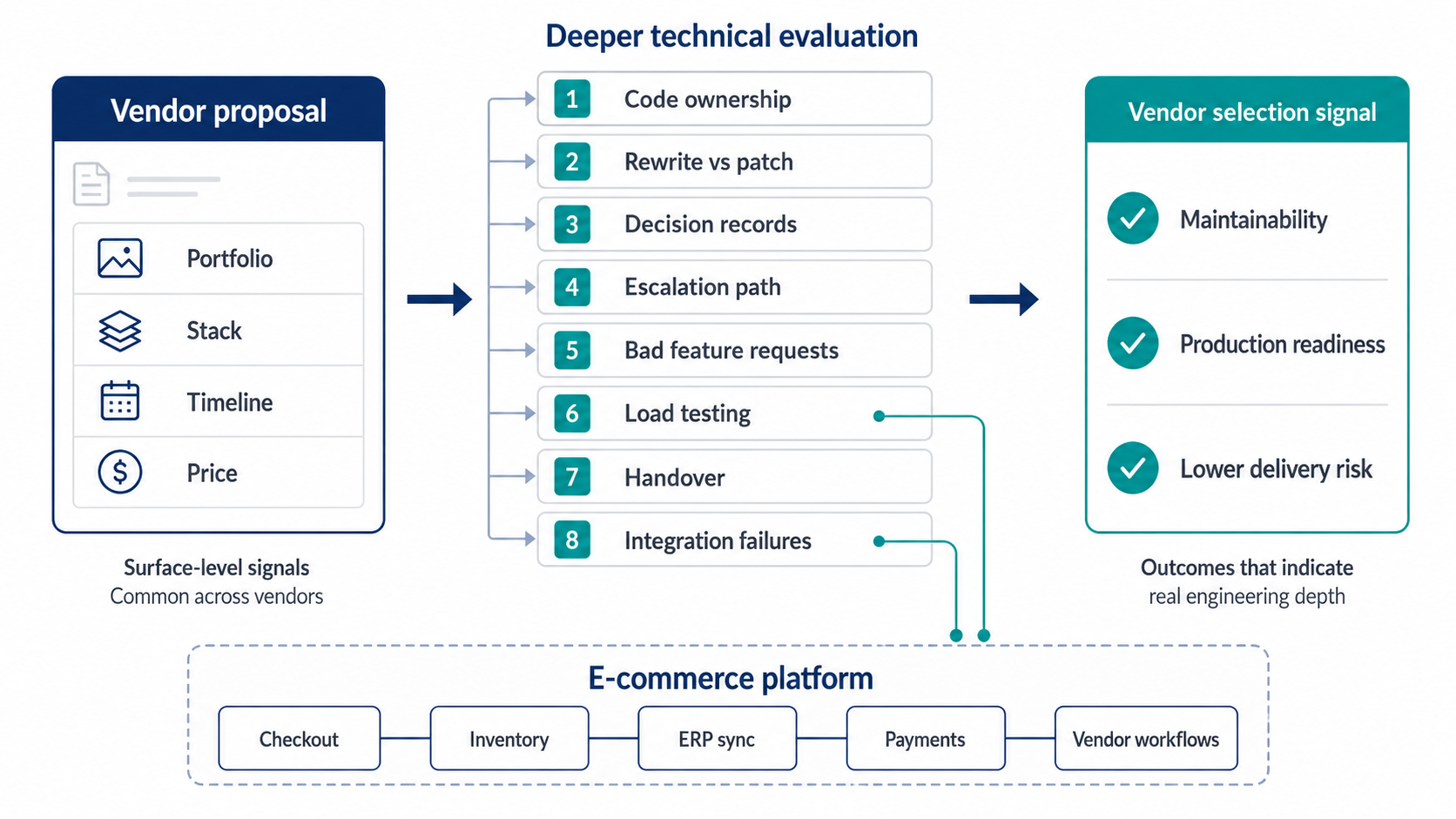
Technical RFP evaluation should test how a vendor handles ownership, decisions, escalation, testing, handover, and production failures — not only portfolio, stack, timeline, and price.
What happens when the vendor disagrees with the client?
A vendor’s escalation path matters because silent agreement often creates worse software than open disagreement.
Clients sometimes ask for features that create technical risk. A business stakeholder may want a manual admin override that bypasses audit logs. A product owner may request a shipping rule that breaks inventory consistency. A procurement team may push for a fixed scope even though integration access is still unknown. A vendor who simply accepts every request is easy to work with during procurement and risky during delivery.
The RFP should ask how the vendor handles disagreement. Who raises the concern? How is it documented? When does it move from developer-level discussion to tech lead, project manager, CTO, or steering group? How does the vendor separate opinion from risk?
A good answer shows respectful escalation. The vendor should explain the risk, propose options, document the decision, and make sure the client understands the trade-off. They should not turn every disagreement into conflict. They should also avoid hiding concerns in technical language that business stakeholders cannot evaluate.
A bad answer says, “We build what the client asks.” That sounds service-oriented, but it is a red flag for business-critical software. The client pays the vendor for engineering judgment as well as implementation capacity.
Bluepes answer: when we disagree, the first step is to explain the technical and business consequence in plain language. If the issue affects security, maintainability, data integrity, compliance, or production stability, it should be documented and escalated to the right decision-maker. The client can still choose a trade-off, but the choice should be visible.
This is one reason the engagement model matters. A dedicated development team model works better when the client expects ongoing technical judgment, not only ticket delivery. It gives space for Tech Lead, QA, DevOps, BA, and PM roles to surface delivery risks early instead of reacting late.
What does the vendor do when a requested feature is a bad idea?
The bad-feature question tests whether the vendor protects the product or simply protects the contract.
E-commerce and marketplace teams often request features under pressure: custom discounts for one partner, manual order reassignment, admin edits to financial records, supplier-specific exceptions, or urgent mobile workflows for field vendors. Some requests are valid. Others create long-term risk because they bypass the system’s operating model.
A good vendor answer should describe how they challenge the feature constructively. They should ask why the feature is needed, whether the need is temporary or permanent, which users are affected, what operational failure triggered the request, and whether the same outcome can be achieved through a safer workflow.
A bad answer treats product requests as isolated tasks. That approach creates software where each exception becomes its own rule. After a year, the platform becomes hard to test because no one knows which rules are still active and which were emergency patches.
Bluepes answer: we would first identify the operational reason behind the feature. If the client wants manual supplier reassignment, the real issue may be routing quality, supplier availability, inventory sync, or support escalation. Building the manual override may still be necessary, but it should include permissions, audit logs, and a plan for reducing manual use over time.
After the planned article is published, this section should link to location-based order routing failure analysis, because routing exceptions are a strong example of a feature request that often points to a deeper platform issue.
If your RFP responses all sound polished but none explain how vendors handle ownership, disagreement, handover, or production risk, the selection process needs sharper technical signal. Bluepes can review the RFP or proposal set from an engineering delivery perspective before you commit. Discuss your vendor evaluation with Bluepes.
How and when does the vendor load-test?
Load testing should be tied to production risk, traffic patterns, integrations, and release timing, not treated as a generic pre-launch checkbox.
E-commerce systems behave differently under load because traffic, payments, inventory, search, promotions, and third-party integrations interact. A homepage may handle traffic well while checkout slows down. Search may stay fast while inventory reservation fails. A payment provider may respond correctly while the order confirmation process times out downstream.
A strong RFP asks when the vendor load-tests, which flows they test, what assumptions they use, what environments they test against, and how they handle bottlenecks found late in delivery. The answer should cover critical journeys, not only raw traffic.
For an e-commerce platform, useful load-testing targets may include:
- product search and filtering during peak traffic;
- cart and checkout under concurrent sessions;
- inventory reservation and stock release;
- payment callback handling;
- order creation and confirmation;
- ERP, warehouse, and fulfilment sync;
- supplier or vendor dashboard activity during campaign periods.
A good answer explains test scenarios, data volume, concurrency assumptions, monitoring, bottleneck ownership, and retesting after fixes. It also admits where load testing is limited. Staging environments rarely mirror production perfectly, and third-party systems often restrict realistic testing.
A bad answer says, “We do performance testing before launch” without naming flows, thresholds, data shape, or responsibility for remediation.
Bluepes answer: we would expect load testing to focus on the flows that create business damage if they fail. For e-commerce, checkout, inventory reservation, payment callbacks, order sync, and vendor-facing workflows usually deserve priority. The vendor should define assumptions with the client and record which risks remain after testing.
NIST SP 800-160 frames system quality and risk through an engineering lifecycle perspective for complex systems. The relevance for RFPs is direct: production readiness depends on engineering practices across design, development, verification, operation, and sustainment, not a single final test phase. Reference: NIST SP 800-160 Vol. 1.
After publication, this section can also link to the planned supplier mobile app decision guide for marketplaces, especially where supplier workflows require push notifications, offline sync, and field-level order response.
How does handover work if the client moves the project?
Handover quality determines whether the client has real freedom to change vendors later.
A vendor who builds well but hands over poorly still creates lock-in. The client may own the repository, yet lack deployment knowledge, environment documentation, test strategy, operational runbooks, or enough architectural context to continue safely. This becomes visible only when the client tries to move the project.
An e-commerce RFP should ask what happens if the client wants to transfer the project to an internal team or another vendor. The answer should describe handover materials, repository access, credentials transfer, environment documentation, known issues, backlog state, deployment process, test coverage, and support during transition.
A good answer is concrete. It names artefacts and responsibilities. It may include a handover checklist, a transition window, recorded walkthroughs, architecture notes, and access review.
A bad answer says, “We provide all documentation at the end.” End-stage documentation usually misses the reasoning behind decisions made during delivery. Handover should be prepared throughout the project.
Bluepes answer: handover should be planned from the beginning. The client should have access to repositories, delivery boards, documentation, and environments according to the agreed governance model. At transition time, the outgoing team should explain architecture, deployment, known risks, open decisions, and operational routines. Good handover reduces dependency on individuals.
The ISO/IEC/IEEE 12207 software lifecycle standard covers processes for software systems across acquisition, supply, development, operation, support, and retirement. That matters for RFPs because vendor evaluation should cover the full lifecycle of the system, not only the build phase. Reference: ISO/IEC/IEEE 12207 software lifecycle processes.
Bluepes’ Kortreistved marketplace development case is relevant here as a public example of full-cycle marketplace development for a location-based e-commerce model. The case should be referenced only for the facts published on the Bluepes site: marketplace development, dedicated team delivery, product strategy through launch, Agile methodology, and embedded QA.
How does the vendor handle intermittent integration failures?
Intermittent integration failures reveal whether the vendor has operational experience or has only worked with happy-path delivery.
E-commerce platforms depend on systems that do not fail cleanly: ERP, payment gateways, warehouse software, shipping providers, tax services, BI pipelines, supplier portals, and marketplace APIs. The dangerous cases are intermittent. A payment callback arrives late. Inventory sync succeeds for nine orders and fails for the tenth. A supplier status update gets accepted by the mobile app but never reaches fulfilment. Logs show partial success, and support cannot reproduce the issue.
An RFP should ask how the vendor designs for these cases. The answer should cover retries, idempotency, dead-letter queues, event logs, reconciliation jobs, correlation IDs, alerting, and business-level monitoring. The vendor should also explain how operations teams can see whether a process completed end to end.
A good answer names failure modes. It explains what happens when a third-party API times out, when duplicate messages arrive, when an order status changes twice, when a payment callback is delayed, and when two systems disagree about inventory.
A bad answer focuses only on API connectivity. “We integrate with ERP and payment providers” is not enough. Connectivity proves that systems can talk. It does not prove that the business process survives partial failure.
Bluepes answer: integration work should start by identifying which business processes cannot be left ambiguous. For e-commerce, that usually means order creation, payment confirmation, inventory reservation, fulfilment status, refunds, and vendor settlement. Each flow needs traceability, retry logic, duplicate protection, and a reconciliation path when systems disagree.
This is where proposals often expose their limits through silence. If a vendor never mentions idempotency, retries, operational monitoring, or reconciliation in an integration-heavy e-commerce proposal, the omission is meaningful.
What to decide before writing the RFP
The client team must make three decisions before sending the RFP because vendors cannot compensate for unclear buyer-side ownership.
The first decision is the engagement model. A fixed-scope project works when requirements, integrations, and acceptance criteria are already clear. A time-and-materials model fits evolving requirements and discovery-heavy work. A dedicated team fits when the client needs ongoing engineering capacity across product, QA, DevOps, and architecture. Mixing these models without clarity creates proposal confusion because vendors price risk differently.
The second decision is what happens to the codebase at the end. Will the client own the full product? Will the vendor host or manage it? Will another internal team maintain it later? Will the vendor keep responsibility for operations after launch? These answers affect repository setup, documentation, infrastructure access, and handover planning.
The third decision is who owns technical decisions inside the client organization. A CTO, Head of Engineering, Product Owner, or technical founder must have authority to accept trade-offs, challenge vendor assumptions, and resolve disagreements. If procurement controls the RFP while engineering has no decision authority, the final vendor choice may optimize contract shape rather than delivery risk.
A clean RFP gives vendors the conditions to answer honestly. It does not need 200 questions. It needs enough clarity for a strong vendor to explain how they would actually work.
When a PoC phase helps before vendor commitment
A PoC phase helps when the RFP contains technical uncertainty that proposal answers cannot resolve safely.
For e-commerce and marketplace projects, a PoC is useful when the highest risks sit in integrations, migration, routing logic, unfamiliar technology, supplier workflows, performance constraints, or team fit. It should test the riskiest assumption, not recreate the whole platform.
A PoC is worth considering when:
- the vendor must connect to legacy ERP, warehouse, payment, or supplier systems with unclear access;
- the platform depends on custom order routing, vendor assignment, or marketplace-specific business logic;
- the client needs to validate offline-first mobile workflows, push-driven supplier actions, or sync-on-reconnect behavior;
- the existing codebase has uncertain quality and the vendor must assess whether to extend or rebuild;
- the client wants to test the working relationship before committing to a longer engagement.
A PoC is wasted effort when requirements are stable, integrations are well documented, the vendor already has direct experience with the same technical pattern, and the timeline cannot absorb a validation phase. In that case, discovery plus a well-defined delivery plan may be enough.
Bluepes answer: PoC work should be tied to a decision. If the decision is whether to rebuild a routing module, the PoC should test routing. If the decision is whether a supplier mobile app can work offline, the PoC should test offline queueing and sync. If the decision is whether a vendor understands an old codebase, the PoC should include code review and a small production-like change.
For teams that need to reduce technical uncertainty before a full build, Bluepes provides proof-of-concept validation for technical risk. The value is strongest when the PoC has a narrow question and a clear go/no-go decision.
Red flags in e-commerce vendor proposals
Proposal omissions often reveal more than proposal claims because experienced vendors know which risks deserve attention.
A strong e-commerce proposal should not cover every possible technical issue. It should cover the issues that matter for the project type. For a marketplace, that may include supplier workflows, payouts, routing, inventory ownership, and admin tooling. For retail e-commerce, it may include checkout, ERP sync, product catalogue, promotions, payment callbacks, and warehouse integration.
Watch for these red flags:
- no mention of code ownership or handover;
- no explanation of how technical decisions are documented;
- no escalation path for technical disagreement;
- no load-testing approach for checkout, inventory, or order flows;
- no discussion of intermittent integration failures;
- no clear assumptions behind timeline and price;
- no named roles responsible for architecture, QA, DevOps, and delivery governance.
A proposal can be visually impressive and still weak. The issue is not design quality. The issue is whether the proposal gives enough evidence that the vendor can protect the codebase, the delivery process, and the business workflows after the contract is signed.
This is the point where Bluepes’ software engineering services for platform delivery are relevant. For business-critical e-commerce systems, the vendor should bring engineering capacity, delivery structure, QA discipline, and technical judgment into the same working model.
Key takeaways
- E-commerce RFP technical questions should test ownership, handover, escalation, load testing, and failure handling, not only experience and price.
- Code ownership must include repositories, infrastructure scripts, test suites, documentation, and deployment knowledge.
- Vendors who cannot disagree constructively are risky for business-critical software.
- Load testing should focus on checkout, inventory, payment callbacks, order sync, and vendor workflows.
- A PoC is useful when it answers a specific technical uncertainty before a larger commitment.
Better RFP questions lead to better vendor choices
An e-commerce RFP should help the buyer see how a vendor will behave after the proposal stage. Portfolio examples, delivery timelines, and stack lists still matter, but they rarely expose the working habits that determine whether the product remains maintainable after launch.
The eight questions in this article create a stronger signal because they force vendors to explain operational behavior: who owns the code, how decisions are documented, how disagreement is handled, how production risk is tested, and how the client can leave without losing knowledge. These are the areas where weak vendors become expensive after selection.
For e-commerce companies comparing proposals now, the next step is to review the RFP against the risks the project actually carries. A marketplace with supplier routing needs different questions than a retail platform with ERP sync issues. A rebuild needs different questions than a maintenance engagement.
Bluepes can help assess vendor proposals, define a PoC, or structure a delivery team for a business-critical e-commerce build. Review your e-commerce vendor selection with Bluepes before the contract turns proposal gaps into delivery risk.
Summarize with AI
 ChatGPT
 Claude
 Gemini
 Grok
Grok Perplexity
FAQ











Interesting For You


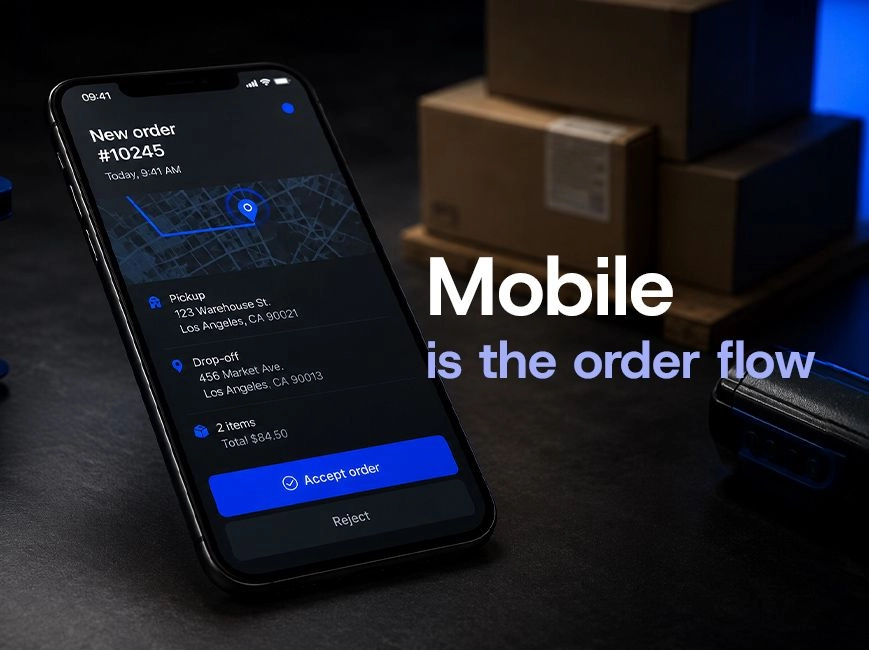
Supplier mobile app for marketplaces: a decision guide
For marketplace teams with a functioning supplier dashboard, the next decision is whether to extend it with a mobile experience and what shape that mobile product should take. The reader of this piece already has operational evidence on where vendors fall out of the flow. The question is whether a supplier mobile app for marketplaces is worth the engineering investment, and which architectural decisions matter most if the answer is yes.
Read article

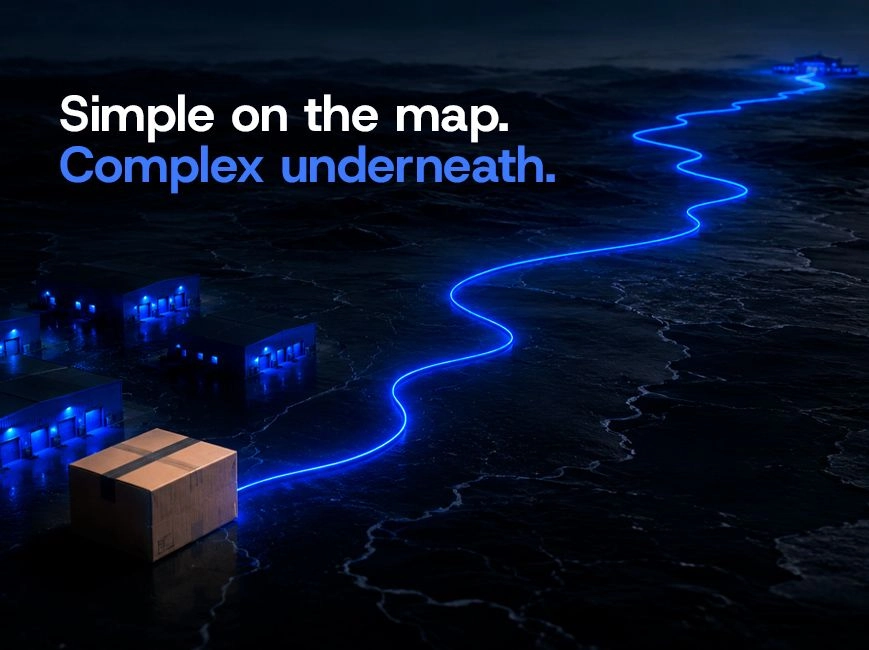
Location-based order routing: where geo-routing breaks
Location-based order routing is an architectural choice that touches four systems at once — supplier registry, inventory visibility, pricing logic, and customer-facing UX. The routing algorithm itself is usually the smallest part of the work. Most marketplaces hit this point when delivery cost starts to dominate the customer's experience of the platform.
Read article


Marketplace plugin vs purpose-built platform: when to move
Marketplace plugin vs purpose-built platform is not a feature comparison. A plugin is an adapter over someone else's commerce architecture. At low volume the adapter holds. As the operating model grows — multi-jurisdiction payouts, custom routing, per-vendor pricing and inventory variation — the gap between what the plugin allows and what the business needs widens into operational cost. At that point the architecture decides the next eighteen months of the business, not the feature roadmap.
Read article