


Preorder ecommerce: building deferred-payment order flows


Preorder ecommerce looks like a small checkout change: let a customer buy now and receive later. The moment you build it, the first real question — charge now or at delivery? — turns a checkout tweak into payment scheduling, future-date inventory, and a cart that has to reject certain combinations. In seasonal commerce, where the product genuinely does not exist yet at order time, that complexity is the whole problem.
A preorder flow has three hard parts beyond the buy button: how and when the customer pays, when each product actually becomes available, and which items can share an order when their delivery dates differ. Get those three right and the rest is ordinary checkout; get any of them wrong and you either strand inventory, charge at the wrong moment, or promise a delivery date you cannot honor.
This is an engineering walkthrough for teams building a preorder flow for a seasonal product, written for the CTO or product lead who has already decided they need it and wants the implementation depth. It covers the two payment models and the scheduler they depend on, supplier-specific availability dates, the cart rules that keep conflicting future-date items apart, and the timing of inventory commitment. The examples come from a marketplace we built that shipped preorders with deliberate limitations and expanded from there.
What makes preorder ecommerce hard
Preorder ecommerce means selling a product before it is available for delivery, with the customer committing now and receiving later. In seasonal commerce the product often does not exist yet at order time — firewood for next winter, a fashion drop still in production, ski gear before the season. That gap between order and fulfilment is where the engineering lives.
The hard parts are payment timing, per-supplier availability dates, and which future-dated items can share one order. Each one touches a different subsystem — payments, inventory, and cart — and a preorder flow only works when all three agree on the same future delivery date for a given order. The sections below take them in turn.
Two payment models: split payment and full prepayment
There are two clean ways to take money for a preorder, and the choice shapes the rest of the build.
Split payment takes a deposit at order time and charges the balance automatically before delivery. On a marketplace we built, that split is 10 percent at order and 90 percent charged 20 days before delivery. Stripe documents this exact shape under saving a card during payment, which lists ‘charging a deposit and storing the payment details to charge the full amount later’ as a primary use case: you take the deposit, save the payment method with consent, and charge the rest off-session when the time comes.
Full prepayment charges the whole amount at order, usually with a discount as the incentive to pay early — 5 percent on that same build. It is simpler to run, because there is no later charge to schedule, at the cost of asking the buyer for the full amount upfront. Either way, the card is tokenized and stored for reuse; Adyen’s tokenization describes the same mechanism from another provider, storing a token and charging it later on a non-fixed schedule, which is worth knowing because the pattern is not tied to one gateway.
Making the deferred charge reliable
Split payment lives or dies on the later charge, and that charge runs without the customer present, which is where the work is. A scheduled job fires the balance charge ahead of delivery, and it has to behave correctly even when networks fail and cards expire. The deferred charge has to handle several things:
- firing on time, ahead of the delivery date, from a reliable scheduler
- a failed or expired card, by notifying the customer to update their payment method before delivery
- off-session authentication, since the charge is merchant-initiated and the customer is not there to approve it
- retries, without ever charging twice
That last point is the one that quietly bites. If the charge request times out, the job retries, and without protection the customer is billed twice. The fix is an idempotency key: Stripe’s idempotent requests let the server recognize a retry of the same request and return the original result instead of creating a second charge. Generate the key per charge attempt and reuse it on every retry, and a flaky network costs you a duplicate request rather than a duplicate charge.
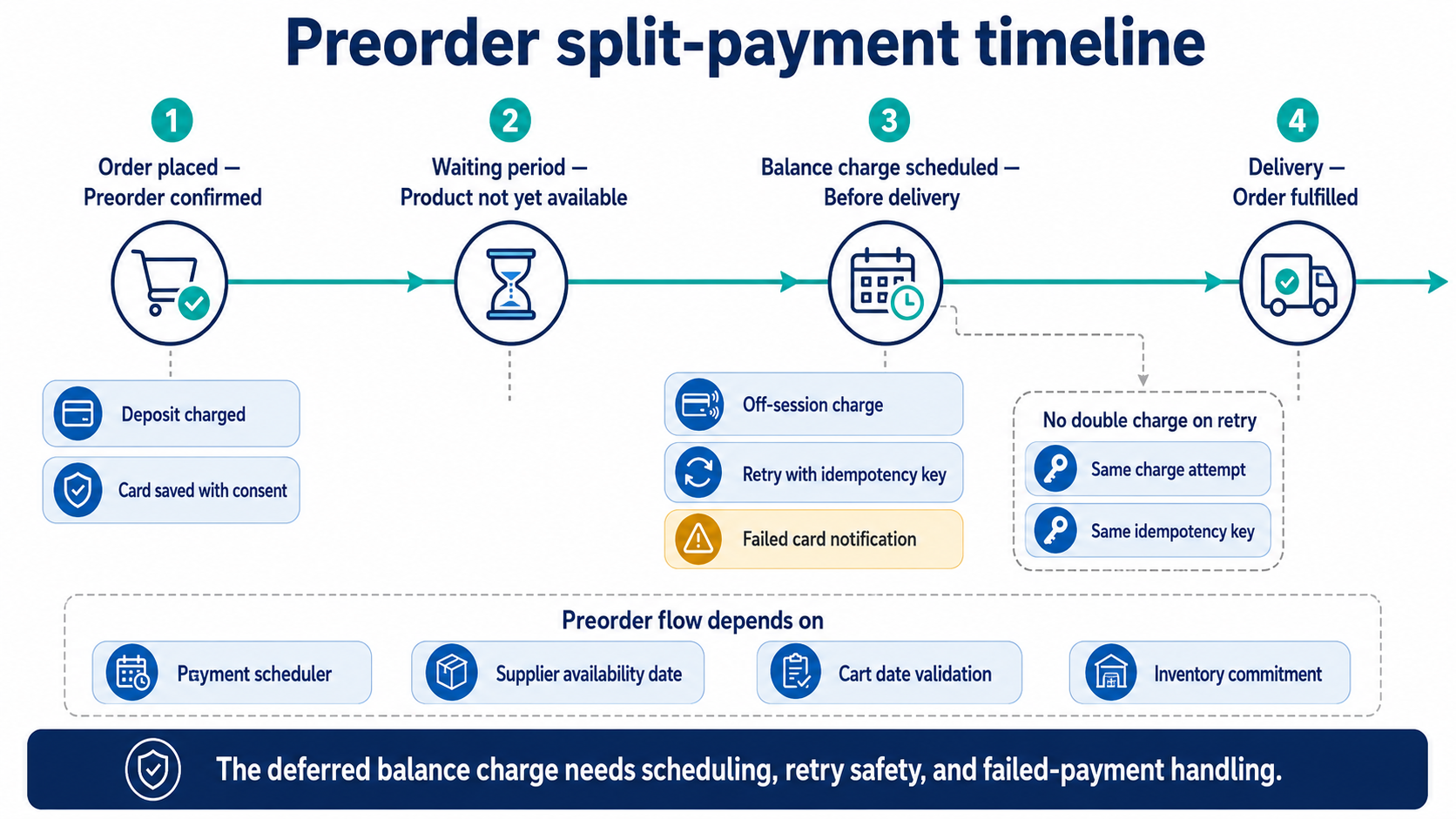
A split-payment preorder needs a scheduled balance charge before delivery, with retry handling that prevents duplicate charges.
If you are designing a preorder flow and the payment-scheduling side is the part giving you pause, that is the right instinct — it is where most of the risk sits. Our e-commerce engineering team has built split-payment preorders with deferred charging and can scope the scheduler, retries, and failure handling for your platform.
Availability is per-supplier, not platform-wide
A preorder needs a date for when the product becomes available, and on a marketplace that date belongs to the supplier, not the platform. The same product can be ‘available from’ different dates depending on who is fulfilling it, so the availability date has to be stored and resolved at the supplier level and carried onto the order. On a marketplace we built, supplier-specific availability dates drive the whole preorder calendar: the date a buyer sees, and the date the deferred charge counts back from, both come from the supplier fulfilling that particular order.
Treating the date as platform-wide is the common mistake, and it surfaces late — a buyer is promised a date one supplier can meet and another cannot, and the order fails at fulfilment. Tying the date to the supplier from the start keeps the promise honest and gives the payment scheduler a real date to work back from.
Future-date cart conflicts: what can and can’t combine
Once a cart can hold preorder items, it has to validate across future dates, because not every combination can ship as one order. The cart enforces a set of rules:
- two preorder items with conflicting delivery dates cannot share one order, since one route cannot deliver both on the same day
- a preorder combined with a group-buy item is restricted, because the two have separate timing and pricing logic that can contradict each other
- a preorder combined with a bundle or package product is handled with care, since a bundle assumes its parts ship together
These rules are not edge cases to bolt on later; they are the cart’s core job once preorders exist. The bundle and group-buy interactions in particular deserve their own attention, and we cover them in our pieces on bundle pricing and group buying. The cleanest implementation validates each combination explicitly at add-to-cart and at checkout, so a conflicting pair is caught before payment, not after.
Inventory commitment, and shipping a first version
The quiet decision in any preorder build is when to commit inventory to a future-dated order. Lock stock too early and you strand inventory that could have sold sooner; lock too late and you risk overselling a date you cannot honor, especially when a supplier can still revoke availability before fulfilment. The right point depends on how firm the supplier’s commitment is and how far ahead the delivery date sits, and most e-commerce platforms that run preorders end up with an explicit commitment step rather than treating a preorder like ordinary stock.
One practical lesson from building this: the first version shipped with limitations on purpose. Preorders touch payment, inventory, and cart at once, so trying to support every combination on day one is slow and fragile. Constraining the launch — one payment model, a restricted set of cart combinations — made it possible to ship, learn from real orders, and widen coverage as the edge cases revealed themselves. For a feature this entangled, the constrained first version is usually the faster route to a working one.
Key takeaways
- Preorder ecommerce sells a product before it is available, and its hard parts are payment timing, per-supplier availability dates, and future-date cart conflicts.
- Two payment models work: split payment (deposit now, balance charged automatically before delivery) and full prepayment with a discount incentive.
- The deferred balance charge must fire on time, handle failed cards and off-session authentication, and use an idempotency key so a retry never double-charges.
- Availability dates belong to the supplier, not the platform, and the cart must block preorder items whose delivery dates conflict.
- Decide inventory commitment timing deliberately, and ship a first version with limitations rather than trying to cover every combination at once.
Why the payment and cart rules decide whether preorders work
Preorder ecommerce earns its difficulty in three places: the deferred payment, the supplier-owned availability date, and the cart that has to keep conflicting future orders apart. The buy button is trivial; the scheduler that charges a balance without double-charging, the date that follows the supplier rather than the platform, and the rules that stop two incompatible preorders from sharing an order are what make the feature hold up under real orders. A team that designs those three before writing the checkout will ship a preorder flow that survives its first season, instead of one that strands inventory or charges at the wrong moment.
If you are building preorders for a seasonal product and want the payment, date, and cart logic designed before the first build, a short technical review will save a rebuild. Discuss your preorder architecture.
Summarize with AI
 ChatGPT
 Claude
 Gemini
 Grok
Grok Perplexity
FAQ











Interesting For You



Group buying architecture for delivery marketplaces
The interesting part of group buying lives in the order logic underneath the discount. This article covers how the model works in delivery commerce, the radius and discount-tier choices that shape it, and the failure mode that breaks real implementations — open-ended groups that accept members after delivery has been planned. The examples come from a marketplace we built that added group ordering and then had to fix exactly that.
Read article


White label app development: build vs runtime config
This is the architecture-decision version of the topic, written for the frontend lead or CTO who has to make the call rather than the buyer comparing app builders. It covers when each approach fits, a real project that used build-time configuration for its web apps and runtime selection for its mobile app, and the failure mode that turns a clean build flag into branching logic scattered across the codebase.
Read article


Hyperlocal delivery: address resolution and matching
This is an engineering walkthrough for teams rebuilding their address and supplier-matching layer after discovering that a postal-code approach causes complaints and rework. It covers moving to coordinate-based resolution, handling the addresses a maps API cannot fully resolve, and treating availability as more than distance. The examples come from a marketplace that made exactly this migration, from postal-code matching to full coordinate resolution.
Read article