


Group buying architecture for delivery marketplaces


Group buying lets several buyers in the same area pool into one order and unlock a collective discount, with a shared delivery that makes the discount pay for itself. This is the Pinduoduo-style model — buyers team up, the price drops as more join, and one route serves the cluster. It is the version worth building into a delivery marketplace, and the one this article covers.
Two other things share the name and are not the subject here. A buying group, or group purchasing organization, is a procurement consortium where businesses combine demand to negotiate supplier contracts. Vertical buying groups in audiology, automotive, or franchise networks pool purchasing within an industry. The model below is consumer-facing collective ordering for delivery, where the discount exists because neighbors share a route, and the engineering problem is keeping that shared route intact.
The interesting part of group buying lives in the order logic underneath the discount. This article covers how the model works in delivery commerce, the radius and discount-tier choices that shape it, and the failure mode that breaks real implementations — open-ended groups that accept members after delivery has been planned. The examples come from a marketplace we built that added group ordering and then had to fix exactly that.
What group buying means in delivery commerce
Group buying is collective buying: a product is offered at a reduced price on the condition that a minimum number of buyers commit to it. The model traces back to the Chinese practice of tuángòu, or team buying, and the definition of group buying still rests on that conditional discount — the deal unlocks only when enough people join. In delivery commerce, the condition carries extra weight, because the discount is tied to a shared delivery rather than a shared price alone.
That link between the discount and the route is what separates delivery group buying from a coupon. When neighbors order together and one vehicle serves the cluster, the platform saves on fulfilment and passes part of that saving back. Take away the shared route, and the discount has nothing behind it.
How the model works at scale: Pinduoduo and Meituan
The two reference implementations are Chinese. Pinduoduo built its growth on a team-purchase model: each product shows an individual price and a lower group price, and a buyer who starts or joins a group within a set window unlocks the discount, then recruits others through social apps to fill it. The mechanic is self-spreading, since the more people a buyer brings in, the better the price, so buyers do the marketing themselves.
Meituan runs a different shape of the same idea. Its community model, described in the Meituan platform overview, uses a bulk-purchasing approach that groups neighborhood orders and delivers them next-day to a designated pick-up point, often coordinated by a local community leader. The discount comes from aggregating demand and delivering in bulk to one place rather than to many separate doors.
A Western delivery marketplace usually adapts the second shape more than the first. Instead of a community leader and a pick-up point, it groups buyers by geography — neighbors within a small radius — and runs one delivery route for the group. The social recruitment of Pinduoduo and the bulk-route economics of Meituan combine: buyers invite nearby buyers, and the platform serves them on a single route.
The two design choices that carry it: radius and discount tiers
Two parameters decide whether delivery group buying works: how wide the group’s geographic radius is, and how the discount scales with group size.
The radius is set around the person who starts the group. It has to be tight enough that one route can serve everyone in it, and loose enough that a buyer can actually find neighbors to join. On a marketplace we built, that radius is 350 meters from the initiator’s address — a deliberate choice with operational consequences. Checking whether a new participant falls inside it is a geographic distance test: with both addresses stored as coordinates, MySQL’s ST_Distance_Sphere returns the meters between them, and the join is allowed only if that distance is within the radius.
The discount scales with the group. The public case for that build describes tiered discounts in a 25 to 70 percent range, deepening as members join, which is what turns buyers into recruiters. The specific tiers on that build:
Each step up the ladder is a reason for a participant to bring in one more neighbor, because the next tier lowers the price for everyone already in the group.
If you are scoping a collective-ordering feature and want the radius, tier, and route rules thought through before you build, that is the kind of problem worth a conversation. Our e-commerce engineering team has built group buying into a live marketplace and can map the design to your delivery model.
The failure mode: open-ended groups break the shared route
The model breaks when a group keeps accepting members after delivery has started to be planned. The whole discount rests on one shared route, and a late joiner cannot be added to a route that is already planned or already run.
On the marketplace we built, the original implementation allowed open-ended group orders. New participants could join even after some of the group’s deliveries had been planned or completed, which quietly broke the business logic: group delivery was supposed to happen through a single shared route, and open membership made that impossible. Fixing it took several changes layered in over time:
- a hard group deadline, after which no new member can join
- delivery-date inheritance, so every member takes the initiator’s delivery date and the route stays one route
- a block on delivery planning for any group member until the deadline passes
- single-route enforcement across all members of the group
Underneath those rules is a state problem: the group order moves through a lifecycle — created, members joining, deadline reached, filled or expired — and every rule depends on knowing exactly where it is. Recording that lifecycle as an append-only series of events, in the style Microsoft documents for the event sourcing pattern, keeps the state unambiguous: you can see when each member joined relative to the deadline, and no late join can slip behind a planned route.
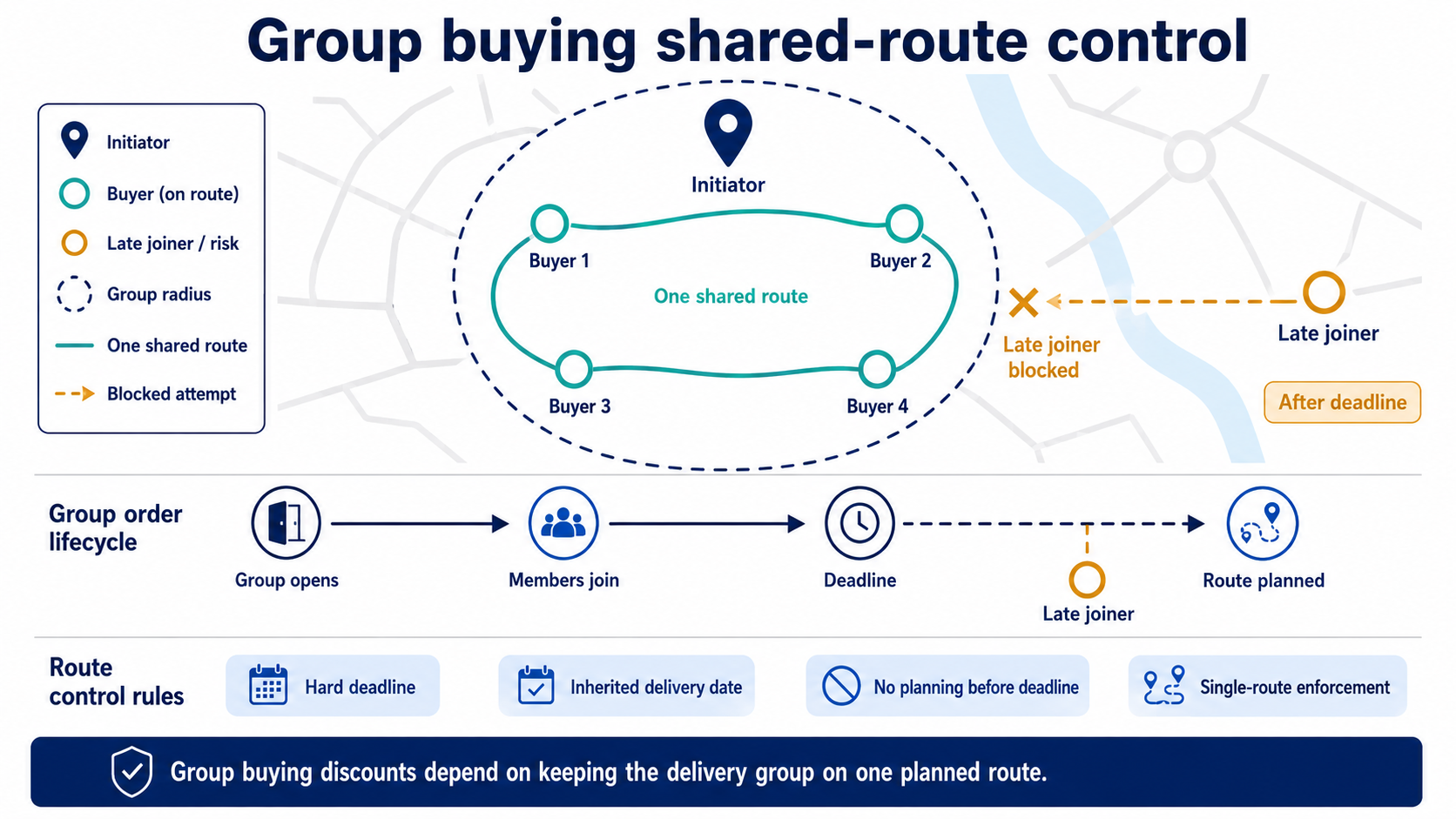
Group buying works when the group closes before route planning, so every member can be served through one shared delivery route.
Patterns worth building in: dynamic upgrade and cashback
Two patterns make the model smoother in practice. The first lets a regular order become a group order. If a product supports group ordering, a buyer placing a normal order can convert it into a group order, with a group code generated automatically, so the group can start from an order that was already happening rather than only from a deliberate group action.
The group code is how others join. It is distributed by email with instructions, and each join is validated against the participant’s delivery address, so the radius rule holds for everyone who uses the code. The address check is the same distance test that defines the group in the first place.
The second pattern is cashback. Because members join at different moments and the final discount depends on how many end up in the group, the cleanest accounting is to charge each participant and then return the discount as a refund once the group fills. Everyone pays the same fair price for the final group size, regardless of when they joined. This pattern appears across e-commerce marketplaces that run any kind of conditional or volume discount, not only group buying.
When group buying fits a delivery marketplace, and when it doesn’t
Group buying fits a narrow but real set of conditions. It works when buyers are geographically dense enough to form groups within a tight radius, when the products are repeat, low-cost essentials that people are happy to coordinate on, and when the delivery economics actually improve by serving a cluster on one route. Firewood, groceries, and household staples fit, because the model was built for exactly this kind of repeat, plannable demand. It does not fit several common cases:
- sparse geography, where no group can form inside a radius tight enough for one route
- instant or time-critical delivery, where buyers will not wait for a group deadline to be reached
- high-variance carts, where members of a group want very different things and the shared-route saving disappears
The geographic side of this — how the radius is defined and how addresses resolve to coordinates — is its own engineering problem, covered in a companion piece on hyperlocal delivery. On the build-versus-buy question, the discount interface is the easy part to copy; the deadline, route, and state rules are the part that decides whether the feature holds up, and they are where most of the engineering effort goes.
Key takeaways
- Group buying offers a collective discount on the condition that a minimum number of buyers join, and in delivery it ties that discount to a shared route.
- The reference models are Pinduoduo’s social team-purchase and Meituan’s community bulk delivery; Western marketplaces usually group buyers by a tight geographic radius.
- Two parameters carry the model: the group radius around the initiator, and discount tiers that deepen as the group grows.
- The main failure mode is the open-ended group: accepting members after delivery is planned breaks the single shared route the discount depends on.
- Fix it with a hard deadline, an inherited delivery date, no planning before the deadline, and single-route enforcement.
Why the route rules matter more than the discount
Group buying reads like a pricing feature and behaves like an order-coordination problem. The discount is easy to display and easy to copy; what decides whether the model works is the logic that keeps a group on one shared route — the radius that bounds it, the deadline that closes it, and the state tracking that stops a late join from breaking a plan. The Asian platforms that scaled it, Pinduoduo and Meituan, succeeded on operations as much as on price. A delivery marketplace adding the feature should budget its effort the same way, putting most of it into the order rules rather than the discount screen.
If you are planning a collective-ordering feature and want the radius, deadline, and route logic designed before the first build, a short technical review will save a rebuild. Discuss group buying for your marketplace.
Summarize with AI
 ChatGPT
 Claude
 Gemini
 Grok
Grok Perplexity
FAQ











Interesting For You



White label app development: build vs runtime config
This is the architecture-decision version of the topic, written for the frontend lead or CTO who has to make the call rather than the buyer comparing app builders. It covers when each approach fits, a real project that used build-time configuration for its web apps and runtime selection for its mobile app, and the failure mode that turns a clean build flag into branching logic scattered across the codebase.
Read article


Hyperlocal delivery: address resolution and matching
This is an engineering walkthrough for teams rebuilding their address and supplier-matching layer after discovering that a postal-code approach causes complaints and rework. It covers moving to coordinate-based resolution, handling the addresses a maps API cannot fully resolve, and treating availability as more than distance. The examples come from a marketplace that made exactly this migration, from postal-code matching to full coordinate resolution.
Read article


Product bundle pricing: snapshotting and vendor rules
This piece is written for both sides of that conversation: the product or marketing lead deciding whether to add bundles, and the engineer who has to build them without breaking historical orders or constraining vendors. It draws on a marketplace where packages drive most of the revenue, and it covers the rules, the pricing models, and the one engineering choice — snapshotting — that quietly determines whether your order history stays honest.
Read article