


BI Team Alignment for 2026: BA, Engineering, and Business


BI team alignment for 2026 has become more visible as Power BI Fabric and Amazon Quick Suite expanded their governance, lineage, and refresh features through 2025. The tooling caught up with the complexity of mid-market BI work. How BA, engineering, and business teams coordinate around those tools usually lagged behind, and that coordination gap is where dashboards continue to break in production.
The patterns are recognisable. Conflicting metrics show up across Finance and Operations dashboards. Refreshes miss windows because upstream owners changed without notice. Requests bounce between business analysts and data engineers through multiple sprints before anyone notices the scope shifted during the original intake. Each of these emerges whenever teams work alongside each other without explicit decision rights, clear intake rules, or durable handoff artifacts. As 2026 BI workloads grow, the cost of that ambiguity compounds.
This article looks at how mid-market companies organise team alignment for 2026 BI workloads: who decides what, how requests move from a stakeholder's question to a tested dashboard, which artifacts survive the handoff between teams, and what happens when departments disagree. The focus is the coordination layer between business intent and technical implementation — the part where new BI platform features don't close the gap on their own.
Updated in June, 2026
Why BI team alignment matters more than platform features in 2026
Team alignment determines whether the new BI platform features actually improve reporting stability, or whether they just expand the surface area where misaligned teams can produce conflicting numbers. A semantic model with three unclear owners produces three versions of revenue. A lineage view that no one is responsible for reading produces audit risk rather than transparency. Refresh diagnostics in Amazon Quick Suite tell you that SPICE capacity was exceeded — they don't tell you which team owns the dataset that ran over.
Through 2025, Microsoft Fabric and Amazon Quick Suite both released features that assume an operating model is already in place. Fabric's expanded governance — workspace roles, sensitivity labels, lineage, and deployment pipelines — only works as a coordination tool when teams agree who can mark a model as production-ready. Quick Suite's dataset modelling improvements help teams reuse logic across analyses, but only if there's an agreement on which dataset is canonical.
For mid-market BI teams — typically a small core of BA, engineering, and analyst roles supporting business stakeholders across several departments — this is the moment where investment in platform features starts producing diminishing returns without parallel investment in coordination. The cost shape is different: platform features carry licence dollars, while alignment costs meeting time and documentation hours. The trade-off usually runs in favour of the alignment work once teams compare escalation volume before and after.
Where this becomes most visible: the same KPI showing different values in two dashboards. This is one of the structural symptoms covered in structural causes of KPI misalignment across teams, and most of the durable fixes sit in the coordination layer rather than in the data layer.
Decision rights across BA, engineering, and business stakeholders
Most BI alignment problems start with unclear decision rights rather than unclear data. When no one knows who decides what a KPI means — or when multiple people think they do — the dashboards that depend on that KPI inherit the ambiguity. Three categories of decisions usually need explicit owners.
KPI definition decisions come first. Business stakeholders own the definition: what counts as monthly recurring revenue, what an active patient is, what closed-won means. The BA documents the definition and its edge cases. Engineering validates whether the definition can be calculated consistently against the data available. When this split breaks down — typically because an executive overrides a definition without telling the BA — two dashboards start showing different numbers and engineering gets blamed for the inconsistency.
Data model decisions form the second category. Granularity, joins, refresh strategy, and physical model choices belong to engineering. The BA contributes by clarifying what the business needs to be able to slice; engineering owns whether that's feasible at the chosen grain. A BA who unilaterally requests minute-level granularity without engineering input usually triggers a rebuild some sprints later.
Access and visibility decisions sit in the third bucket. Who can see which subset of the data — row-level security, workspace-level access, share scope — is a business and security question, with input from compliance where regulated data is involved. Engineering implements; engineering does not decide who sees what.
The cleanest version of this is a short written document, often a single page, that lists the decision categories, the accountable owner, the consulted parties, and the escalation path. Many mid-market teams already have one informally, and formalising it tends to be a contained effort that prevents months of escalations. Where this fits into the broader operating model is covered in BI operating model patterns for mid-market teams.
Intake and triage that prevents work from piling up
An intake process is the lightest-weight mechanism for keeping BA and engineering capacity predictable. Without one, BI work arrives through Slack direct messages, hallway conversations, and ad hoc emails — each carrying different assumptions about urgency, scope, and approval. Each shadow request eats capacity that was supposed to support the prioritised roadmap.
A working intake process typically has four components. A standard request form captures the business question, the decision the dashboard supports, the named stakeholders, and the data scope. A weekly or biweekly triage session — short, time-boxed, async-friendly — reviews new requests and assigns ownership. Three work categories help route requests efficiently: net new work (architecture and feasibility review needed), modifications to existing assets (scoped within the current operating model), and data quality or bug work (fast-tracked through a separate lane to avoid blocking new build). A capacity gate means no work starts without a named BA and engineering owner.
The trade-off worth being honest about: intake adds visible overhead in the form of meeting time and documentation, and stakeholders sometimes push back when their request can't start the same day. The alternative — invisible overhead in the form of reprioritisation, context switching, and rework — usually costs more. Most mid-market BI teams that introduce a basic intake report fewer surprise escalations within their first review cycles, even before the process matures.
Common failure modes when intake is missing or weak: engineering jumping into implementation before business validation; BAs producing detailed requirements without engineering feasibility input; stakeholders bypassing the BA entirely and treating engineering as the front door for any data question.
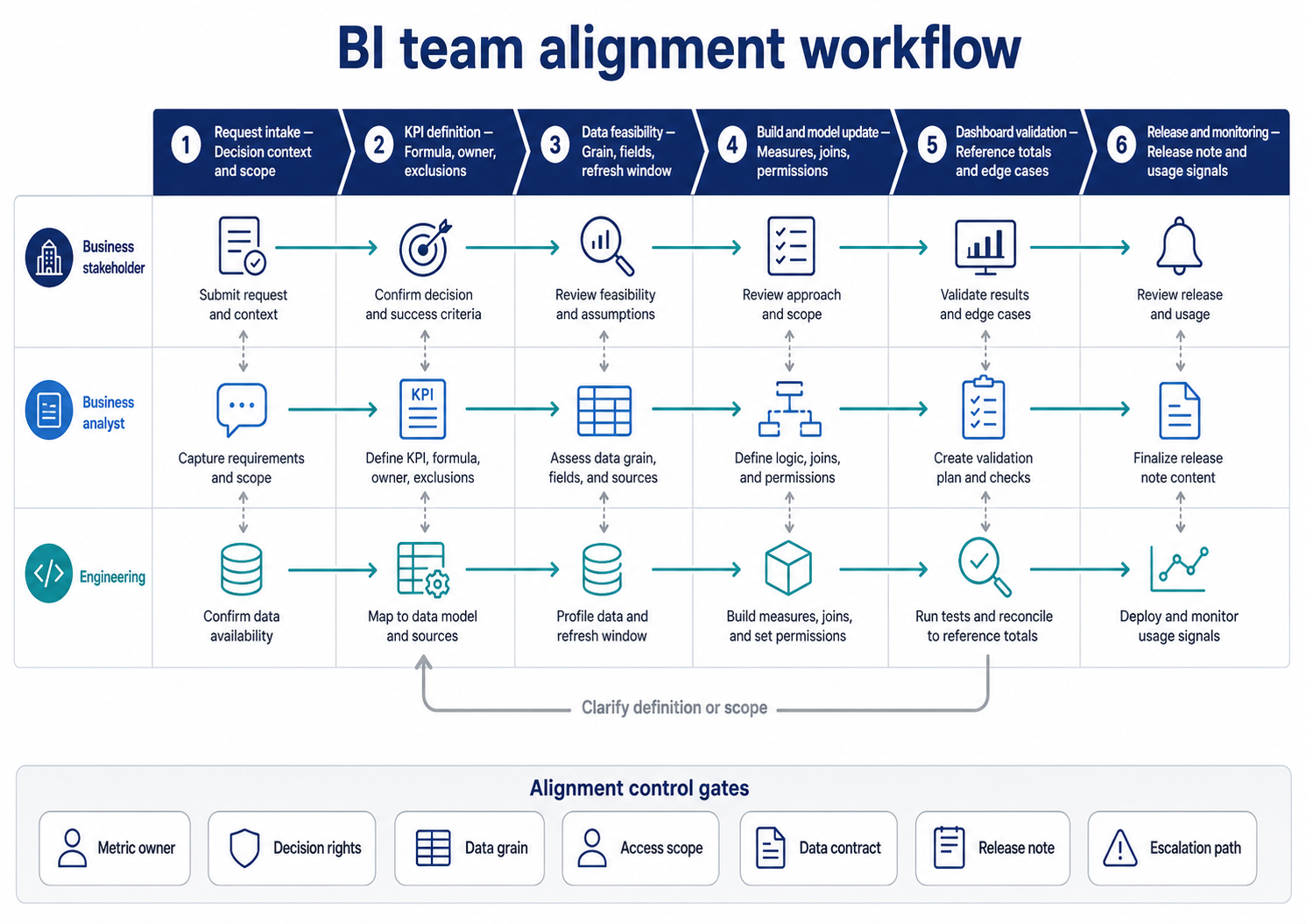
BI team alignment works when every request has visible ownership, decision rights, feasibility review, validation, release notes, and an escalation path.
If your team is running BI work across two or three departments and intake bottlenecks are slowing delivery, the pattern is fixable. A working session with engineers and BI specialists who've structured operating models in similar mid-market environments can outline a starting point in a single conversation. Discuss your BI operating setup with Bluepes.
Joint working rituals between BA and engineering teams
Sustainable BI delivery depends on a small number of recurring working sessions where BA and engineering review the same artifacts together. The rituals matter less for the meeting time and more for the shared mental model they produce. A team that walks through a draft dashboard together resolves more ambiguity in one session than a team passing the same artifact through serial Slack threads.
Three rituals carry most of the value:
- Pre-implementation review. The BA presents the proposed scope. Engineering challenges feasibility — granularity, refresh frequency, integration with the existing semantic model. The business stakeholder confirms intent against the actual question being answered. Work begins after this session, not before.
- Mid-build checkpoint. An early prototype, often a stub dashboard against synthetic or partial data, is walked through against the original question. This catches misinterpretations early — when the cost of rework is hours, not sprints.
- Pre-release dashboard walkthrough. The stakeholder sees the finished dashboard, in the platform, with real data. Final adjustments are agreed before the dashboard is shared more widely.
These rituals exist informally in most well-functioning teams. Formalising them — adding them to the standard cadence, naming who must attend, agreeing what artifacts come in and out — is what makes them survive team turnover. A team that depends on three specific senior people doing this informally loses the practice when those people leave; a team with a documented ritual keeps it.
For teams using Power BI implementation and governance services, these rituals integrate naturally with Fabric's deployment pipelines, where the pre-release walkthrough happens in the test workspace before deployment to production. For Amazon Quick Suite analytics delivery, the same pattern works against folder-based environments and dataset version promotion.
Handoff artifacts that survive the transition between teams
The artifacts produced during a BI request matter more than the meetings, because the artifacts persist after the meetings end. Three artifacts hold most of the cross-team alignment in place.
The metric specification documents the KPI itself: name, formula, owner, exclusion rules, validation queries, and the source of truth for the definition. When a new dashboard reuses an existing KPI, the spec is the reference. When a stakeholder questions a value, the spec is the answer.
The data contract documents the agreement between the producing system and the consuming dataset: fields, types, null rules, refresh frequency, breaking-change protocol, and named owners on both sides. Data contracts are becoming more common in mid-market BI environments; deeper patterns are covered in lightweight data governance patterns for BI.
The release note documents what changed, why, who approved, and when the change goes live. Even a short note — three or four bullet points published to a shared channel — prevents the most common stakeholder complaint: "the number changed and I didn't know."
What makes these artifacts work is the same in all three cases: a named owner, a known cadence for review, and an actual update history. Documents written once and abandoned don't help anyone. The version history is the artifact almost as much as the current version.
Routing disagreements without bottlenecking the BI team
Most BI disagreements resolve fastest when teams agree in advance who decides — and when the decision path differs depending on whether the disagreement is technical, semantic, or political. A single escalation channel for everything turns the executive sponsor or steering group into a bottleneck within months.
Technical disagreements — real-time versus batch, granularity, where in the pipeline a calculation should live — stay with engineering. The BA contributes by surfacing business impact: "if we go batch, the dashboard is four hours behind, which Operations needs to know." Engineering decides; the decision is recorded.
Semantic disagreements — how revenue is defined, when a patient counts as discharged, what constitutes a churned customer — belong to the business owner of the relevant KPI. The BA documents the trade-offs and the options; the business owner picks. Engineering then implements the chosen definition consistently.
Political disagreements are the harder category: two departments want different versions of the same metric, both for valid business reasons. Sales wants revenue net of refunds and discounts; Finance wants revenue on an accrual basis. These escalate to a small standing group — a metric council, BI steering committee, or whatever name the organisation uses — that makes the cross-functional call. The output is sometimes one definition and sometimes two named, scoped definitions clearly tied to specific decisions.
When all three categories route to the same place, that place becomes the bottleneck. When they route by type, decisions happen at the right speed: hours for technical, days for semantic, weeks for political. Most mid-market teams that map out their escalation paths find that only a small share of disagreements end up at the steering group, which is what makes the steering group sustainable as a recurring forum.
Key takeaways
- Team alignment is the rate-limiter on getting value from 2026 BI platform investments — Fabric and Amazon Quick Suite features perform as well as the coordination around them.
- Explicit decision rights for KPI definitions, data model choices, and access scope prevent the most common cause of conflicting dashboards.
- A lightweight intake and triage process keeps BA and engineering capacity predictable and shuts down shadow requests through direct messages.
- Three artifacts hold cross-team alignment in place: metric specifications, data contracts, and release notes — each with a named owner and a review cadence.
- Different categories of disagreement need different escalation paths; routing everything to one decision point creates a bottleneck within months.
Why 2026 BI investment depends on team alignment, not just platform features
For mid-market BI teams entering 2026, the question is no longer whether Fabric or Amazon Quick Suite offers the features needed to manage scale. Both platforms shipped substantial governance, lineage, and modelling improvements through 2025, and most of the gaps that mattered in 2023 have been closed. The remaining gap, in the teams we work with most often, sits in the coordination layer: who decides, who hands off to whom, what artifacts persist, and what happens when there's a disagreement.
The work of designing that coordination layer typically isn't a large investment in absolute terms. A one-page decision-rights document, a structured intake process, three or four core artifacts under named ownership, and a differentiated escalation path together represent a contained block of design work — and a period of running them deliberately before they feel natural. Where the operating discipline takes hold, the return shows up as reduced escalations, fewer rework cycles, and faster delivery on the requests that drove the BI investment in the first place.
For mid-market companies preparing 2026 BI roadmaps that involve multiple departments, a dedicated discovery session with Bluepes BI specialists examines how decision rights, intake, and handoff patterns can be designed for the specific stack in use — Power BI Fabric, Amazon Quick Suite, or hybrid. Plan a BI alignment review with Bluepes.
Summarize with AI
 ChatGPT
 Claude
 Gemini
 Grok
Grok Perplexity
FAQ











Interesting For You



Reporting workflows for business analysts in 2026
Reporting workflows give business analysts a controlled path from request intake to published dashboard. The workflow defines who owns the metric, which dataset is trusted, how changes reach the semantic model, what validation happens before publishing, and how refresh or access issues are tracked after release.
Read article



How Can Data Science Help My Organization?
Nowadays, there is a tendency to hire data scientists or even form data science groups in companies. This does not only apply to specific activity sectors or large organizations. Small and midsize businesses are more frequently involving data scientists, in order to get actionable insights from collected information. So, how does data help to run and grow everyday businesses? There are several areas where collected data and the insights drawn from that data can have a significant impact on business.
Read article



Data quality rules every BI team should apply before 2026
Data quality rules close that gap. They define what every dataset is expected to contain, when it is allowed to update, which numeric values count as plausible, and how the system should respond when any of those expectations is violated. They are the reason the same KPI returns the same number across Finance, Operations, and the executive team on a Monday morning, even when the underlying systems have changed during the week.
Read article