


BI Readiness for 2026: Governance, Lineage, and Cost Control


Most mid-market BI environments enter 2026 with a backlog of pending reporting work and a smaller backlog of pending engineering decisions: extend the current semantic model or rebuild it; consolidate workspaces or keep them separate; raise the Fabric capacity tier or fix the refreshes that pushed it past the threshold. Each of those decisions is easier when the team knows where the BI environment actually stands. The fast way to know is a structured readiness check.
BI readiness is the state of governance, lineage, refresh and capacity controls that determines how predictably reporting holds up as workloads grow. A team is ready when scaling adds dashboards without adding reconciliation calls. This article walks through the dimensions a BI lead can inspect this quarter, what “not ready” looks like in each one, and which gap to close first.
Both Power BI Fabric and Amazon Quick Suite added more granular governance and diagnostics through 2025, which makes the assessment cheaper to run than it was a year ago. The reverse is also true: teams that postpone the check pay for it later in capacity bills and KPI disputes.
Updated in June, 2026
What BI readiness means for a mid-market team
BI readiness is the answer to a single question: if reporting workloads double next quarter, what breaks first? It covers six dimensions — governance, lineage, data quality, KPI consistency, refresh and capacity, and team alignment — and each of them fails in a recognisable way before any dashboard goes red.
Definition placed early because the term carries different meanings across vendor materials. Microsoft uses it in the context of Fabric capacity sizing. AWS uses it loosely when describing Quick Suite onboarding maturity. The operational definition used in this article is narrower: readiness is the team's ability to detect a problem at the layer where it originated, fix it without paging three other teams, and continue shipping reports. Nothing more ambitious than that — but very few mid-market environments hit the bar without preparation.
Symptoms that say the environment is not ready
Before running the structured check, scan for visible symptoms. Each one maps to a readiness gap downstream. None of them is decisive on its own, but two or more from the list usually means the audit will surface deeper issues.
- Two dashboards show different totals for the same metric, and nobody can say which is the source of truth in under a minute.
- Capacity bills rose in Q4 2025 without a clear cause, and the next budget cycle includes a line item for “BI overage”.
- Refresh failures arrive as user complaints, not as alerts to the BI team.
- A column rename upstream broke five reports, and the team learned about it from the morning stand-up.
- Permissions are managed dataset by dataset, and the last access review was more than six months ago.
- Analysts run the same calculation in three places because the semantic model has no shared measure for it.
The pattern across these symptoms is the same: information about the BI environment lives in the wrong place. Costs are invisible until the bill arrives, refreshes fail in silence, KPI logic lives in DAX rather than in a named definition. Readiness work moves each of those signals into a place where the right person can act on it before it becomes a meeting.
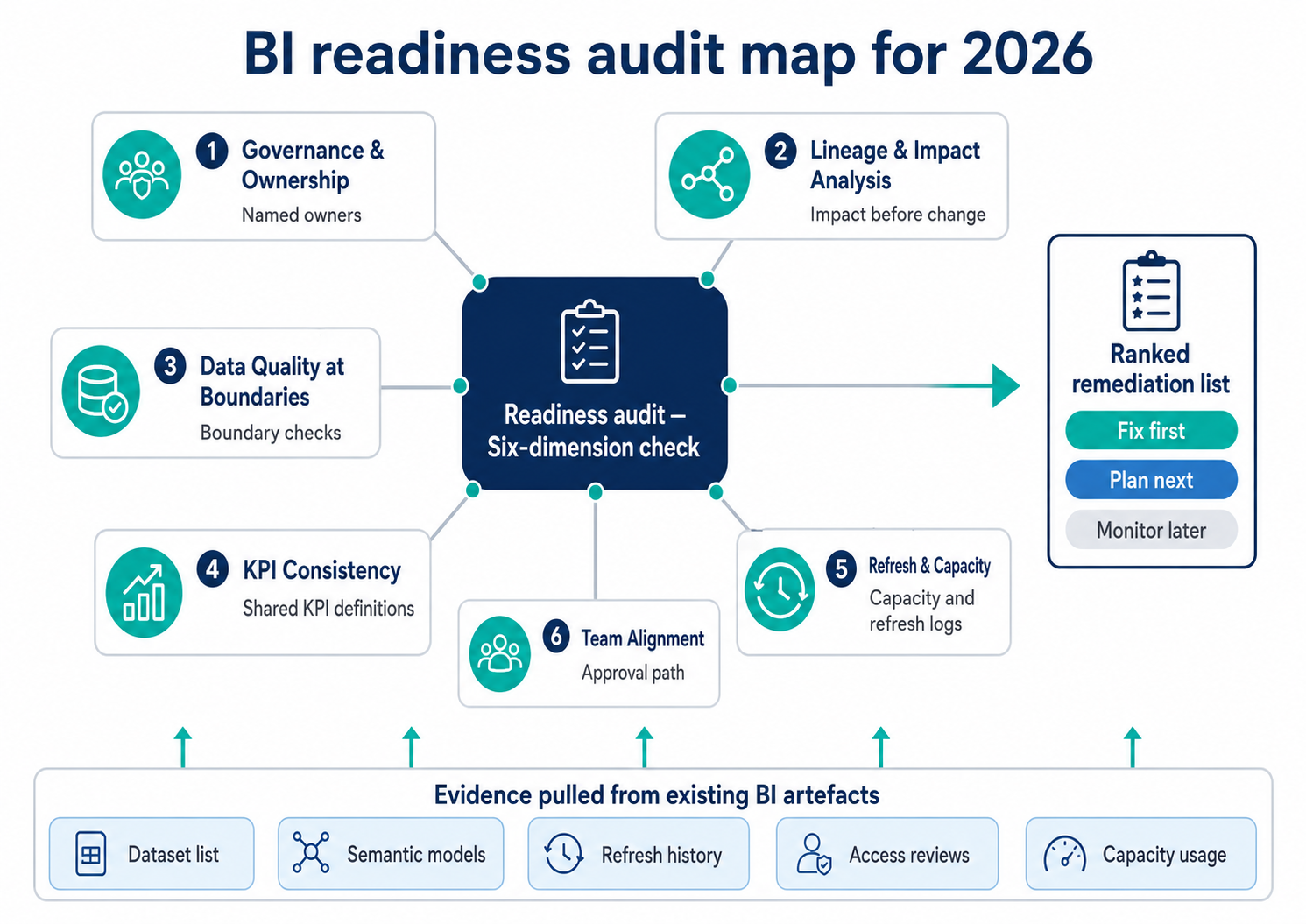
A BI readiness check helps teams inspect governance, lineage, data quality, KPI consistency, refresh and capacity, and team alignment before scaling reporting workloads.
How to run the readiness check across six dimensions
The check below takes one focused week for a mid-market team and produces a ranked list of gaps. Each dimension has the same structure: what to inspect, what bad signs look like in the artifacts the team already produces, and where to go for the implementation depth once a gap is confirmed.
Governance and ownership
Pull the list of datasets, semantic models and shared workspaces. For each, the audit asks two questions: who approves changes, and where is that recorded? If the answer requires a Slack search or a hallway question, the dataset is ungoverned in practice, regardless of what the tenant settings say. A second check: how many of the top ten dashboards have a named KPI owner who can approve a definition change? Below seven is a gap.
Once the gap is confirmed, the deeper implementation patterns — KPI cards, named owners, data contracts, release notes — are covered in lightweight data governance for BI. Use it as the build-out playbook once the audit shows which datasets need it first.
Lineage and impact analysis
Lineage is the dimension where Power BI Fabric and Quick Suite both made visible progress in 2025. Fabric expanded the lineage view to cover Lakehouse dependencies; Quick Suite improved refresh logs and dataset dependency surfacing. The audit question is whether the team can answer, in under five minutes, which reports a single upstream field change would affect. A team that cannot answer this is operating without an early-warning layer; every schema change becomes a post-incident review rather than a planned migration.
Microsoft's lineage documentation describes the view and its scope. The audit doesn't require lineage tooling to be perfect — it requires that the team uses it before approving changes, not after.
Data quality at boundaries
Most data quality work in mid-market environments runs after ingestion: row counts in the warehouse, completeness checks in the semantic model, null handling in DAX. The audit checks whether any quality validation happens at the boundary — before the data enters the warehouse. Boundary checks catch schema drift before it propagates; warehouse checks catch the symptoms after five reports have already absorbed them.
A team without boundary contracts can still ship, but it absorbs more cleanup cost per release. Data quality rules for mid-market BI lays out the rules teams adopted through 2025 to keep dashboards stable.
KPI consistency across teams
The audit on KPI consistency is a one-hour exercise that produces a clearer picture than any dashboard tour. Pick three metrics that appear in both finance and operations reporting — revenue, active customers, gross margin — and ask each team to send their calculation. A mid-market environment that returns three identical calculations for all three metrics is in the top quartile. The more common result is six different calculations across the three metrics.
Inconsistency at this layer almost always has a structural cause rather than a calculation error. Structural causes of KPI misalignment walks through where the divergence usually originates.
If the symptom scan flagged two or more items and the audit at this point is still surfacing gaps, an outside review can cut the assessment time in half by separating real architectural debt from cosmetic issues. Discuss a BI readiness review — a one-week structured audit across the six dimensions, with a ranked remediation list at the end.
Refresh and capacity
This dimension folds two questions into one: are refreshes running on a schedule that matches upstream data arrival, and is the capacity tier sized for the actual workload rather than the worst week. The audit pulls the last 30 days of refresh logs and looks for three things: refreshes scheduled more frequently than upstream updates; refreshes that retry more than twice per day; and SPICE or Fabric capacity that hit ceiling alerts during normal business hours, not month-end.
For Amazon Quick Suite, SPICE behaviour is documented in AWS guidance — capacity formulas there are useful for sizing reviews. For deeper patterns on refresh resilience and recovery, the cluster article on BI resilience patterns for late data and schema changes covers what to put in place once the audit confirms the gap. For cost-focused tuning specifically, predictable BI cost control covers the consolidation patterns that reduced compute consumption in case studies from 2025.
Team alignment and operating model
The last dimension is the one most teams skip and the one that determines whether the other five remain healthy six months after the audit. The check looks at how a metric change moves through the team: who proposes it, who approves it, how engineering hears about it, how business users are notified. If the answer is “Slack and good intentions”, the readiness work will erode as soon as audit pressure lifts.
Mid-market teams generally land on a lightweight model rather than a formal data office. The patterns are described in BA, engineering, and business alignment for 2026 BI workloads and in the broader lean BI operating model for mid-market teams. Either is a sensible starting point once the audit identifies where the current model is breaking.
What to fix first when the audit surfaces several gaps
Most readiness checks surface gaps in four or five of the six dimensions. Fixing all of them in one quarter is neither realistic nor advisable — the fixes interact, and changing the operating model and the semantic model in the same sprint produces confusion rather than progress. The sequence below comes from what has worked across audits run with mid-market teams in 2024–2025.
KPI consistency goes first. As long as finance, operations and product show different numbers for the same metric, every other improvement is contested. A small wave of definition work — three to five KPIs, each with a one-screen card and a named owner — clears the discussion ground.
Governance comes second. With KPI definitions stable, ownership of datasets and semantic models is straightforward to assign because the definitions already point at owners. This is also the cheapest step to do well; most of the friction is political rather than technical.
Refresh and capacity come third, because by this point the team has enough visibility into which datasets actually matter to make sensible consolidation decisions. Consolidating duplicated datasets is the most productive step in this dimension: each retired dataset removes its own refresh schedule, its own transformation cost and its own permission surface. The size of the benefit depends on how much overlap accumulated through earlier years; teams that ran a cleanup recently see a smaller delta than teams that have not consolidated since the original Power BI Premium or QuickSight rollout.
Lineage, data quality and team alignment work in parallel from month two onward. None of the three benefits from being rushed before the first three are stable.
Where Power BI Fabric and Amazon Quick Suite differ during the audit
The six dimensions apply to both platforms, but the audit collects different evidence on each. A short summary helps the BI lead allocate review time.
Teams running on both platforms — increasingly common in mid-market environments after acquisitions — should expect the audit to take noticeably longer and to surface gaps in dataset consolidation that single-platform audits do not. The platform-specific service pages cover the implementation side: Power BI consulting and governance and Amazon Quick Suite implementation and review.
When an internal audit is enough, and when it isn't
Internal readiness checks work well when the team has at least one senior BI engineer with full visibility across the environment and the political standing to ask uncomfortable questions about ownership. The check fails when those conditions are missing — usually because the senior engineer is the same person who built the current model and would have to audit their own work, or because ownership questions cross too many department lines for an internal reviewer to land them.
External review fits at that point. A focused engagement runs the six-dimension audit in five working days, produces the ranked gap list and the remediation sequence, and hands the implementation back to the internal team. Bluepes runs these as a fixed-scope engagement for mid-market BI environments — schedule a readiness review.
Key takeaways
- BI readiness is the team's ability to detect a problem at the layer where it originated and fix it without cross-team escalation.
- Six dimensions cover it: governance, lineage, data quality at boundaries, KPI consistency, refresh and capacity, team alignment.
- KPI consistency is the first gap to close — until finance and operations agree on a number, every other fix is contested.
- Lineage and refresh visibility are the cheapest wins on both Power BI Fabric and Amazon Quick Suite in 2026.
- Internal audits suffice when there is a senior engineer with full visibility and political standing; external review fits when those conditions are missing.
Why a structured readiness check beats reactive fixes through 2026
Reporting workloads scale faster than mid-market BI teams in 2026. The teams that handle that scaling without a quarterly capacity surprise or a board-level KPI dispute are the ones that ran a structured assessment first, picked the right three gaps to close, and left the rest for the next cycle. The teams that improvise are the ones that meet the same problems in November that they could have surfaced in February.
If the symptom list at the top of this article matched two or more items in your environment, the readiness check is the next concrete step. Request a BI readiness review — a one-week structured audit, ranked remediation plan, and a sequence the internal team can run.
Summarize with AI
 ChatGPT
 Claude
 Gemini
 Grok
Grok Perplexity
FAQ











Interesting For You



Power BI vs Amazon Quick Suite: a 2026 platform decision
Power BI suits organizations whose data, identity, and productivity already sit inside Microsoft 365 and Azure, with teams that model in DAX and consume through Excel-based workflows. Amazon Quick Suite (rebranded from QuickSight on October 9, 2025) suits AWS-native stacks where dashboards reach large viewer populations or get embedded inside customer-facing applications. The cost shape is different too — per-user heavy for Power BI, viewer-economical for Quick Suite — and the gap compounds with team size.
Read article


BI operating model for mid-market analytics teams
A BI operating model gives mid-market companies a practical way to run analytics work without turning every dashboard request into a ticket queue. It defines who owns KPI logic, who changes the semantic model, how dashboard releases are reviewed, and what reliability level business users can expect from each report.
Read article



Operational BI for faster decisions: alerts and write-back
Operational BI closes that gap by connecting metrics to alerts, recorded actions, and controlled scenarios. The goal is to make the dashboard useful at the point where a business owner needs to decide, assign, approve, pause, adjust, or escalate. The system does not need to become a full workflow engine. It needs enough structure to show what happened, who acted, what data they saw, and whether the action changed the metric.
Read article