


AI coding assistants for teams without quality slipping


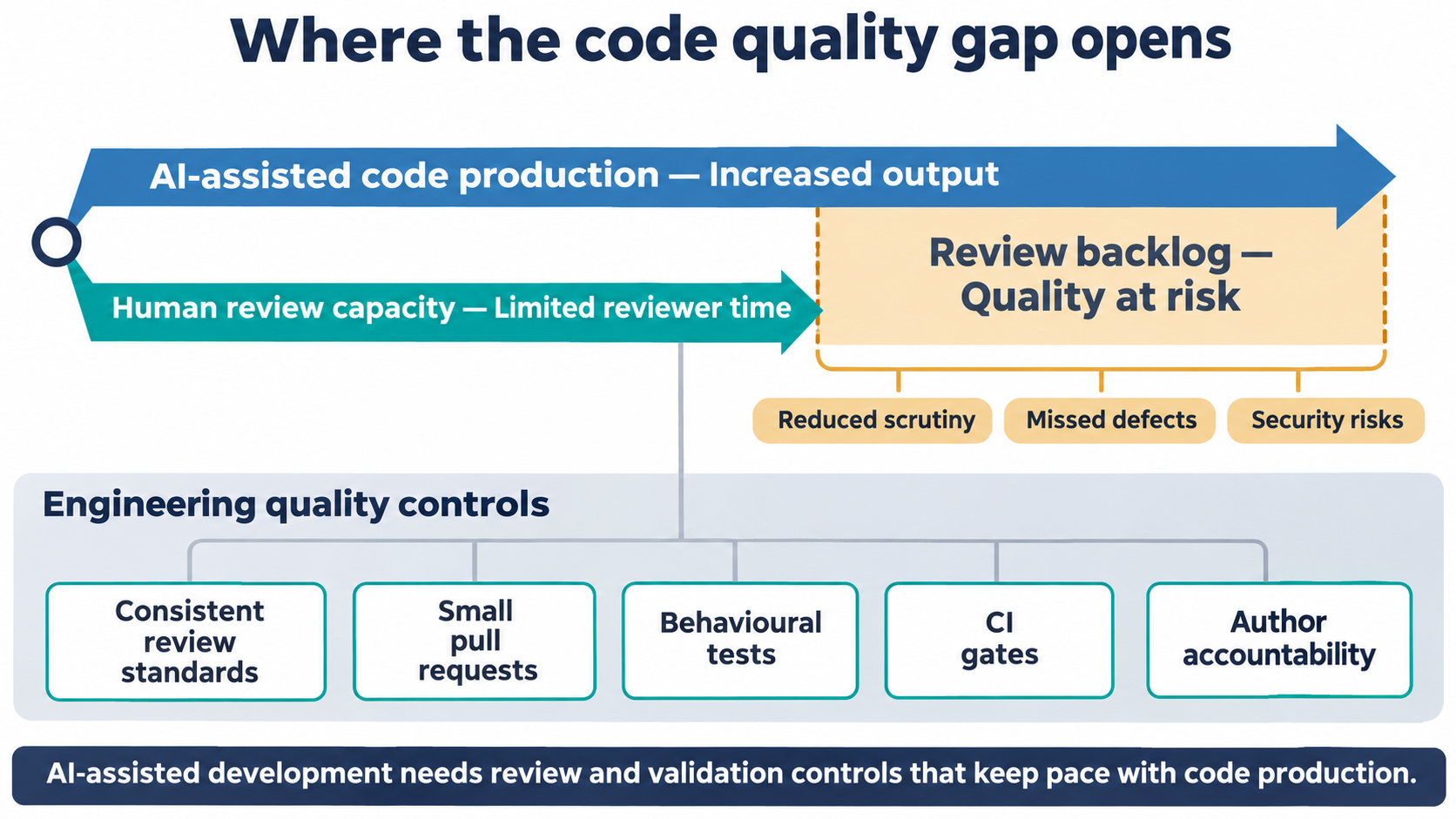
A two-person team tripled its pull-request count the month it adopted an AI coding assistant, and the bug rate climbed right alongside the output. The tool wasn't writing worse code; it was writing far more of it, faster than two people could review properly. Rolling out AI coding assistants to a team speeds up the writing and leaves the reviewing exactly as slow as it was, and that gap is where quality slips.
Keeping quality through an AI rollout is mostly about the review side, not the model. The same review bar, smaller pull requests, tests that actually test something, and automated checks in CI catch what the extra output would otherwise push through. The engineer who merges still owns the code, whether they typed it or generated it.
What follows is why quality slips when a small team adopts these tools, and the specific guardrails that hold it steady — one review bar, capped change size, real tests, CI gates, and clear author accountability — without giving up the speed.
Why code quality slips when a team adopts AI assistants
Quality slips because the assistant speeds up writing but not reviewing. A small team has little review slack to begin with, so when output climbs, the scrutiny applied to each change falls, and the changes that get a lighter look are exactly where bugs enter. The tool moved the bottleneck from producing code to reviewing it, and did nothing to widen the narrower end.
The data points the same way. The 2024 DORA report found that as AI adoption increased, it was accompanied by an estimated 1.5% drop in delivery throughput and a 7.2% reduction in delivery stability, and it stressed that the basics — small batch sizes and disciplined testing — still decide outcomes. A Stanford study (Perry et al.) adds a sharper warning: participants with an AI assistant wrote significantly less secure code and were more likely to believe their code was secure. Faster output and more confidence in it, with quality and security quietly moving the other way, is the pattern a rollout has to design against.
None of this argues against the tools; it argues for controls. The assistant is a strong accelerator inside well-run production AI systems and a strong way to multiply a small team's output. The job of a rollout is to make sure the review side scales with the writing side rather than falling behind it.
Keep one review bar for AI-generated code
AI-generated changes get the same review as hand-written ones, and often need more. The temptation is to wave through a diff because "the AI wrote it," but the assistant has no stake in the result and no memory of why the code around it exists, so its output needs at least as careful a read as a new hire's. The engineer who opens the pull request is the author, full stop, and on a small team that is usually one of your senior developers whose name is on the merge.
The specific risk here is over-trust, and the Stanford finding names it directly: people lean on AI output and rate it more secure than it is. Generating code is not the same as understanding it, and the moment an engineer merges a change they cannot explain, the assistant has become the author of record with no one accountable for the logic. The rule that holds is simple to state and worth enforcing: if you cannot explain what a change does and why, it is not ready to merge, whoever or whatever wrote it. How much of the review itself can be delegated to an AI reviewer is a separate question, handled in a companion article on AI code review.
Cap pull-request size
Small pull requests are the cheapest quality control you have, and AI makes them harder to keep. An assistant can produce an 800-line change as easily as an 80-line one, and a large diff is both more tempting to generate and far harder to review well. Google's engineering practices are explicit that small changelists are reviewed faster and more thoroughly and are less likely to introduce bugs — which is exactly the margin a small team loses when output jumps.
Put a soft cap on change size and hold to it. A reviewer reads a focused 150-line pull request carefully; faced with a 900-line one, the same reviewer skims, approves, and misses things, and no amount of good intent changes that. Splitting AI-generated work into reviewable pieces costs the author a little time and saves the reviewer far more, and it keeps each change small enough that a human can actually hold it in their head. This is also the DORA point about small batch sizes, applied at the level of a single pull request.
Setting these norms — one review bar, capped change size, the test and CI gates below — is quick to describe and easy to skip under delivery pressure, which is when a rollout quietly loses its quality. Our engineers have adopted these tools inside teams without the drop. Set it up with a dedicated engineering team that already works to a code-quality standard.
Require tests that actually test something
Do not accept AI-generated code without tests, and do not accept tests that only confirm the code just written. An assistant asked to write both the code and its tests will often produce tests that pass against whatever it generated, including its bugs — a test that agrees with the implementation no matter what proves nothing. The DORA report puts disciplined testing among the basics that decide outcomes, and it is the control that catches what review misses. Treating tests as a first-class deliverable is where test automation earns its place in an AI-assisted workflow.
A useful test is one that fails when the behaviour is wrong. That sounds obvious, and it is exactly what circular AI-written tests quietly skip. A few properties separate a real test from a rubber stamp:
- It asserts the expected behaviour, not merely that the function runs without error.
- It fails if you break the code it covers — if it still passes, it tests nothing.
- It covers the edge cases and error paths, not only the happy path the model wrote first.
- It was reviewed by a human who understands what correct behaviour is for this code.
Let CI do the enforcing: linting, static analysis, and secret scanning
Automated checks in CI catch the drift and the risky patterns that humans shouldn't have to spot by eye. Linting, formatting, and type checks keep AI output consistent with the rest of the codebase instead of drifting into a different style on every generation. For security, static analysis matters more with AI in the loop, given the Stanford finding — GitHub's code scanning with CodeQL flags vulnerabilities and coding errors and runs on every pull request, and secret scanning catches credentials an assistant may paste in from a training-data pattern.
These gates are cheap to run and never get tired, which is their whole value on a small team with limited review time. They matter most in regulated environments such as fintech, where an insecure pattern that slips through is costly in a way a style nit never is. CI won't replace human review — it narrows what review has to focus on, so the scarce human attention goes to logic and design rather than to catching a missing semicolon or a hard-coded key.
Set team norms before the first week
Agree how the team will use the assistant before habits form, not after. On a small team, whatever three engineers do in the first fortnight becomes the unwritten standard, so it is worth making it a written one: where the assistant helps, where it doesn't, and what every engineer is accountable for regardless of how a change was produced. A short, shared convention prevents the common failure where each person uses the tool differently and the codebase drifts in three directions at once.
The norms that matter are few. State that the author owns and must understand every change; that AI-generated code gets the standard review and tests; that pull requests stay small; and that the CI gates are not optional. Keep a note of what the assistant is good and bad at in your stack, and revisit it as the tools change. Where the team is still deciding how much to trust AI-driven review and AI-written tests specifically, that is worth settling deliberately rather than by default, and is covered in a companion article on AI code review. The risks and their guardrails line up cleanly:
Key takeaways
- AI coding assistants speed up writing, not reviewing, so on a small team quality slips at the review stage where there is the least slack.
- The 2024 DORA report found AI adoption accompanied by lower delivery throughput and stability, and a Stanford study found AI-assisted code was less secure and more trusted.
- Keep one review bar: AI-generated changes get the same scrutiny as hand-written ones, and the engineer who merges must be able to explain the code.
- Cap pull-request size and require tests that fail when behaviour breaks, because small changes and real tests catch what extra output pushes through.
- Let CI enforce the rest — linting, static analysis, secret scanning — and write down team norms before habits form.
Why the guardrails have to come before the speed
An AI coding assistant is a genuine multiplier for a small team, and the output it adds is only as safe as the review, tests, and gates it lands in. The guardrails are not elaborate — one review bar, small pull requests, tests that actually fail on bad code, CI doing the mechanical enforcement, and an author accountable for every change — but they have to be in place before the speed arrives, because the first delivery crunch is exactly when a team without them starts merging code no one has really read. Set them up front, and you keep the multiplier without the quality drop.
If you're putting an AI coding assistant in front of a small team and want the speed without the regressions, the guardrails are worth designing in from week one — roll out an AI coding assistant without the quality drop with our team.
FAQ











Interesting For You


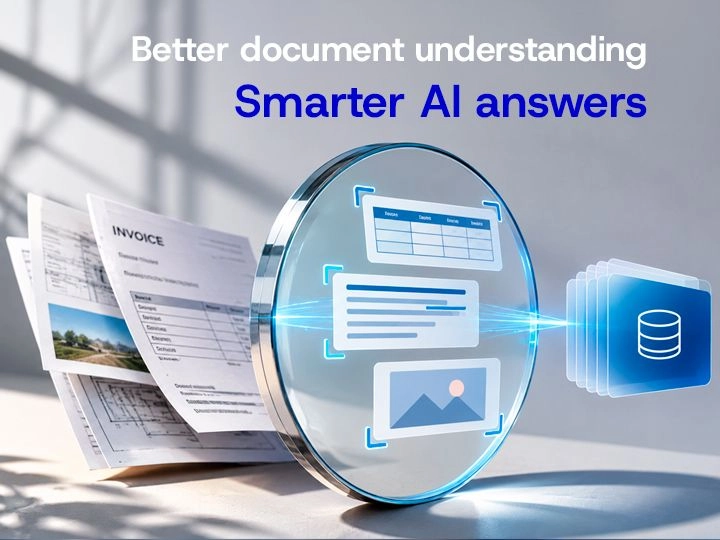
Multimodal RAG: why your RAG breaks on real documents
What follows is why RAG breaks on real documents and the ingestion steps that fix it — layout-aware parsing instead of plain text, OCR for scans, pulling tables out as structure, and using a vision model to turn figures and complex tables into text a retriever can actually find.
Read article

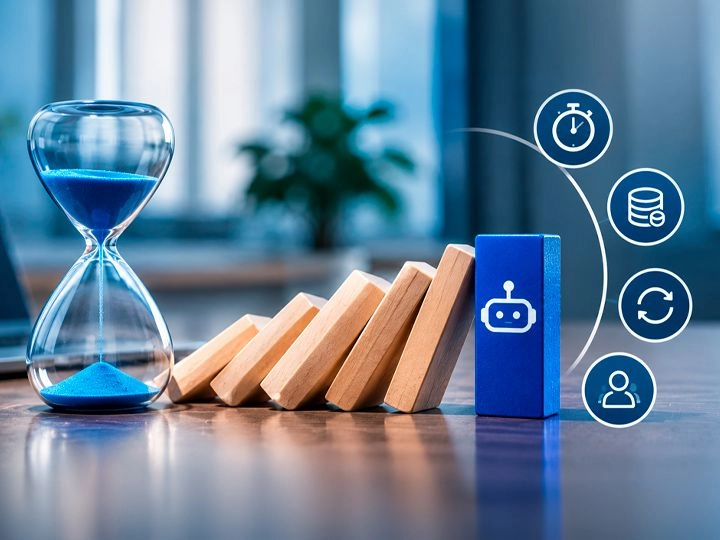
AI agents in production: controls that stop runaway runs
What follows is why agents run away, the specific controls that stop them — per-step and per-run timeouts, retries with backoff and idempotency, token and cost budgets, loop detection — and when escalating to a human beats retrying one more time.
Read article

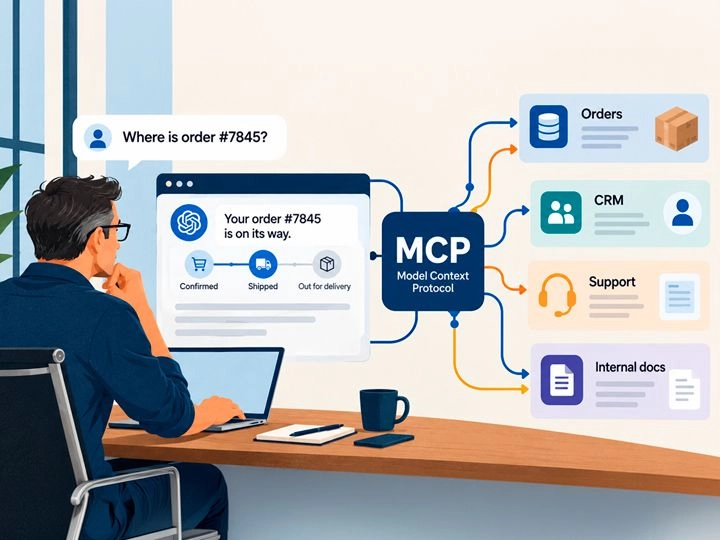
MCP integration: connecting AI to the data it needs
What follows explains what MCP standardizes, how tools and resources differ, how to design scoped access with approval gates, and where these integrations tend to break once real traffic and real permissions are involved.
Read article