


How to scale Boomi integrations under high load: Molecules, tuning, and monitoring


Queue buildup is usually the first warning. Processes that completed in seconds start taking minutes, retry counts climb, and the operations team begins investigating what looks like a connector issue — but the actual cause is a single-node runtime that was not built for this volume.
Bluepes is an independent software and integration consulting company that works with Boomi on client projects across healthcare integration projects and fintech environments.
This article is for CTOs and engineering managers who already run Boomi and are starting to see performance pressure under growing load. Next — a structured explanation of how Molecule architecture addresses this, which parameters to tune, and how to build monitoring that catches degradation early.
Updated in April 2026
Boomi provides three tools for managing high-load scenarios: Molecules for horizontal runtime scaling, performance tuning for thread and JVM configuration, and process-level monitoring for operational visibility. Used together, they let organizations grow integration volume without the brittleness of a single-node deployment.
How to recognize that a single Atom is the bottleneck
A Boomi Atom — the single-node runtime — works reliably for modest integration volumes. The problems surface gradually as workloads grow: queue depth increases, individual process execution times lengthen, and CPU saturation becomes common during batch runs or peak periods.
According to the Boomi Capacity Planning & Performance Tuning Guide, four metrics signal that a runtime is approaching its limits: CPU usage, thread execution count, JVM heap usage, and queue depth. When two or more of these trend upward consistently over a two-week observation window, architectural change delivers more value than further incremental tuning.
The failure mode most teams encounter first is a single connector blocking all other flows. One slow backend system holds a thread indefinitely, and unrelated processes stop executing as a result. This cascades into visible delays for downstream systems and end users — the kind of incident that prompts an emergency review of something that should have been addressed in planning.
Boomi Molecule architecture: how distributed runtime execution works
A Boomi Molecule is a multi-node runtime cluster where multiple machines run the same deployed integration packages. Boomi distributes workload across nodes automatically. If one node stops, the remaining nodes continue processing without interruption — something a single Atom cannot provide.
This differs from vertical scaling. Adding more memory or CPU to a single Atom raises its ceiling but does not eliminate the single point of failure or allow competing processes to run in parallel on separate hardware. The Boomi Molecule documentation covers the full setup, but the operational difference is straightforward: a Molecule treats the cluster as the runtime unit, not the individual machine.
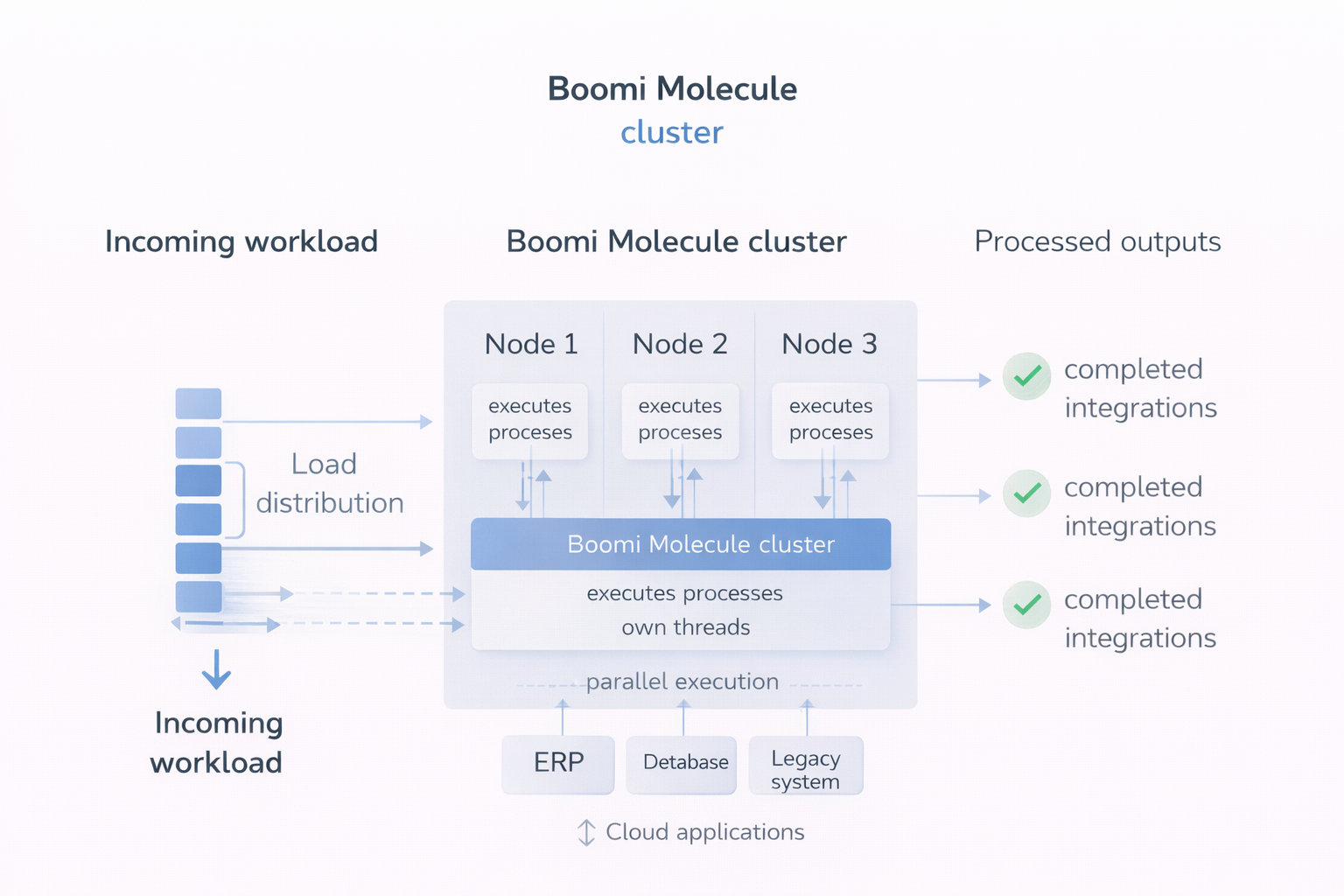
Boomi Molecule distributes incoming workload across multiple nodes, enabling parallel execution and reducing queue buildup under high load.
Atom vs Molecule — capability comparison
Forked vs shared JVM execution
Boomi supports two execution modes. In shared JVM mode, all processes on a node run within a single JVM instance. In forked execution, each process gets its own JVM. The Xtivia technical walkthrough of Boomi forked execution covers configuration detail, but the operational effect is this: a runaway or memory-heavy process cannot destabilize other flows when it runs in an isolated JVM.
Forked execution is not the right choice for every deployment. It adds startup overhead — a few seconds per process launch — which makes it unsuitable for sub-second latency requirements. For batch workloads, near-real-time integrations, and high-volume data processing, however, the isolation benefit outweighs the startup cost.
If your team is already dealing with queue growth or instability at peak periods, an architecture review before the next scaling decision avoids significant rework later. Describe your current Boomi deployment to Bluepes engineers — integration engineering services — and get specific recommendations based on your workload profile.
How to tune Boomi runtime performance for high-load workloads
A Molecule cluster provides the capacity framework. Stability under load still depends on deliberate tuning across three areas.
Execution threads and queue depth
More threads allow more processes to run in parallel — but they also increase CPU contention. The approach that works in practice is incremental: raise the execution thread count by two to four, then observe queue depth and average execution time over 48 hours before adjusting further. Each node in the cluster should be configured consistently; asymmetric thread counts create uneven load distribution across nodes.
Queue depth is worth monitoring as a lagging indicator. A queue that drains between peak periods suggests the thread count is adequate. A queue that accumulates across days points to thread exhaustion or a persistent connector problem — worth distinguishing before adding nodes, because the remediation differs entirely.
Connector timeout configuration
Connector timeouts need to reflect the actual behavior of backend systems under normal conditions, not optimistic defaults. Too short, and integrations fail and retry unnecessarily, doubling effective load. Too long, and threads remain blocked for extended periods, reducing available parallelism across the cluster.
A practical baseline: measure actual backend response times over a representative week, then set timeouts at 1.5× to 2× that value. This provides a buffer for occasional backend slowness without allowing indefinitely held threads. Document these decisions — engineers inherit integrations without context, and connector timeout rationale is rarely written down anywhere.
JVM memory and garbage collection
Each Molecule node runs its own JVM, and heap exhaustion causes node instability. Initial heap should be set to 75–80% of available RAM, leaving room for the operating system and other processes. For deployments with many concurrent large-payload processes, enabling garbage collection logging gives visibility into whether heap pressure is the actual cause of observed slowdowns rather than connector behavior or thread configuration.
How to monitor a Boomi Molecule cluster in production
Distributed architecture adds monitoring complexity. A single Atom has one process log; a Molecule has several, and problems can originate on any node. Boomi's Process Reporting dashboard aggregates execution logs across nodes, but operational stability requires more than reviewing failures after they occur.
The integration observability practices article covers observability tooling in detail. For a Molecule under sustained load, four metrics warrant continuous tracking:
- Queue depth per node — disproportionate depth on one node indicates uneven work distribution, which points to a thread imbalance or a process affinity issue
- Thread utilization rate — consistently above 85% means thread exhaustion becomes likely during traffic spikes
- JVM heap usage — patterns above 75% during normal operation are a scaling signal, not a crisis threshold; address before it becomes one
- Process execution time trends — gradual increase over weeks is a capacity signal, not a connector issue; the two require different responses
For process-level visibility into specific integration flows, Boomi's API Management layer provides additional context when APIs are part of the deployment architecture — relevant when governance requirements apply, as described in the API governance in Boomi article.
Node management: adding and removing nodes in a running cluster
One operational advantage of Molecules over single Atoms is the ability to manage nodes without a full maintenance window. Adding a node to a running Molecule does not require stopping processing on the cluster; new nodes pick up work automatically once they join. The Boomi Molecule documentation covers the join procedure, but the operational principle is that the cluster absorbs new capacity without interruption.
Removing a node requires draining in-flight processes first. Removing a node without draining causes execution errors for whatever was running on that node at the moment of removal. The correct sequence: stop accepting new work on the target node, wait for running processes to complete, then detach from the cluster. Teams that have done this under time pressure once tend to build it into a formal runbook afterward.
The same rolling pattern applies to patching and version updates. Update one node at a time, verify it returns to normal processing, then proceed to the next. This approach substantially reduces risk compared to simultaneous cluster-wide updates, which force a full maintenance window and introduce the possibility of a failed rollout affecting the entire runtime.
Key takeaways
- A single Boomi Atom becomes a bottleneck when CPU, thread count, JVM heap, and queue depth trend upward together — at that point, architectural change delivers more than further configuration tuning.
- Boomi Molecules distribute workload across nodes and eliminate single points of failure; forked execution adds process-level isolation for workloads where one runaway process cannot be allowed to affect others.
- Thread count, connector timeouts, and JVM heap configuration each require deliberate adjustment — defaults suit average loads, not sustained high-volume or high-concurrency scenarios.
- Monitoring a Molecule cluster requires tracking queue depth and thread utilization per node, not just aggregate failure counts from the Process Reporting dashboard.
- Rolling node management allows scaling and maintenance without stopping the cluster, but drain-first sequencing is required when removing nodes — skipping it causes execution errors.
The architecture decisions that compound over time
Getting Molecule configuration right before performance problems become incidents saves significant work later. Organizations that set up Molecules as a deliberate architectural choice — rather than as a reactive response to a queue crisis — spend less time on emergency tuning and avoid the harder work of migrating a production deployment under pressure.
Monitoring decisions matter as much as the architecture itself. Teams that instrument thread utilization and per-node queue depth from the start catch gradual degradation weeks before it becomes an incident. Those that rely only on default Boomi alerting typically discover capacity problems when an integration window has already been missed.
Bluepes engineers have worked through high-load Boomi deployments across fintech and healthcare client projects. If your team is planning a Molecule deployment or running one that is showing early signs of performance pressure, reach out for a specific architecture discussion: discuss your Boomi setup with Bluepes.
Boomi is a trademark of Boomi, LP. Bluepes is an independent software and integration consulting company. We are not affiliated with, endorsed by, or certified by Boomi, LP.
Summarize with AI
 ChatGPT
 Claude
 Gemini
 Grok
Grok Perplexity
FAQ











Interesting For You



Why composable enterprise architecture requires a strong integration layer
Most IT modernization projects follow the same logic: replace monolithic platforms with best-in-class tools, gain flexibility, and move faster. It works — until you realize that a dozen disconnected tools create a different kind of problem. Composable enterprise architecture is the strategy; integration is what determines whether it succeeds or collapses. This article is for CTOs, IT directors, and architects who are building or evaluating modular IT environments. It addresses what happens when the integration layer is an afterthought — and what a well-designed one looks like in practice. Composable enterprise architecture is an IT strategy that treats business capabilities as modular, interchangeable components — each of which can be updated, replaced, or extended without disrupting the rest of the system. The challenge is that every component still needs to exchange data with the others in real time. That is where the integration layer, rather than the individual applications, becomes the critical infrastructure.
Read article


API governance in Boomi: how mid-market teams keep control
When a mid-market company runs 50 active integrations and six product teams pushing API changes independently, governance stops being a process question and becomes a risk question. One team overwrites a shared endpoint. Another deprecates a version without notifying consumers. A partner integration breaks at 2 a.m. with no clear owner to call. Bluepes is an independent integration consulting company that works with Boomi as one of its core platforms. This article draws on that hands-on experience — not as Boomi's representative, but as a team that has debugged the consequences of missing governance and helped clients build the structures that prevent them. This article is for CTOs, VP Engineering, and IT Directors at mid-market organizations who manage growing API catalogs and want a practical governance model they can implement incrementally. Next — a breakdown of the five governance layers, how each maps to Boomi's tooling, and where teams typically lose control. API governance in Boomi means applying consistent rules for how interfaces are designed, secured, versioned, and retired. The Boomi API Management module provides the infrastructure. The design conventions, ownership assignments, and review cadences are decisions the engineering team makes. Organizations that get this right reduce integration failures, shorten partner onboarding, and make security audits straightforward rather than stressful.
Read article



How companies are future-proofing their tech stacks with cloud-native integration
The average mid-market company runs dozens of business applications: an ERP, a CRM, a separate billing system, various cloud tools, and increasingly AI-powered services layered on top. Each of those systems generates data the others need. Keeping them connected is no longer an IT side project — it is a condition for the business to function. This article is for IT Directors, CTOs, and technical leads who are managing integration infrastructure built for a smaller, simpler stack. If your team spends more time fixing broken connections than building new capabilities, this is for you. Next — a look at what future-proofed companies actually do differently, and what a more sustainable architecture looks like. The short answer: companies that scale without constant integration disruption tend to have moved away from custom-built, point-to-point connections and toward managed integration platforms. Boomi is one of those platforms. Bluepes is an independent software consulting company that works with Boomi and other integration tools on behalf of clients — this article reflects that perspective, not Boomi's marketing position.
Read article