


How financial data becomes inconsistent — and what structured integration solves


Financial systems rarely break in obvious ways. Payments are processed, accounting entries appear, data moves from one platform to another. The problem surfaces later — when finance teams prepare month-end reconciliations, quarterly reports, or audit packages and find that figures from the accounting platform, the payment provider, and the BI tool do not agree.
This article is for CFOs, finance operations leads, and IT directors at mid-market companies who have connected multiple financial systems but still spend significant time reconciling data before each close. Next — a structured explanation of why inconsistencies happen and which integration approaches reduce them.
Financial data inconsistencies are not random. They follow predictable patterns related to event timing, partial updates, and the absence of coordinated flow logic. Structured integration using a centralized iPaaS layer addresses these patterns directly and reduces the operational cost of managing finance data across systems.
Updated in April 2026
Why financial data becomes inconsistent across systems
Modern finance stacks are built from specialized platforms: payment providers, accounting and general ledger systems, ERP platforms, treasury tools, and BI reporting layers. Each system enforces its own validation rules, processing schedules, and data models.
When integrations connect these systems as isolated, point-to-point flows, financial events are handled independently rather than as coordinated sequences. A payment confirmed by the provider may reach the accounting system with a delay. A retry triggered by a timeout may produce a duplicate entry. A partial sync may leave reporting tools referencing data that was corrected upstream hours earlier.
None of these failures trigger technical alerts. The systems stay up. But the numbers diverge.
Event timing and retry behavior in payment APIs — documented in Stripe's webhook architecture — illustrates how events may arrive out of order or be retried after a downstream system has already processed earlier data. This is expected behavior in distributed systems, not a bug.
The AWS whitepaper on distributed data management explains the broader principle: in systems where each component manages its own state, temporary mismatches are the norm unless flows are explicitly coordinated. In finance, those temporary mismatches tend to become permanent without active management.
Typical patterns behind financial data mismatches
Financial inconsistencies are rarely caused by broken APIs. They result from flow-level gaps that surface over time.
These patterns explain why reconciliation becomes a permanent step rather than an occasional exception. Once teams start budgeting reconciliation effort into every close cycle, the integration design has effectively failed its core purpose.
If your team is already running reconciliation as a standard close step rather than an exception, the integration layer likely needs review — not the accounting system. Our engineers work regularly with finance and banking clients on exactly this type of diagnostic. Describe your current setup and we'll identify where the structural gaps typically are.
Why point-to-point integrations increase financial risk
Point-to-point integrations are built for speed. A new payment provider comes online, an accounting module is added, a reporting tool is connected. Each connection seems isolated and manageable at the time.
What changes over time is the aggregate. Each new connection introduces another path where data can diverge. Error handling logic lives in multiple places and is maintained inconsistently. When one system updates its API or changes its event model, engineers need to locate every integration that depends on it — without a clear map of where those integrations live.
For finance teams, this fragmentation has concrete costs: delayed close cycles, extended audit preparation, and reduced confidence that automated reports reflect the actual state of the business. This is the operational context in which our clients consider moving from point-to-point connections to a centralized integration layer.
Using an iPaaS layer to structure financial data flows
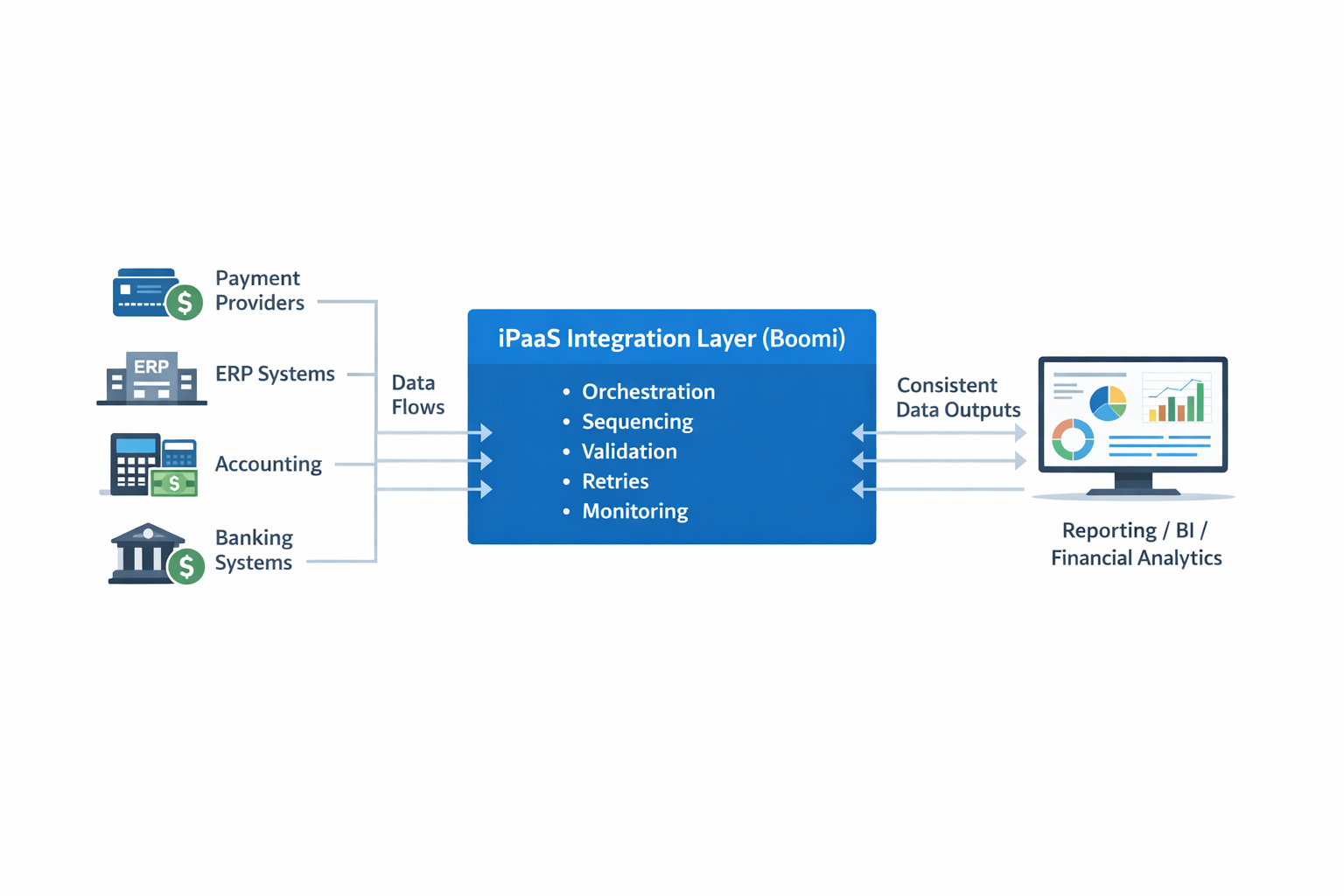
An Integration Platform as a Service (iPaaS) introduces a single layer where financial data flows are defined, orchestrated, and monitored. Instead of embedding logic inside individual systems, integration flows are built once and reused across the finance stack. This makes it possible to control event sequencing, retry behavior, and data validation explicitly — rather than inheriting whatever behavior each connected system happens to implement.
Boomi is one of the iPaaS platforms our clients choose for financial integration work. Its flow-based architecture and broad connector library make it practical for finance environments where multiple specialized systems need to exchange transaction data reliably and at scale.
A centralized integration layer is most effective when maintained by a dedicated integration team that treats flow logic as core infrastructure — not as a collection of ad hoc connections managed by whoever set them up. The team owns change control, monitors flow behavior, and ensures that new integrations are built to the same consistency standards as existing ones.
Designing financial integration flows that stay consistent
Connectivity is the easier part. The harder challenge is behavioral: whether flows act predictably when systems respond at different speeds, when retries occur, or when upstream data changes after downstream systems have already processed it.
The approach that reduces inconsistency is to design flows around financial events rather than system boundaries. A payment, invoice correction, or settlement should be treated as a complete unit of work, regardless of how many systems it touches. This requires the integration layer to coordinate the sequence — not just pass data from one API to another.
When flows are designed this way, partial updates are detected rather than silently propagated. Downstream systems receive data only after it has been validated and correctly sequenced upstream.
Practical integration patterns used in finance
A small set of patterns account for most of the consistency gains in financial integration work.
Idempotent processing is foundational. The idempotent receiver pattern describes how distributed systems handle duplicate messages safely — a direct requirement in any integration where retries are possible. Without it, a single timeout can produce two accounting entries for the same transaction.
Monitoring finance integrations beyond system health
Standard monitoring answers infrastructure questions: is the system up, is the API responding, are error rates within threshold. For financial integrations, these answers are insufficient.
What finance teams need to know is whether a financial event completed fully and correctly across all relevant systems. A transaction may process successfully in the payment provider, reach the integration layer, and then fail silently before updating the accounting system. Infrastructure monitoring shows green. Finance discovers the gap at close.
This is where observability in integration flows becomes critical. Teams need to track each financial event end-to-end: where it entered the integration layer, what validation it passed, which downstream systems it reached, and whether any step retried or produced an unexpected result. This level of visibility is what allows teams to identify gaps before they reach reconciliation — and to resolve them based on evidence rather than manual comparison.
Scaling finance operations without increasing reconciliation effort
Transaction volume growth tends to increase reconciliation effort faster than it increases revenue. This is rarely a capacity problem. It is a coordination problem: more events flowing through integration logic that was never designed to handle complexity at scale.
The alternative is to treat integration infrastructure as something that scales deliberately. When flow logic is centralized, scaling integration infrastructure means updating definitions in one place, not locating and modifying each individual connection.
Organizations that use Boomi for financial integrations adopt this approach when adding new payment methods, expanding into new regions, or layering in additional reporting requirements. The integration layer absorbs the new complexity without requiring equivalent growth in reconciliation effort.
Key takeaways
- Financial data inconsistencies follow predictable patterns — timing gaps, silent retries, partial updates, system isolation — none of which trigger technical failures.
- Point-to-point integrations become a liability over time because error handling is fragmented and changes propagate through multiple disconnected flows.
- A centralized iPaaS layer, when properly structured, makes financial data behavior predictable and auditable by design.
- Patterns like idempotent processing and event sequencing are not advanced features — they are baseline requirements for reliable financial integration.
- Flow-level observability is what allows teams to catch inconsistencies before close, rather than discovering them during reconciliation.
Conclusion
When finance teams cannot explain why numbers differ across accounting, reporting, and payment systems, the issue rarely lies in the accounting logic. It usually indicates that integration flows lack structure, coordination, or visibility.
At Bluepes, we work with clients as an independent integration consultancy — not as a Boomi affiliate. The work usually starts by reviewing the integration layer: identifying where inconsistencies originate and what needs to be restructured to restore data consistency across systems.
Financial data inconsistencies are a structural problem with a structural solution. Treating integrations as coordinated, observable infrastructure rather than isolated connections is how finance teams reduce reconciliation effort and regain confidence in automated reporting.
If your close process depends on manual alignment across systems, that is where we usually begin. Describe your current financial integration setup and we will identify where the gaps typically originate.
Boomi is a trademark of Boomi, LP. Bluepes is an independent software consulting company. We are not affiliated with, endorsed by, or certified by Boomi, LP.
Summarize with AI
 ChatGPT
 Claude
 Gemini
 Grok
Grok Perplexity
FAQ











Interesting For You



Why businesses are rethinking their integration strategy
Most IT teams don't notice integrations until something breaks at the worst possible moment. A new CRM rolls out, and three weeks later someone in finance discovers that customer data hasn't been syncing. An ERP upgrade ships on schedule and quietly disables five automated workflows that nobody documented. Revenue numbers look wrong in the dashboard because two systems are still running on different update cycles. This article is for CTOs, IT Directors, and VP Engineering roles who suspect their current integration architecture costs more to maintain than it should — in engineering hours, in delayed releases, and in recurring data quality incidents. Next — a clear breakdown of where standard approaches fail, what modern platforms actually offer, and how companies in healthcare, e-commerce, and finance are handling this shift in practice. Business integration modernization — replacing a fragmented collection of point-to-point connections with a centralised, scalable architecture — has become a priority for companies that have grown past their original tech stack. The pressure isn't coming from trend reports; it's coming from the compounding overhead of keeping legacy connections alive as systems multiply.
Read article



How companies are future-proofing their tech stacks with cloud-native integration
The average mid-market company runs dozens of business applications: an ERP, a CRM, a separate billing system, various cloud tools, and increasingly AI-powered services layered on top. Each of those systems generates data the others need. Keeping them connected is no longer an IT side project — it is a condition for the business to function. This article is for IT Directors, CTOs, and technical leads who are managing integration infrastructure built for a smaller, simpler stack. If your team spends more time fixing broken connections than building new capabilities, this is for you. Next — a look at what future-proofed companies actually do differently, and what a more sustainable architecture looks like. The short answer: companies that scale without constant integration disruption tend to have moved away from custom-built, point-to-point connections and toward managed integration platforms. Boomi is one of those platforms. Bluepes is an independent software consulting company that works with Boomi and other integration tools on behalf of clients — this article reflects that perspective, not Boomi's marketing position.
Read article


Why Agentic AI in the Enterprise Depends on the Integration Layer
Most enterprise AI projects do not fail because the models are inadequate. They fail because the data feeding those models is inconsistent, delayed, or simply unreachable. According to a 2025 analysis, why AI agent pilots fail in production comes down to one recurring problem: the absence of a structured integration layer between AI systems and enterprise data. This article is for CTOs and VPs of Engineering who are evaluating how to introduce AI agents into existing enterprise infrastructure. It addresses what integration architecture those agents actually require to work reliably — and where Boomi fits into that picture. The short answer: agentic AI needs a stable, governed integration layer to access enterprise data, trigger downstream processes, and log every action taken. Without that layer, agents either operate on incomplete information or become impossible to audit and explain.
Read article