


EV Charging Network Scalability: What Breaks First and How to Fix It


Electric vehicle adoption is outpacing the infrastructure built to support it. According to the International Energy Agency's Global EV Outlook 2024, the global EV fleet surpassed 40 million vehicles — and charging networks designed for early-adopter volumes are now expected to absorb demand they were never scoped for.
If your engineering team manages a charging network that started at 20 stations and now operates 500, you already know this: the problems at scale are not the problems at launch. Placement logic that worked on intuition breaks the moment you expand across regions. Load balancing that held at 30% utilization becomes a liability when a fleet operator plugs in 40 vehicles at the same depot simultaneously. The architecture decisions that seemed fine at go-live are the ones generating incidents two years later.
This article examines where EV charging networks actually fail under growth — and what the engineering decisions look like that prevent it. The short answer is consistent across networks of different sizes: most failures trace back to three structural gaps — a Charging Station Management System not designed for distributed state management, a missing real-time telemetry pipeline, and grid integration that was deferred until it became a crisis.
Updated in April 2026
How EV Charging Networks Actually Fail at Scale
Most EV network failures at scale are not hardware problems. The charger itself works. What fails is the software layer responsible for session management, fault detection, and load coordination — and these failures tend to be invisible until enough users have been affected to generate a pattern of complaints.
The sequence is recognisable. An operator expands from a pilot to a regional rollout. The CSMS (Charging Station Management System) that handled 50 chargers starts behaving unpredictably at 300: session timeouts increase, firmware updates pushed to chargers fail without confirmation, and operators discover a charger is offline only when a driver reports it. At this point the problem is not the charger count — it is that the CSMS was never architected to handle distributed state across hundreds of independently managed endpoints.
The event-driven architecture design decisions that govern how a charging platform processes session events determine whether it can handle hundreds of concurrent WebSocket connections without bottlenecks. Networks that look identical from the outside diverge sharply on this dimension.
The OCPP Version Problem
OCPP — the Open Charge Point Protocol — defines how charging stations communicate with the CSMS. Most operators are still on OCPP 1.6, which was designed for simpler networks. According to the OCPP 1.6 was designed for simpler deployments. The Open Charge Alliance's OCPP 2.0.1 specification adds capabilities that are functionally necessary at scale: device management, smart charging profiles, certificate-based security, and protocol-level V2G support.
The migration from 1.6 to 2.0.1 is not a configuration change — it requires firmware updates on existing hardware, renegotiated data schemas, and partial rewrites in the CSMS backend. Teams that deferred this migration while expanding now manage a dual-protocol environment where new hardware speaks 2.0.1 and older hardware speaks 1.6, and the CSMS is expected to handle both simultaneously.
OCPP 1.6 vs OCPP 2.0.1: operational impact at scale
Table: Key operational differences between OCPP versions at network scale.
Smart Load Management: The Grid Constraint Is an Engineering Problem
A surge in fast charging demand can overload local grid infrastructure — but framing this as a "grid problem" misplaces where the solution lives. Grid capacity is a constraint that exists upstream. How a charging network responds to that constraint at the software level is entirely within the engineering team's control.
Dynamic load balancing distributes available power across active chargers based on real-time session demand, site capacity limits, and grid operator agreements. Without it, a depot with a 250 kW connection and 10 fast chargers will either hard-cap each charger at 25 kW regardless of actual demand, or allow the first chargers to connect to draw their full rated power, leaving later arrivals throttled. Neither behavior is what fleet operators signed up for, and neither is easily explainable to a customer whose vehicles are not charged by morning.
Whether load control logic sits at the charger level or the CSMS level is a consequential architectural choice. Backend engineering for distributed charging platforms at this scale means the CSMS needs a real-time view of all active sessions and the ability to push updated power limits to individual chargers within seconds — not on the next polling cycle.
On-Site Energy Storage Changes the Cost Structure
Charging sites equipped with on-site battery storage can buffer demand spikes without drawing from the grid at peak tariff rates. The benefit is site-dependent: fleet depots and workplace charging with predictable daily demand profiles get the most predictable return. Drop-in public charging with variable traffic patterns gets less.
Research from the Rocky Mountain Institute on EV charging economics indicates that for high-utilisation depot sites, on-site storage can reduce grid demand charges by 30–60% depending on the utility rate structure. At the right site, that is not a marginal improvement — it changes the unit economics of operating that location.
V2G (vehicle-to-grid) integration takes this further by enabling EV batteries to discharge back into the grid during peak demand windows. The protocol work for V2G is already defined in OCPP 2.0.1 and ISO 15118. The harder variables are bidirectional hardware availability and the bilateral grid agreements required to operate commercially. V2G is not yet widespread, but the groundwork needs to be laid at the platform level before the hardware catches up.
If your team is already dealing with session drop rates, silent firmware update failures, or load balancing that degrades under peak demand — these are engineering problems with documented solutions. Discuss your charging platform architecture with the Bluepes team.
What a Reliable CSMS Architecture Looks Like
The CSMS handles charger state, session processing, load profile enforcement, and user authentication. At low scale, a monolithic CSMS with a single database and synchronous API calls works acceptably. At 200–300 chargers and above, that same architecture becomes the bottleneck: a single node handling thousands of concurrent WebSocket connections, writing session events to a single database, and responding to charger status polls under load.
The architectural changes required at scale are not novel — they are the same decisions any distributed system has to work through. Session state needs to be replicated across multiple CSMS nodes, not held on a single server. Charger communication should be handled by a dedicated WebSocket gateway that scales independently of business logic. Fault events and telemetry from individual chargers should publish to an event bus rather than writing directly to a central database under concurrent load.
A cloud-native architecture for charging platforms typically means containerised microservices with horizontal pod autoscaling triggered by charger connection count, and a message broker — Apache Kafka or a managed equivalent — positioned between charger telemetry and downstream processing. The specific failure modes that need to be designed for include: CSMS node failure during an active session, network partition between a regional cluster of chargers and the central CSMS, and firmware rollouts that need to be staged by region or hardware group rather than broadcast simultaneously.
The principles covering failure models and monitoring in distributed systems apply directly to CSMS design — specifically the question of how to distinguish a charger that has gone silent from one that is offline versus one that is legitimately idle. Those three states require different responses from the platform.
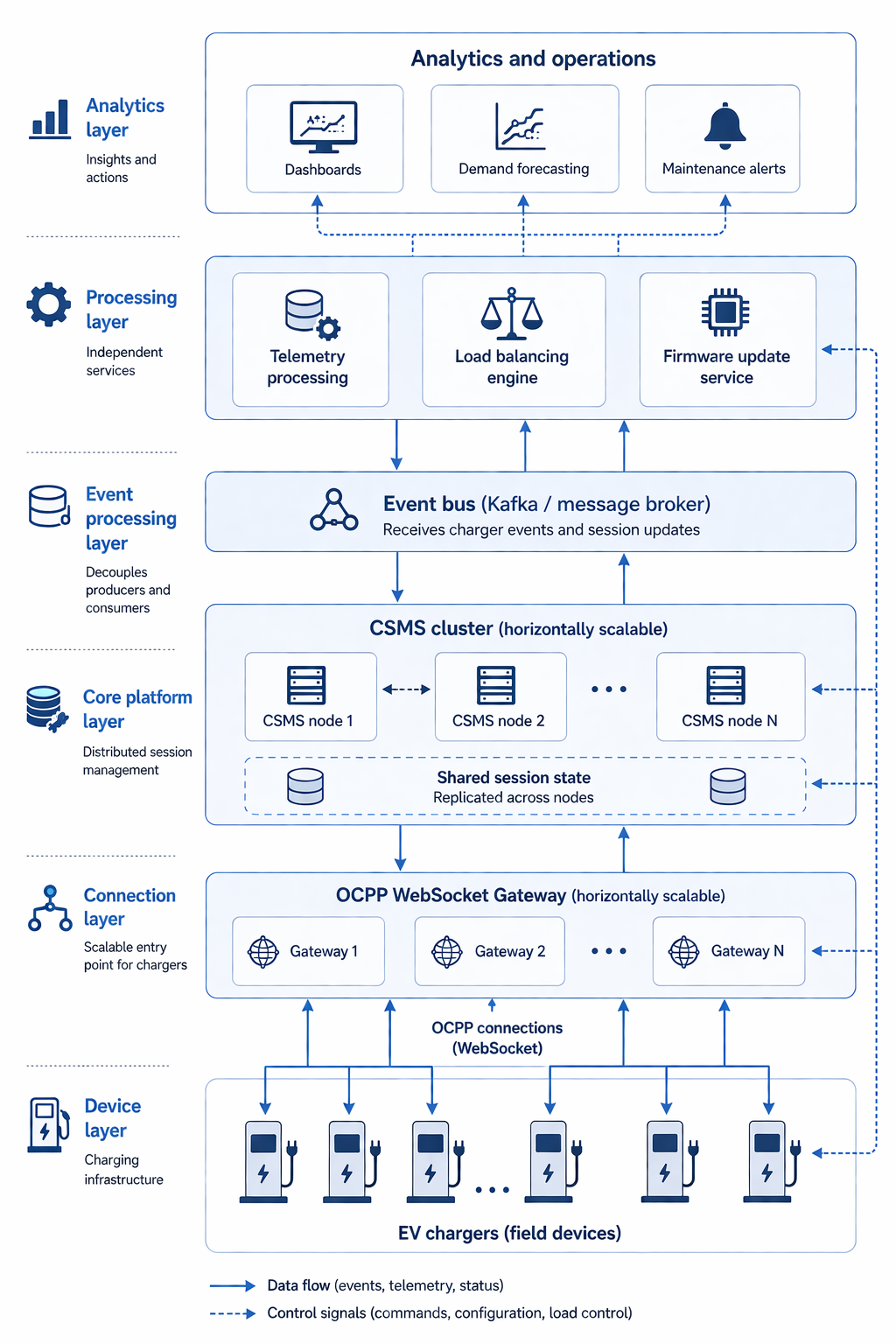
A scalable EV charging platform separates charger communication, session management, event processing, load control, and analytics so each layer can scale independently.
Telemetry and Observability
Every charger in a well-instrumented network produces a continuous stream of operational data: power output, temperature, session state, connector status, firmware version, and error codes. At 500 chargers, this is a high-volume data problem that cannot be addressed with a single-table database write per event.
A practical approach is a tiered pipeline: real-time metrics streamed to an in-memory store for live dashboards and alerting thresholds; raw event data written asynchronously to a columnar store for historical trending and capacity planning. Proactive maintenance depends on this infrastructure being in place. If temperature readings and power output variance can be trended per charger over weeks, failure signatures become detectable before they cause outages. Without the telemetry pipeline, fault detection is reactive by default — teams learn a charger has failed when a driver files a complaint.
Using Data to Make Expansion Decisions That Hold
Charger placement based on demographic maps or executive intuition works for a first deployment wave. For a second wave — especially across multiple cities — the most reliable signal is utilisation data from the existing network: session start times, session duration, queue events, and geographic gaps between where charging sessions are initiated and where chargers are actually located.
Models applying AI-powered demand forecasting to EV charging use historical session data alongside EV registration density growth, route traffic patterns, and planned development zones to project where demand will exceed capacity before it happens. The output is a ranked list of expansion candidates with estimated utilisation curves — a materially different planning input than a heat map of population density.
OCPI (Open Charge Point Interface) is the roaming protocol that allows networks to share charger availability and session processing across operator boundaries. Implementing OCPI means drivers using third-party apps can find, authenticate at, and pay for charging across operator networks — increasing utilisation on existing infrastructure without adding chargers. The integration is not trivial, but the operational benefit is direct.
Where Expansion Fails
The most consistent failure pattern in network expansion is deploying based on coverage targets rather than demand signals. A network that reaches 90% of a metropolitan area but runs chargers at 20% average utilisation has an occupancy problem, not a coverage problem. Expanding without understanding utilisation patterns at existing sites compounds the issue — it distributes fixed operational costs across more assets without a proportionate revenue increase.
A second recurring failure is announced OCPI roaming compatibility that was never fully implemented. Operators declare third-party network support before the integration is complete. Drivers discover the gap when they attempt to charge — the frustration that follows is attributed to the whole network, not to the incomplete integration. This is a backend API problem, not a hardware or UX problem, and it is entirely preventable.
User Experience Is an Operational Metric
A charging station that functions is a baseline. A charging station that drivers route their trips around because they trust it is a different threshold — and reaching that threshold is a function of operational decisions, not just hardware quality.
Real-time availability data, published to third-party navigation apps via OCPI or a direct API, eliminates wasted trips. When drivers arrive at a charger to find it offline, the complaint they file is about the network. The failure they experienced happened before they arrived — when the CSMS reported the charger as available despite a fault it had already detected. Fixing this requires the CSMS reporting charger status accurately and with low latency, not on a polling interval that is minutes behind reality.
Payment reliability is the second pressure point. RFID and app-based authentication are expected. The failure case that matters is a payment that appears to process at the charger but does not reconcile on the backend, leaving the session in an ambiguous state. Resolving this requires robust session reconciliation between the CSMS and the payment processor — a backend integration problem that manifests as a user experience problem.
Loyalty programmes and dynamic pricing incentives that encourage off-peak charging serve two purposes simultaneously: they shift demand away from peak grid windows, and they reward the driver behaviour that keeps the network healthy. Neither is trivial to implement — both require the CSMS to have pricing profile enforcement built into its session management logic from the start, not bolted on as a later feature.
Key Takeaways
- Most EV network failures at scale originate in software — specifically, CSMS architecture not designed for distributed state management across hundreds of concurrent endpoints.
- Dynamic load balancing requires a deliberate design decision: whether load control logic lives at the charger or at the CSMS level determines how the system behaves when simultaneous demand exceeds site capacity.
- The migration from OCPP 1.6 to OCPP 2.0.1 is unavoidable as networks grow — deferring it creates a dual-protocol environment that is operationally harder to maintain than a planned migration.
- Proactive maintenance depends on a functioning telemetry pipeline with real-time alerting. Without it, fault detection is reactive by definition.
- Expansion decisions made without utilisation data from existing chargers tend to produce geographic coverage without demand match — assets in the right area but the wrong locations.
Conclusion
EV charging network scalability is an engineering discipline, and the decisions that determine whether a network holds up at 500 chargers are made when it is at 50. CSMS architecture, load balancing strategy, telemetry pipeline design, and OCPI integration are not features to layer in later — they are the structural conditions under which operational reliability either exists or fails to materialise.
Networks that get this right tend to share a common pattern: they treat software architecture as a primary constraint from the beginning, they instrument everything early, and they do not let coverage targets drive expansion decisions ahead of utilisation data.
If your engineering team is working through what these decisions look like for your specific network — charger count, hardware mix, grid environment, and expansion plans — contact the Bluepes engineering team to discuss your charging platform architecture.
Summarize with AI
 ChatGPT
 Claude
 Gemini
 Grok
Grok Perplexity
FAQ











Interesting For You



Event-driven architecture security: scaling without compromise
A system that can handle 10x its normal load but exposes a new attack surface with every new integration isn't a scaling win — it's a delayed incident. This is the trade-off that most architecture discussions skip: scaling changes your threat model, and your security posture has to evolve right alongside it. This article is for CTOs and VPs of Engineering who are scaling distributed or event-driven systems and need to understand where the real security gaps appear — not the theoretical ones. Next — a structured breakdown of how scalability decisions affect attack surface, which security patterns hold under load, and what implementation looks like across fintech, telecom, and healthcare environments. Event-driven architecture security refers to the set of controls, protocols, and monitoring practices required to protect systems built around asynchronous message flows, streaming pipelines, and API-connected components — where traditional perimeter-based defenses are structurally inadequate. When everything communicates through events and APIs, the security model has to be distributed too. Perimeter thinking doesn't map onto broker topics, service meshes, or auto-scaling groups.
Read article


How to Monitor Distributed Systems and Manage Failure Models
Distributed system monitoring is the combination of telemetry collection — metrics, traces, and logs — with failure-aware alerting that lets engineering teams detect, diagnose, and resolve problems spread across interdependent services. The teams that get this right design their monitoring around specific failure models, and they pay attention to alert quality, not just alert volume. The payoff is significant: incident diagnosis drops from hours to minutes, and each failure stays contained instead of cascading.
Read article


How to Build Software Systems That Scale Without Starting Over
Scalable architecture rests on three interlocking decisions: how the system is decomposed, how it handles failure, and how security keeps pace with growth. Getting all three right from day one is rare. Understanding the trade-offs between them is what separates systems built for one size from those built to change.
Read article